Learn the difference between bend deduction and bend allowance in sheet metal bending. Includes formulas, examples, and practical tips for accurate flat pattern calculation.
In sheet metal fabrication, accurately calculating the flat pattern length is essential for producing precise parts. Two important parameters used in these calculations are bend allowance and bend deduction.
Although these terms are closely related, they represent different concepts in sheet metal bending design. Engineers and prensa plegadora operators use them to determine how much material is required before bending.
This guide explains the difference between bend deduction and bend allowance, including formulas, calculation examples, and practical manufacturing considerations.
Quick Answer: Bend allowance is the arc length of the bend measured along the neutral axis, while bend deduction is the value subtracted from the total flange lengths to calculate the flat pattern. Both are used in sheet metal bending calculations to determine accurate flat dimensions before forming.
What Is Bend Allowance?
Bend allowance (BA) refers to the length of the material along the neutral axis that is used to form the bend.
When a sheet metal part is bent, the outer surface stretches while the inner surface compresses. The neutral axis lies somewhere between these two layers and maintains a constant length.
The bend allowance represents the arc length of the bend measured along this neutral axis.
Understanding bend allowance is essential when calculating the flat pattern length of a sheet metal component.
Bend Allowance Formula
The standard formula used to calculate bend allowance is:
BA = (π × A / 180) × (R + K × T)
Where:
Symbol
Meaning
A
Bend angle
R
Inside bend radius
T
Material thickness
K
K factor
Example:
Material thickness: 2 mm Bend angle: 90° Inside radius: 2 mm K factor: 0.33
The bend allowance can be calculated by inserting these values into the formula.
What Is Bend Deduction?
Bend deduction (BD) is the amount subtracted from the total flange lengths to obtain the correct flat pattern length.
Unlike bend allowance, which measures the arc length of the bend, bend deduction accounts for how the bend shortens the total flat length.
In practice, designers calculate the flat pattern as follows:
Flat Length = Flange1 + Flange2 − Bend Deduction
This method is commonly used in CAD sheet metal modules and manufacturing drawings.
Bend Deduction Formula
Bend deduction can be calculated using the following formula:
BD = 2 × (R + T) × tan(A / 2) − BA
Where:
Symbol
Meaning
R
Inside bend radius
T
Material thickness
A
Bend angle
BA
Bend allowance
Because bend deduction depends on bend allowance, the two parameters are closely related.
Bend Deduction vs Bend Allowance (Key Differences)
The following table highlights the main differences between bend allowance and bend deduction.
Feature
Bend Allowance
Bend Deduction
Definición
Arc length of the bend
Length subtracted from flange total
Purpose
Calculate bend arc
Calculate flat pattern
Calculation
Uses K factor
Derived from BA
Aplicación
Design calculations
Flat pattern development
Both methods can produce the same final flat length if calculated correctly.
Example Calculation
Consider the following bending scenario:
Material: Mild steel Thickness: 2 mm Bend angle: 90° Inside radius: 2 mm K factor: 0.33
Step 1: Calculate bend allowance using the BA formula.
Step 2: Use the bend allowance to determine bend deduction.
Step 3: Apply the bend deduction to calculate the final flat pattern length.
This process ensures accurate part dimensions before manufacturing.
Factors Affecting Bend Allowance and Bend Deduction
Several factors influence the values of bend allowance and bend deduction.
Material Type
Different materials have different elongation properties.
For example:
Material
Bending Behavior
Aluminum
High ductility
Mild steel
Moderate ductility
Stainless steel
Lower ductility
Materials with lower ductility typically require larger bend radii.
Material Thickness
Thicker sheet metal requires larger bending force and produces a larger bend allowance.
Thickness also influences the position of the neutral axis.
Bend Radius
A larger inside bend radius increases the arc length of the bend and therefore increases bend allowance.
Utillaje para prensas plegadoras
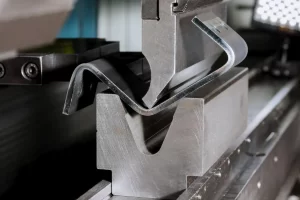
Tooling geometry directly affects bending results. Punch radius and V-die opening determine the final bend radius produced during press brake bending.
Using consistent tooling helps maintain accurate bend calculations.
Bend Allowance vs K Factor vs Bend Deduction
These three parameters are often used together in sheet metal calculations.
Parameter
Function
K Factor
Defines neutral axis location
Bend Allowance
Determines arc length of bend
Bend Deduction
Determines flat pattern length
Understanding how these variables interact helps engineers produce accurate sheet metal designs.
Best Practices for Accurate Sheet Metal Bending
To improve bending accuracy, consider the following guidelines:
Use consistent press brake tooling
Verify the K factor through test bends
Maintain proper bend radius for the material
Use CAD sheet metal tools for calculations
These practices help ensure consistent manufacturing results.
Conclusión
Both bend allowance and bend deduction are essential parameters in sheet metal bending calculations. While bend allowance measures the arc length of the bend, bend deduction determines how much material must be subtracted when calculating the flat pattern.
Understanding the relationship between these values allows engineers to design accurate sheet metal parts and achieve consistent bending results in press brake operations.
PREGUNTAS FRECUENTES
What is bend allowance in sheet metal?
Bend allowance is the arc length of the bend measured along the neutral axis during sheet metal bending.
What is bend deduction?
Bend deduction is the value subtracted from the total flange lengths to calculate the flat pattern length.
What is the difference between bend allowance and bend deduction?
Bend allowance measures the bend arc length, while bend deduction adjusts the flat pattern length used before bending.
Which method is better for flat pattern calculation?
Both methods can be used. Many CAD systems prefer bend deduction because it directly calculates flat pattern dimensions.
Stay Updated on Industrial Innovations
Subscribe to our newsletter for the latest insights on manufacturing technology, sustainability, and industry trends.