CNC V Grooving Machine: Benefits, Structure, and Applications
- Conocimientos, Noticias
- 90+ reading now
Learn how a CNC V grooving machine improves bending precision, surface quality, and production efficiency. Explore its structure, advantages, and sheet metal applications.
In modern sheet metal fabrication, precision and appearance are just as important as structural strength. One key process that significantly improves bending quality and visual finish is V grooving. To achieve consistent and accurate grooves, manufacturers increasingly rely on the CNC V grooving machine.
Whether you work with stainless steel decorative panels, elevator sheets, or architectural cladding, understanding CNC V grooving technology can help optimize both quality and efficiency.
A CNC V grooving machine is a specialized sheet metal processing machine designed to create precise V-shaped grooves on metal sheets. CNC V grooving is often used before press brake bending to achieve sharper and more accurate angles.These grooves reduce material thickness along the bend line, enabling sharper, cleaner bends without damaging the surface.
Unlike traditional grooving equipment, a CNC V groover machine uses computer numerical control to ensure:
This makes it ideal for high-precision industries where dimensional accuracy and surface quality are critical.

CNC V grooving machines are generally classified into two main types: vertical V grooving machines and horizontal V grooving machines. These configurations differ primarily in sheet positioning, machine structure, and application focus.
A vertical V grooving machine holds the sheet metal in an upright position during processing. This design is particularly suitable for large-format sheets, such as stainless steel decorative panels and architectural cladding. The vertical structure not only saves floor space but also improves sheet stability, making it ideal for applications where surface quality and long-sheet accuracy are critical.
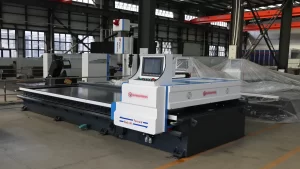
A horizontal V grooving machine, by contrast, processes sheet metal laid flat on the worktable. This layout offers easier loading and unloading, especially when handling smaller sheets or thicker materials. Horizontal machines are widely used in general sheet metal fabrication environments where operational convenience and high throughput are priorities.
Both machine types can achieve high-precision grooving when equipped with advanced CNC systems. The choice between vertical and horizontal designs depends on sheet size, workshop layout, material handling requirements, and production workflow.

Without V grooving, bending thick or coated sheets often leads to:
V grooving reduces resistance during bending, allowing for sharp and accurate bend angles.
Materials like stainless steel or coated sheets may crack under excessive stress. Grooving lowers the stress concentration at the bending line.
Result:
Cleaner bends with minimal surface damage.
In decorative metal applications, visible defects are unacceptable. V grooving helps achieve:
| Feature | Máquina ranuradora en V CNC | Traditional Grooving |
|---|---|---|
| Precisión | High | Moderate |
| Groove Consistency | Excellent | Operator-dependent |
| Eficacia | High | Lower |
| Automatización | Yes | Limited |
| Repeatability | Excellent | Inconsistent |
| Labor Requirement | Low | Higher |
Conclusion:
CNC-controlled grooving dramatically improves stability and productivity.
A typical CNC V grooving machine is engineered for precision, stability, and repeatable accuracy. Its core structure usually includes a rigid machine frame, a linear guide rail system, a tool holder with cutter assembly, a CNC control system, and a feeding and clamping table.
The machine frame provides essential rigidity and vibration resistance, ensuring stable cutting performance even during continuous operation. The linear guide rail system enables smooth and precise movement of the cutter, directly contributing to groove accuracy. The tool holder and cutter are responsible for forming clean and consistent V-shaped grooves with controlled depth. Meanwhile, the CNC control system allows operators to program groove positioning, spacing, and depth with high precision. Supporting the entire process, the feeding and clamping table stabilizes the sheet metal, preventing unwanted movement during machining.
One of the biggest advantages of a CNC V groover machine is its ability to deliver high precision grooving. Thanks to computer numerical control, groove depth and positioning remain accurate and consistent across the entire sheet. This automation ensures consistent quality, eliminating variations commonly associated with manual operation.
By creating uniform grooves, the machine significantly improves bending results, allowing for sharper angles and cleaner edges. Additionally, controlled grooving helps reduce material damage by lowering stress concentration, minimizing the risk of cracks or surface deformation. From a productivity perspective, CNC automation leads to higher production efficiency, shortening processing time while reducing labor dependency.
CNC V grooving machines are widely used in industries where both appearance and bending precision are critical. Common applications include stainless steel decorative panels, elevator interior panels, architectural cladding, cabinet and enclosure fabrication, aluminum composite panels (ACP), and signage or display systems. These machines are especially valuable in projects requiring sharp bending lines, clean edges, and premium visual finishes.
Selecting the right V grooving machine requires careful evaluation of several factors. First, the grooving thickness range must match your material specifications to ensure proper cutting performance. The working width and length should be compatible with your sheet dimensions.
Equally important is the CNC control system, which should offer an intuitive interface and flexible programming capabilities. The quality of the cutter and tooling directly affects groove precision, surface finish, and tool lifespan. Finally, consider your required accuracy level, particularly for decorative or architectural applications where even minor deviations may impact the final result.
Q1: Why is V grooving necessary before bending?
V grooving reduces bending resistance, enabling sharper angles and preventing cracks or deformation.
Q2: What materials can be processed?
Stainless steel, carbon steel, aluminum, and decorative coated sheets.
Q3: Is CNC grooving better than manual grooving?
Yes. CNC V grooving provides higher precision, consistency, and efficiency.
Q4: Does V grooving affect material strength?
When properly controlled, it improves bending quality without compromising structural integrity.
Rellene la siguiente información para recibir un presupuesto gratuito y un folleto de productos. Le responderemos en 24 horas.