



How to Choose Metal Shear Blades for Hydraulic Shearing Machines
- Conocimientos, Noticias
- 90+ reading now
Quiénes somos
Durmapress specializes in designing, manufacturing, and selling various metal processing equipment, including bending machines, shears, punches, and laser cutting machines. The company was founded in 2014, with years of experience and technology accumulation. DurmaPress has become one of the well-known brands in China's metal processing machinery industry.



Contáctenos
Entradas recientes



Categorías
Síganos
Nuevo vídeo semanal
Table of Contents
Choosing the wrong shear blade does not always produce an immediate failure. More often, it shows up as a shorter-than-expected service life, inconsistent cut quality, or chipping that appears before the edge has seen meaningful wear. Getting the selection right means matching the blade to the machine, the material being cut, and the production conditions — not simply ordering the same nominal size as the last set.
This guide covers what matters for cizalla hidráulica blade selection: machine compatibility, blade material, geometry, specifications, and what information to send a supplier when ordering custom or replacement blades.

1.Start With Machine Compatibility
Before comparing blade grades or contacting suppliers, confirm that the blade you are considering is actually approved for the machine. Physical fit — matching the holder length and bolt pattern — is necessary but not sufficient.
Start with the machine documentation:
- Exact machine model and serial number — not the product family or nominal capacity class
- Shear design — hydraulic guillotine, swing-beam, or another configuration
- Approved blade part number or drawing reference from the machine manufacturer
- Rated capacity verified against the actual material grade, tensile strength, and cutting length — a capacity figure based on mild steel does not apply to high-strength structural plate
A different blade material does not increase the machine's rated capacity. If your workpiece or cutting length falls outside what the documentation covers, contact the machine manufacturer before ordering.
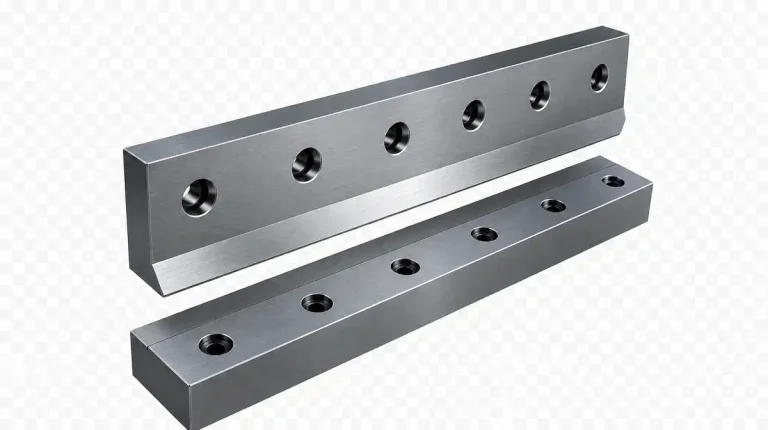
1.1 Verify the Blade Drawing
Nominal blade dimensions — length, width, thickness — are not a complete specification. The drawing governs details that determine whether the blade seats correctly and cuts accurately:
- Bevel angle and direction: the slope of the cutting face must match the blade holder geometry
- Hole pattern: center distances, hole diameters, and countersink angles and depths
- Mounting orientation: which face seats against the holder and which edge is in the cutting position
- Tolerances: dimensional tolerances matter for seating, fastener engagement, and edge position
If you are measuring from an existing blade, treat those measurements as a cross-check, not the sole specification. Previous regrinding may have reduced thickness or altered edge geometry. Resolve any discrepancy against the approved drawing before placing an order.
1.2 Confirm Upper and Lower Blade Configuration
Upper and lower blades are not always interchangeable. Identify each position separately when ordering.
Key configuration questions:
- Single-edge or reversible: If the blade can be rotated, confirm how many edges are actually usable in the permitted mounting positions on your machine. Not every corner qualifies.
- One-piece or segmented: Segmented arrangements can simplify handling where permitted, but joint positions must match the machine design.
- Individual replacement or matched set: On some machines, replacing a single blade without matching the remaining blades introduces seating or alignment inconsistencies.
These are machine-specific requirements, not optional preferences.
2. Match the Blade to Your Material and Production Conditions
Blade selection begins with a clear description of the actual work — not a general category. "We cut steel" covers too wide a range to support a useful recommendation.
Document the following before contacting a supplier:
- Material family: carbon steel, stainless steel, aluminum, galvanized or coated sheet, high-strength structural steel
- Material grade and specified tensile strength, where available
- Thickness range: minimum, maximum, and the combination most common in daily production
- Maximum cutting length
- Surface condition: scale, coatings, or surface treatments that affect abrasiveness and wear behavior
- Production volume: cuts per shift, batch patterns, and whether the machine runs continuously or intermittently
- Cut-quality requirements: acceptable burr height, edge straightness, and dimensional tolerance
The combination that drives the most wear, chipping, or quality complaints in your current production — not the average case — is the one the blade must handle reliably. A blade selected for average conditions often fails at the demanding end of the range.
3. Compare Shear Blade Materials
For hydraulic guillotine shearing of sheet metal and plate, most applications are served by a small set of tool steel grades. Each represents a different balance of wear resistance, toughness, and suitability for the operating conditions.
| Blade Material | Wear Resistance | Toughness | Aplicaciones típicas |
|---|---|---|---|
| 9CrSi | Medium | Medium | General sheet metal, mild and carbon steel, cost-effective general use |
| D2 / SKD11 / Cr12MoV-type | High | Medium | Stainless steel, coated sheet, higher production volume, abrasive materials |
| 6CrW2Si | Medium–High | High | Heavy-duty cold shearing, thicker plate, applications with higher impact loading |
| H13 | Medium | High (thermal) | Hot shearing or applications involving elevated blade temperature |
The table describes general tendencies, not absolute rankings. Heat treatment, specified hardness range, and manufacturing quality within the same nominal grade can affect performance significantly. A material certificate with documented hardness and heat-treatment traceability is more informative than a grade name alone.
Other tool steels — including A2, 5160, M2 high-speed steel, and carbide-tipped designs — are used in specialized industrial shearing applications, but they are not standard choices for most hydraulic sheet-metal guillotine shears.
3.1 9CrSi — General-Purpose Sheet Metal Cutting
9CrSi is the most widely used blade steel for hydraulic guillotine shears on carbon steel and mild steel. It offers a practical balance of wear resistance, toughness, and cost, and is widely available in standard and custom blade dimensions. It is a reasonable starting point for shops cutting a mixed range of materials and thicknesses at moderate production volume.
3.2 D2 / SKD11 / Cr12MoV-Type — Stainless Steel and High-Volume Work
High-chromium tool steels in the D2 / SKD11 / Cr12MoV group are commonly recommended for stainless steel, galvanized sheet, coated materials, and operations where gradual edge wear is the primary service-life limit. Their high carbon and chromium content provides substantially better abrasion resistance than 9CrSi.
The trade-off is toughness. These grades are more susceptible to chipping than 9CrSi or 6CrW2Si when clearance is incorrect, alignment is imperfect, or the material feed is inconsistent. Upgrading to a D2-type grade does not compensate for a setup problem — if blades are chipping rather than wearing, review clearance and alignment before changing the blade material.
Note that D2 (AISI), SKD11 (JIS), and Cr12MoV (GB) are different designations from different standards systems. Although they share a similar high-chromium, high-carbon composition, they are not identical. Specify the standard and grade designation clearly when ordering rather than using the terms interchangeably.
3.3 6CrW2Si — Heavy-Duty Cold Shearing
6CrW2Si offers higher toughness than D2-type grades while retaining reasonable wear resistance. It is used in applications involving thicker plate, higher impact loading, or conditions where chipping has been a persistent problem with harder grades. It is also commonly specified for alligator shears processing heavy scrap, though that is outside the hydraulic guillotine context.
3.4 H13 — Hot Shearing Applications
H13 is a hot-work die steel that maintains hardness and resists thermal fatigue at elevated temperatures. Its relevance is specific: it is appropriate where blade temperature is a material factor, such as in hot shearing of heated plate. For standard room-temperature hydraulic sheet-metal shearing, H13's lower hardness compared to D2-type grades provides no advantage and is not a typical selection.
4. Blade Geometry and Cutting Configuration
Beyond steel grade, blade geometry affects how the cut progresses and how load is distributed across the cutting edge.
Bevel angle at the cutting edge influences edge strength and cutting force. A sharper, lower-angle edge reduces cutting force and produces a cleaner cut on thin or soft materials. A stronger, higher-angle edge handles thicker or harder materials more reliably but requires more force. Blade drawings specify the approved bevel — do not assume the geometry from a previous blade applies if the grade or supplier has changed.
Clearance is the gap between the upper and lower cutting edges. Many sheet-metal applications fall within roughly 5–10% of material thickness as a general reference, but the machine manufacturer's clearance chart takes priority over any general rule. Incorrect clearance is one of the most common causes of excessive burrs, edge deformation, and premature blade wear.
Rake angle is primarily determined by the shear's mechanical design and cutting configuration. It affects cutting-force distribution and material distortion across the cut length, but operators should follow the machine manufacturer's specified setting rather than treating rake angle as a general adjustment variable.
For detailed clearance values, calculation methods, and adjustment procedures by material and thickness, see our hydraulic shear blade clearance guide.
5. How to Order Replacement Shear Blades
Ordering replacement blades is where specification errors most often occur. The information below covers what a supplier needs to quote accurately and supply a compatible blade.
Machine and blade identification:
- Machine model, serial number, and shear design
- Approved blade part number or drawing reference (provide the drawing, not just measurements from a worn blade)
- Upper or lower position — specified separately for each
Application details:
- Material grades and specified strength
- Thickness range: minimum, maximum, and typical
- Maximum cutting length
- Production volume and duty cycle
Documentation requirements:
- Steel grade designation and applicable standard (AISI, JIS, GB, or equivalent)
- Specified hardness range (HRC) and heat-treatment condition
- Material certificate or mill certificate traceable to the supplied blades
- Dimensional inspection report confirming hole pattern, bevel geometry, and tolerances
Practical steps before bulk ordering:
- Request a trial set for a new grade or new supplier before committing to full quantity
- Run trial cuts on the actual material and thickness range used in production
- Inspect cut quality — burr level, edge squareness, distortion — before approving for regular use
- Record cutting conditions, edge condition at the start of service, and any anomalies
A supplier who can explain why the proposed grade and heat treatment suit your specific application — with reference to your machine and material — is more useful than one who defaults to their most-sold product.
6. How to Compare Shear Blade Suppliers
Blade sourcing decisions made on unit price alone frequently produce higher total operating cost. Evaluation should cover:
Technical capability:
- Can the supplier confirm grade, heat treatment, and hardness documentation for each supply?
- Do they offer blades ground to the machine-approved drawing rather than standard sizes only?
- Can they provide material certificates and dimensional inspection records?
Service and support:
- What are standard lead times for custom-dimensioned blades?
- Do they offer regrinding services within specified geometry and minimum dimension limits?
- Can they supply matched sets when the machine requires it?
Supply reliability:
- Is the grade you need consistently available, or subject to extended lead times?
- What is the minimum order quantity for custom specifications?
A supplier with long lead times on a critical blade grade creates inventory and production risk that does not appear in the quoted price.
7. Shear Blade Cost: Purchase Price vs. Cost per Cut
The lowest-priced blade is rarely the lowest-cost choice over a production cycle. A more useful comparison accounts for:
- Usable cutting edges before regrinding is required
- Regrinding cycles — how many times the blade can be reground within minimum dimension limits, and the cost and lead time per regrind
- Cutting volume per edge based on actual material and duty
- Change-over time — labor and downtime for blade rotation, regrinding, and full replacement
- Scrap and rework risk — blades producing marginal cut quality late in service generate cost that does not appear on the blade invoice
- Availability — a lower-unit-cost blade with long lead times creates inventory carrying cost and production exposure
Shops with a blade service record — logging material, cutting volume, regrind dates, and defects — can compare options on real evidence rather than supplier estimates. If records are not currently kept, starting a log with the next blade set gives useful data within a few months of production.
8.FAQ
Start with the machine model, serial number, and service documentation to locate the approved blade part number or drawing. The drawing specifies dimensions, bevel geometry, hole pattern, countersinks, and mounting orientation. Do not rely on measurements from a worn blade alone — previous regrinding may have changed critical dimensions.
D2-type high-chromium tool steels (D2 / SKD11 / Cr12MoV-type) are the standard recommendation for stainless steel and coated sheet. Their high wear resistance suits the abrasive nature of stainless and the work-hardening behavior it exhibits under shearing. Confirm machine compatibility and clearance settings before upgrading from a general-purpose grade — chipping problems are more likely to be caused by clearance or alignment issues than by the blade material.
Not always. D2-type grades offer high wear resistance but moderate toughness. If blades are chipping rather than wearing — often a sign of incorrect clearance, misalignment, or material feed inconsistency — a tougher grade such as 6CrW2Si may outlast D2 in practice even if D2 looks better on paper. Identify whether wear or chipping is the failure mode before selecting a replacement grade.
Burrs are most commonly caused by incorrect clearance, improper blade seating, or misalignment — not a defective blade. Check clearance against the machine manufacturer's chart for the actual material and thickness. Verify blade seating, fastener torque, and alignment along the full cutting length before concluding the blade is at fault.
Regrind when edge wear is progressing but the blade has not suffered chipping or cracking — early regrinding removes less material and preserves more service cycles. Replace when the blade is cracked, chipped beyond regrinding, or has reached the minimum allowable dimension after repeated grinds. Do not rotate a chipped edge into the cutting position.
Provide the machine model and serial number, the approved blade drawing or part number, upper or lower blade position, material grades and tensile strength, thickness range, cutting length, production volume, and any known problems with the current blade. Also request steel grade designation, heat-treatment specification, hardness documentation, and a material certificate traceable to the supplied blades.
9. Conclusion
Shear blade selection comes down to four decisions made in the right order: confirm machine and drawing compatibility, define the actual material and production conditions, choose blade material and geometry to match, and validate performance with trial cuts before full production.
The most common selection mistakes — ordering by price, skipping the blade drawing, or upgrading to a harder grade without diagnosing whether chipping or wear is the real failure mode — all become less likely when the selection process follows that sequence.
If you are specifying replacement blades for a cizalla hidráulica de guillotina and are unsure whether your current blade grade is correctly matched to the material and production conditions, provide the machine model, blade drawing reference, material specification, and thickness range to confirm the appropriate blade specification for your application.