Quiénes somos
Durmapress specializes in designing, manufacturing, and selling various metal processing equipment, including bending machines, shears, punches, and laser cutting machines. The company was founded in 2014, with years of experience and technology accumulation. DurmaPress has become one of the well-known brands in China's metal processing machinery industry.
Póngase en contacto con nosotros
Entradas recientes
Categorías
Síguenos
Nuevo vídeo semanal
What Is Laser Cutting Precision and How Does It Work?
Laser cutting precision refers to how closely the actual cut matches the intended design dimensions — measured in terms of dimensional accuracy, edge quality, and repeatability across production runs.
The process works by directing a high-powered, focused laser beam onto the material surface. The concentrated energy melts, burns, or vaporizes the material along a programmed path. A CNC controller guides the cutting head using coordinates from CAD or CAM software, ensuring the laser follows the exact design geometry every time.
The key to precision lies in the physics of the beam itself. A focused laser spot can be as small as 25 microns — roughly one quarter the width of a human hair — which allows extremely fine cuts with minimal material loss (kerf). Because the beam never physically contacts the workpiece, there is no mechanical deflection or tool wear that could introduce error over time.
How Accurate Is Laser Cutting?

Laser cutting is one of the most accurate cutting technologies available in industrial manufacturing. In practical terms:
| Parameter | Typical Value |
|---|---|
| Laser spot focus size | ~25 microns |
| Minimum cut width (kerf) | < 0.001 inch (0.025 mm) |
| Dimensional tolerance | ±0.1 mm to ±0.05 mm |
| Positional accuracy (fiber laser) | ±0.03 mm or better |
These numbers place laser cutting well ahead of plasma cutting (typically ±0.5–1 mm tolerance) and far more consistent than manual or flame-based methods. For industries such as aerospace, electronics, and precision sheet metal fabrication, these tolerances meet or exceed production requirements.
It is worth noting that fiber laser cutting machines achieve tighter tolerances than CO₂ systems for metal cutting, while CO₂ lasers remain competitive for non-metal materials such as acrylic and wood.
Why Is Laser Cutting So Accurate?
Several technical characteristics combine to make laser cutting inherently more accurate than conventional mechanical cutting:
1. Coherent, focused photon beam:The laser produces a synchronized, single-wavelength beam that can be focused to an extremely small point. This coherence means the energy is concentrated precisely where needed, with no scattering or deviation.
2. CNC-guided motion control: Modern laser cutters use high-resolution servo motors and linear guides to move the cutting head along programmed X/Y axes. The machine follows CAD coordinates with sub-millimeter accuracy, and the same program can be repeated thousands of times with consistent results.
3. No mechanical contact:Because only the heat from the beam cuts the material, there is no tool pressure, blade deflection, or wear-induced drift. This eliminates a major source of error found in mechanical cutting methods.
4. Fiber optic beam delivery: In fiber laser systems, the beam is transmitted through a fiber optic cable directly to the cutting head. This design maintains beam quality and positioning stability throughout the working area.
5. Minimal heat-affected zone: The focused beam concentrates heat in a tiny area, reducing thermal distortion of the surrounding material. Less distortion means the final part retains its designed dimensions more faithfully.
Types of Laser Cutters and Their Precision Levels
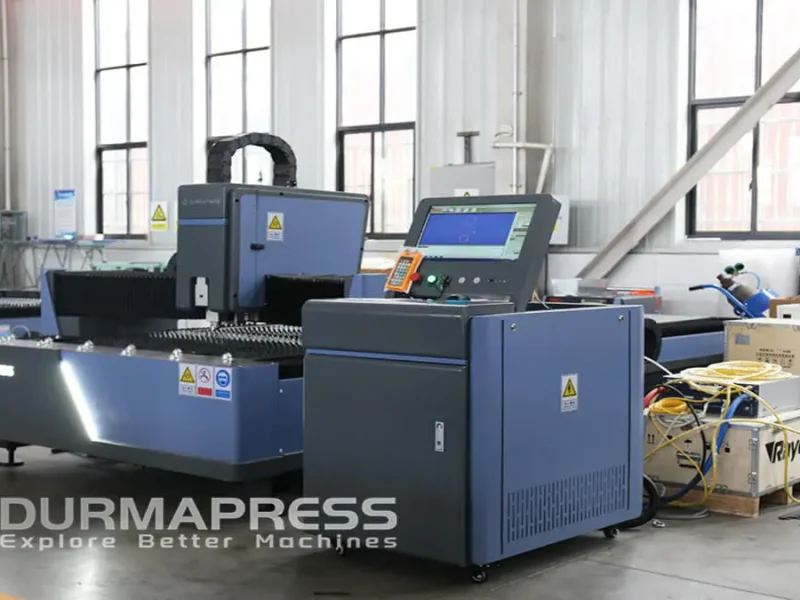
Not all laser cutters deliver the same level of precision. The three main types differ in beam technology, suitable materials, and achievable tolerances.
CO₂ Laser Cutters
CO₂ lasers operate at a wavelength of 10.6 micrometers, making them highly effective for cutting non-metal materials including wood, acrylic, fabric, and some plastics. They can also cut thin metals but are less efficient and less precise on thick steel compared to fiber lasers. Typical positional accuracy falls in the range of ±0.1 mm.
Fiber Laser Cutters
Fiber lasers are the industry standard for metal cutting precision. They operate at a much shorter wavelength (around 1 micrometer), which is more efficiently absorbed by metals. Fiber lasers can achieve positional accuracy of ±0.03 mm or better, cut at higher speeds, and maintain beam quality with far less maintenance than CO₂ systems. Their lifespan (approximately 25,000 operating hours) also significantly exceeds that of other laser types.
For manufacturers cutting carbon steel, stainless steel, aluminum, or copper, fiber laser cutting machines represent the best balance of precision, speed, and long-term cost efficiency.
Crystal / Solid-State Laser Cutters
Crystal lasers (Nd:YAG or Nd:YVO) can handle both metals and non-metals, offering versatility for specialized applications. However, their higher acquisition cost and shorter component lifespan (typically 8,000–15,000 hours) make them less common in high-volume production settings.
Factors That Affect Laser Cutting Accuracy
Whether you operate your own laser cutting equipment or work with a contract manufacturer, these practices will help you achieve consistently higher precision:
1. Match settings to every material
Do not assume that settings calibrated for one material will work for another, even if they appear similar. Always run test cuts when switching materials or thicknesses and document the optimal parameters for future reference.
2. Use the correct focal lens
For thin, intricate work, choose a shorter focal length to minimize spot size. For thicker materials where beam depth is more important than spot size, a longer focal length is appropriate.
3. Optimize cutting speed
Run speed trials on scrap material before committing to production cuts. The goal is the highest speed that still produces a clean edge — this minimizes heat accumulation and thermal distortion.
4. Maintain optics and mirrors regularly
Clean lenses and mirrors with manufacturer-approved optical-grade solvents and lint-free cloths. Contaminated optics scatter the beam and degrade both cut quality and positional accuracy. Inspect the cutting head for worn nozzles or damaged lenses before high-precision runs.
5. Account for kerf in your design
Always factor the laser kerf width into your CAD design, especially for parts that need to fit together in assembly. A difference of 0.1–0.2 mm in kerf compensation can be the difference between a tight fit and a loose joint.
6. Ensure a flat, stable worktable
Even small vibrations or an uneven surface will cause the focal distance to vary across the cut, reducing dimensional accuracy. Check table leveling and clamp the workpiece securely.
7. Choose a high-quality machine
Equipment quality is the most fundamental factor. Machines with higher-grade servo systems, precision guide rails, and stable power sources produce better results regardless of the operator's skill level.
Laser cutting works best as part of a complete sheet metal fabrication workflow. Once your parts are cut to precision, the next step is often bending and forming — learn more about our Prensa plegadora CNC bending solutions to see how Durmapress supports your full production process.
Tips for Improving Laser Cutting Accuracy
Even the most advanced laser cutter will underperform if surrounding conditions are not properly managed. The following factors have the greatest impact on final cut accuracy:
Material Type and Surface Condition: Smooth, flat, and uniform materials yield cleaner and more precise cuts. Rough or uneven surfaces cause the focal point to shift slightly, introducing dimensional variation. Reflective metals such as copper and aluminum require adjusted parameters to avoid beam scattering.
Material Thickness: Thinner materials are generally easier to cut with higher precision. As thickness increases, the beam must deliver more energy, the kerf widens, and maintaining consistent edge quality becomes more demanding. Each material-thickness combination requires individually optimized settings.
Laser Beam Spot Size: A smaller spot size produces finer cuts and tighter tolerances. Spot size is determined by the focal lens specification — a shorter focal length creates a smaller, more concentrated spot. For detailed or intricate profiles, selecting the appropriate lens is critical.
Laser Power and Cutting Speed: Power and speed must be balanced for each job. Too much power causes excessive heat buildup and a wider heat-affected zone; too little results in incomplete cuts. Speed that is too high may produce rough edges, while too slow increases thermal distortion.
Machine Condition and Calibration: Dust on optics, misaligned mirrors, worn guide rails, or inadequate gas pressure all degrade accuracy over time. Regular maintenance and periodic re-calibration are essential for sustained precision performance.
Workpiece Fixturing and Stability:Vibration during cutting introduces positional error. A stable, flat worktable and proper clamping ensure the material remains in position throughout the cut.
Conclusion: Get the Precision Your Production Demands
Laser cutting precision is not a fixed number — it is the result of the right machine, correct settings, proper maintenance, and thoughtful design. With tolerances reaching ±0.03 mm and spot sizes as fine as 25 microns, modern fiber laser cutting machines deliver accuracy that no traditional cutting method can match.
At Durmapress, our fiber laser cutting machines are engineered for demanding industrial applications — from thin-gauge sheet metal to thick structural steel. If you are evaluating laser cutting equipment or need guidance on which specification fits your production requirements, our team is ready to help.
Póngase en contacto con nosotros today to discuss your needs or request a product quote.