Learn how to calculate press brake tonnage using bending force formulas, tonnage charts, and calculators. Understand punch selection, bend deduction, and common bending mistakes.
Introduction – Why Accurate Tonnage Calculation Matters in Press Brake Bending
In sheet metal fabrication, accurate tonnage calculation is critical to both product quality and machine safety. Using insufficient bending force can result in incomplete bends and dimensional errors, while excessive tonnage may damage tooling, overload the press brake, or shorten machine life.
This is why tools such as a press brake tonnage calculator or a tonnage calculator press brake are widely used in modern workshops. Combined with proper formulas, charts, and tooling knowledge, accurate tonnage calculation forms the foundation of safe and efficient press brake bending.
Press Brake Bending Force Formula Explained
Press brake tonnage refers to the force required to bend sheet metal along a specified length. It is usually expressed in tons per meter or tons per foot, depending on regional standards.
Several factors directly influence required tonnage:
Material type and tensile strength
Sheet thickness
Bending length
V-die opening width
Punch geometry and bending method
It is important to distinguish between machine rated tonnage and actual bending tonnage. A press brake rated at 100 tons does not mean that every bending operation can safely use the full capacity across the entire working length.
Press Brake Bending Force Formula Explained
Standard Bending Force Formula
The bending force formula provides a theoretical calculation of required tonnage based on material and tooling parameters. While formulas may vary slightly, most press brake tonnage calculators rely on the same core variables:
Material tensile strength
Sheet thickness
Bending length
V-die opening
The formula helps estimate the bending force before production, reducing trial-and-error and minimizing the risk of overloading the machine.
How Material Type Affects Bending Force
Different materials require different bending forces:
Mild steel – baseline for most tonnage charts
Stainless steel – typically requires 1.3–1.5× more force
Aluminum – lower bending force but sensitive to tooling radius
The calculator then outputs the estimated required tonnage. Compared to manual calculations, a tonnage calculator press brake improves speed, accuracy, and consistency—especially useful for CNC programming and production planning.
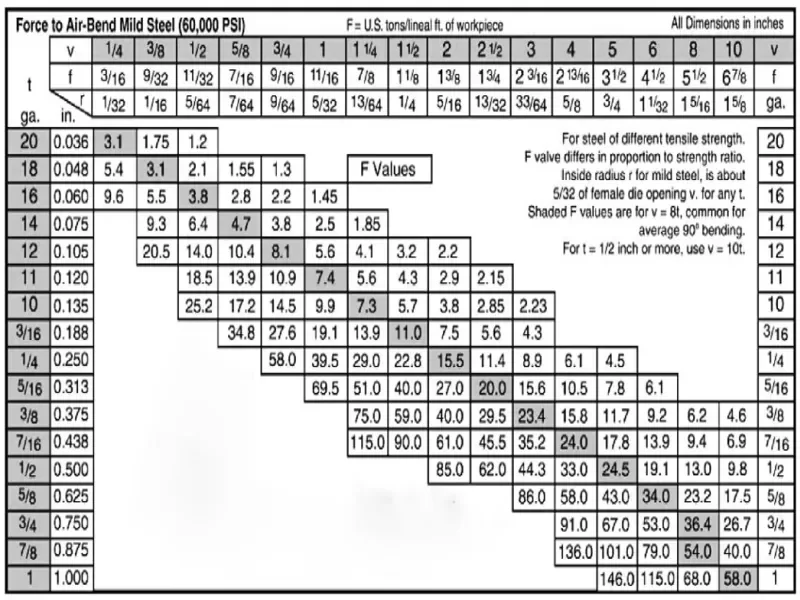
Using a Press Brake Tonnage Chart – When Is It Enough?
What Is a Press Brake Tonnage Chart
A tonnage chart press brake provides quick reference values based on standard assumptions, usually mild steel and common V-die sizes. It is useful for:
Fast shop-floor checks
Training new operators
Simple, repetitive bending jobs
Limitations of a Tonnage Chart
However, tonnage charts have limitations:
They assume standard materials
They do not account for custom punch geometry
They may be inaccurate for special bend angles or narrow V-dies
For modern Industry 4.0 environments, charts are best used together with calculators, not as a replacement.
The Role of Pressing Punch and Die Selection
How Pressing Punch Geometry Influences Required Tonnage
En pressing punch directly affects bending force. Factors such as punch tip radius, angle, and contact area influence how force is distributed during bending. Sharper punches may increase stress concentration, raising tonnage requirements.
Matching Punch and Die to Avoid Overloading
Incorrect punch and die combinations can dramatically increase bending force. Proper tooling selection not only protects the press brake but also extends tooling life and improves bend accuracy. Tooling and tonnage calculation should always be evaluated together.
Bend Deduction vs Bending Deduction – What’s the Difference?
What Is Bend Deduction?
Bend deduction is used to calculate the flat length of sheet metal before bending. It compensates for material deformation during the bending process and depends on:
Material type
Espesor
Bend angle
Tooling radius
What Is a Bend Deduction Calculator Used For?
A bend deduction calculator or bending deduction calculator is essential for:
CNC press brake programming
Offline bending simulation
Ensuring accurate part dimensions
While bend deduction does not directly determine tonnage, inaccurate deduction values often lead to rework and wasted material.
Common Mistakes in Press Brake Tonnage Calculation
Even experienced operators make mistakes, including:
Ignoring material strength variations
Using incorrect V-die openings
Over-relying on tonnage charts
Failing to account for full bending length
Avoiding these mistakes requires combining calculators, charts, and real-world experience.
Best Practices for Safe and Efficient Press Brake Bending
To achieve reliable results:
Use a press brake tonnage calculator for every new job
Cross-check results with a tonnage chart press brake
Leave a safety margin below machine capacity
Verify tooling compatibility before production
Regularly calibrate CNC parameters
These practices reduce downtime, tooling damage, and quality issues.
Conclusion – Combining Calculators, Charts, and Experience
Accurate tonnage calculation is not optional—it is essential for safe, efficient, and repeatable press brake bending. By combining a press brake tonnage calculator, bending force formulas, tooling knowledge, and operator experience, manufacturers can optimize production while protecting equipment.
As sheet metal fabrication moves toward higher automation and smarter factories, precise tonnage calculation will continue to play a critical role in press brake performance and productivity.
FAQ – Press Brake Tonnage & Bending Calculations
Q1: How accurate is a press brake tonnage calculator? A: When correct material and tooling data are used, calculators provide highly reliable estimates for most bending operations.
Q2: Can a tonnage chart replace calculation? A: No. Charts are useful references but lack precision for non-standard materials and tooling.
Q3: How does pressing punch selection affect bending force? A: Punch geometry directly impacts contact area and stress distribution, influencing required tonnage.
Q4: Is bend deduction the same for all materials? A: No. Bend deduction varies with material type, thickness, and tooling radius.
Stay Updated on Industrial Innovations
Subscribe to our newsletter for the latest insights on manufacturing technology, sustainability, and industry trends.