Quiénes somos
Durmapress specializes in designing, manufacturing, and selling various metal processing equipment, including bending machines, shears, punches, and laser cutting machines. The company was founded in 2014, with years of experience and technology accumulation. DurmaPress has become one of the well-known brands in China's metal processing machinery industry.
Contáctenos
Entradas recientes
Categorías
Síganos
Nuevo vídeo semanal
Table of Contents
Walk into almost any sheet-metal shop and you'll hear both terms. Ask the supplier for a quote and their catalog says one thing; the purchase order from the shop floor says another. The question comes up constantly in procurement, training, and supplier communication: press brake vs. brake press — are they the same machine, or is there a functional difference?
The short answer: in most industrial contexts, they describe the same powered sheet-metal bending machine. The difference is in wording, not in function. Prensa plegadora is the globally recognized technical term used in catalogs, engineering documents, and standards. Brake press survives in workshop conversation, informal documentation, and regional usage — but it does not identify a separate category of equipment and should not appear in formal specifications.
The third term, press break, is simply a spelling error. It has no recognized meaning in metalworking.
1. Why "Press Brake" Is the Preferred Technical Term
The term press brake follows a straightforward naming logic that appears throughout metalworking vocabulary. The brake is the main noun — it names a category of sheet-metal forming equipment that clamps and bends material. The press is the modifier — it describes how that brake generates force, through a punch-and-die tooling action rather than through a manually operated leaf or finger mechanism.
Compare this with other brake family names: a box-and-pan brake (also called a finger brake) uses removable fingers to form box shapes, while a cornice brake clamps the sheet and bends it along a straight line using manual leverage. A prensa plegadora applies force through matched tooling — a punch driving into a die — with the ram powered by hydraulic, servo-electric, or mechanical means.
This is why "press" precedes "brake": it tells you what kind of brake it is, not how to stop a vehicle.
1.1 What "Brake" Means in Sheet-Metal Fabrication
In sheet-metal work, a brake is a device for clamping and forming a bend — not a stopping mechanism. The word derives from older Germanic usage referring to machines that applied force to alter the shape of material, long before it became associated with vehicle stopping systems.
Understanding this removes most of the confusion. A sheet-metal brake is a forming machine. Variants are named for their forming method or tooling type: finger brake, leaf brake, box-and-pan brake, and press brake. When you see the word "brake" in a machine name in a fabrication context, think bending tool, not stopping device.
1.2 Why "Brake Press" Still Appears
Reversed word order is not unusual in workshop language, where equipment names often get rearranged colloquially. "Brake press" has been in use long enough that it appears in older manuals, job postings, informal shop instructions, and some regional trade dialects — particularly in parts of North America.
The term is also common in search queries, which is worth noting if you manage technical content. Search engines will return press brake results for both terms. The problem arises when "brake press" enters formal documents: a purchase order, service request, or parts specification using unfamiliar phrasing can slow down a supplier's response or lead to avoidable clarification exchanges.
Use "press brake" in your written assets. Recognize "brake press" as a conversational synonym. Correct "press break" whenever you see it.
2. Do Press Brake and Brake Press Describe the Same Machine?
Yes — with one practical qualification. Both terms refer to a powered machine that forms sheet or plate metal into a desired angle by pressing a punch (upper tool) downward into a die (lower tool), with the workpiece clamped between them. The ram drives the punch; the bed supports the die; the backgauge positions the sheet for repeatable results.
What they do not tell you is anything about how the machine is configured. A 3,000-ton hydraulic press brake used for thick structural plate and a 40-ton tabletop servo-electric unit for precision enclosures are both "press brakes." Equally, some machines called "brake presses" in older literature are full CNC hydraulic systems. The name does not reveal the machine's capacity, drive type, accuracy level, or degree of automation.
2.1 What Determines the Machine's Actual Capability
When you are specifying, buying, or requesting service for sheet-metal bending equipment, the machine name is the starting point — not the specification. The variables that actually define what a press brake can do are:
| Parameter | Why It Matters |
|---|---|
| Rated tonnage | Maximum force the ram can apply; determines material thickness and length you can bend |
| Bending length | Maximum sheet width that fits between the side frames |
| Open height / stroke | The vertical space available for tooling and formed part removal |
| Drive system | Hydraulic, servo-electric, or electro-hydraulic servo — affects speed, energy use, and precision |
| Sistema de control | Manual NC, CNC with standard controller, or advanced 3D CNC with simulation |
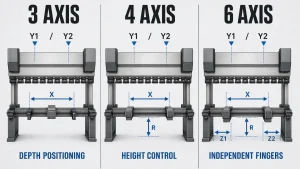
| Backgauge axes | 2-axis for simple parallel bends; 4–6 axis for complex or tapered geometries |
| Crowning system | Compensates for bed deflection across the full bending length |
| Tooling interface | Defines compatible punch and die systems; affects setup time and flexibility |
Two machines with identical names can have completely different capabilities. Two machines with different names — one called a press brake, another called a brake press — can be identical in every technical respect. Specify by parameter, not by name.
For a detailed breakdown of how to match these parameters to your application, see how to choose a press brake for tonnage calculation, drive system comparison, and backgauge selection guidance.
3. Press Brake, Press Break, and Related Terms — A Quick Reference
The table below captures the terminology readers encounter most often in this space.
| Term | What It Means | Use It? |
|---|---|---|
| Prensa plegadora | The powered sheet-metal bending machine | Yes — formal specs, documentation, catalogs |
| Brake press | Informal/regional synonym for press brake | Acceptable in speech; avoid in formal documents |
| Press break | Spelling error — "break" meaning fracture, not bending | No — correct to "press brake" |
| Press braking | The process of bending sheet metal using a press brake | Yes — describes the forming operation |
| Sheet-metal brake | Broad category; includes press brakes, finger brakes, leaf brakes | Yes — when referring to the equipment family |
The most important practical rule: press break appears frequently in forum posts, job descriptions, and even some supplier websites. The misspelling matters because it prevents precise documentation retrieval and makes keyword-based searches for technical manuals, spare-parts lists, and maintenance guides return unreliable results. If your factory's document management system is indexed on the wrong spelling, locating the right service records becomes slower and less reliable.
4. How a Press Brake Differs From Other Sheet-Metal Bending Equipment
The comparison between "press brake" and "brake press" is really a naming discussion, not an equipment comparison. The genuinely useful distinction — the one that affects workflow and capital investment — is between a press brake and other equipment in the sheet-metal brake family.
4.1 Press Brake vs. Manual Leaf Brake or Finger Brake
A manual leaf brake (also called a cornice brake) and a finger brake (box-and-pan brake) operate by clamping the sheet along a straight edge and folding it upward or downward using a manual bending leaf or adjustable finger segments.
The key differences from a press brake:
- Tooling: A finger brake uses simple clamping fingers; a press brake uses matched punch-and-die sets that control bend radius, tonnage, and geometry more precisely.
- Repeatability: Press brakes with backgauge systems deliver consistent positioning for production runs; manual brakes rely more on operator skill for each setup.
- Tonnage: Press brakes range from small bench-top units to multi-thousand-ton production machines; manual brakes are suitable for light-gauge sheet only.
- Bend geometry: Finger brakes are well-suited for box-and-pan work, where the fingers clear the flanges. Press brakes handle a wider range of part geometries using gooseneck punches and specialty dies.
Neither is universally better. A small fabrication shop doing varied one-off work might keep a finger brake for prototyping. A production sheet-metal environment with repeatable parts will almost always run a press brake.
"Brake press" does not mean finger brake or manual brake. This is a common misconception worth correcting directly. The term is a word-order variant of "press brake" — not a category label for simpler or manual equipment.
4.2 Press Brake vs. Plate Roll
A plate rolling machine (plate roll or plate bender) continuously curves sheet or plate metal between two or more rollers, producing cylinders, cones, or arcs. It does not produce discrete angles.
A press brake produces angular bends — precise angles at defined locations along the workpiece. A plate roll produces continuous curvature along the material's length.
These machines address different geometry requirements. A cylindrical tank shell goes through a plate roll. A rectangular electrical enclosure goes through a press brake. Some complex parts require both: a press brake forms flanges and corners, while a plate roll curves the base profile. Choosing one over the other is a geometry decision, not a terminology decision.
For large-radius bending on a press brake, multiple-hit techniques can approximate a curve, but this is a workaround with limitations — not a substitute for a plate roll where true radius forming is required.
5. Which Term Should You Use in an RFQ, Purchase Order, or Service Request?
Use prensa plegadora as the primary equipment name in any formal document. This aligns with OEM catalogs, international standards, engineering documentation, and the terminology used by tooling, controls, and spare-parts suppliers globally.
"Brake press" can be included once as a parenthetical or search synonym when you know the supplier's documentation uses it — but it should never replace a clear equipment description, and it adds no technical precision.
The bigger issue is that neither term alone is adequate for procurement or service communication. A purchase order that says only "press brake" leaves out everything a supplier needs to quote accurately. A service request that says "brake press is not working" tells a technician nothing useful about the machine.
5.1 Press Brake RFQ Checklist
For a new machine inquiry or quotation, provide:
- Application details: Material type and grade (mild steel, stainless, aluminum), thickness range, maximum sheet width
- Part geometry: Bend angles, required tolerances, flange lengths, part drawings or samples
- Production requirements: Volume per batch, number of bends per part, mix of part types (high-volume/low-mix vs. low-volume/high-mix)
- Configuration preferences: Drive system (hydraulic, servo-electric, electro-hydraulic), CNC controller type, backgauge axes, crowning requirement
- Tooling and clamping: Preferred tooling system (Wila, Amada, generic), quick-clamp requirements
- Site requirements: Available power supply, floor space, ceiling height, any environmental constraints
- Support expectations: Warranty scope, on-site commissioning, operator training, spare-parts availability
For a spare-parts or service request, the name "press brake" or "brake press" is almost meaningless without:
- Manufacturer name, model, and serial number
- Controller type and software version
- Photos of the affected component or assembly
- Description of the fault or behavior
- Any recent changes to tooling, material, or operating parameters
An accurate equipment description speeds up every stage of the procurement and support process. Use the right terminology, then back it up with the specifics.
6. Common Questions About Press Brake vs. Brake Press
Q1: Is a brake press different from a press brake?
Answer: In ordinary metalworking use, no. Both names refer to the same powered machine that bends sheet or plate metal using a punch-and-die tooling system. "Press brake" is the preferred term in formal technical communication, catalogs, and engineering documents. "Brake press" is a word-order variant that survives in workshop conversation and some regional usage but does not identify a different type of machine.
Q2: Is "press break" correct for a sheet-metal bending machine?
Answer: No. "Press break" is a spelling error — "break" meaning fracture, not bending. The correct term is prensa plegadora. The mistake is common because "brake" and "break" sound identical, and standard spell-checkers will not flag it. In technical documents, service records, or procurement communications, using "press break" can slow down information retrieval and create unnecessary confusion.
Q3: Does "brake press" mean the machine is manual or older?
Answer: No. "Brake press" is simply an informal name for a press brake. It does not indicate manual operation, older technology, lower accuracy, or any specific drive type. Modern CNC hydraulic machines are sometimes called brake presses in conversation; older manual units are sometimes called press brakes. The name does not describe the machine's configuration. Verify capabilities through tonnage, bending length, control system, and drive type — not the name.
Q4: What details should I provide when buying or servicing a press brake?
Answer: For a purchase inquiry, provide material type and grade, thickness range, maximum bend length, required tolerances, production volume, and any preference for drive system or CNC controller. For a service or spare-parts request, provide the manufacturer, model number, serial number, controller type, and a clear description of the fault or requirement. See the [IL: press brake terminology guide] for a full glossary of key specifications.
Q5: Can I search for press brake manuals using "brake press"?
Answer: Sometimes, but inconsistently. OEM manuals and supplier documentation are indexed under "press brake." Searching "brake press" may return useful results in some cases, but it will miss content that uses only the correct term. For the most complete results — especially when accessing manufacturer service portals, standards documents, or technical databases — search "press brake" alongside the model number and manufacturer name.
7. Use "Press Brake" for Clear Technical Communication
The practical takeaway is straightforward. Prensa plegadora is the term that belongs in purchase orders, engineering drawings, maintenance schedules, training materials, and supplier correspondence. Brake press is a recognized informal variant that describes the same equipment — it will be understood, but it introduces unnecessary ambiguity in formal documents. Press break is always incorrect and should be corrected wherever it appears.
More importantly: the machine's actual capability has nothing to do with which name is used. Whether a quotation says "press brake" or "brake press," the equipment you receive will be defined by its rated tonnage, bending length, drive system, control system, tooling, and backgauge configuration — not its name. Specify those parameters clearly and you avoid the confusion that names alone create.
If you are evaluating equipment for a new fabrication line, upgrading an existing machine, or sourcing tooling and spare parts, start with a clear application brief. The right press brake for your production requirements is determined by what your parts demand — material, geometry, tolerance, volume — not by what the machine is called.
Explore Prensa plegadora CNC models, utillaje para prensas plegadoras, or press brake backgauge systems to continue your research, or contact our team directly to discuss your bending application.