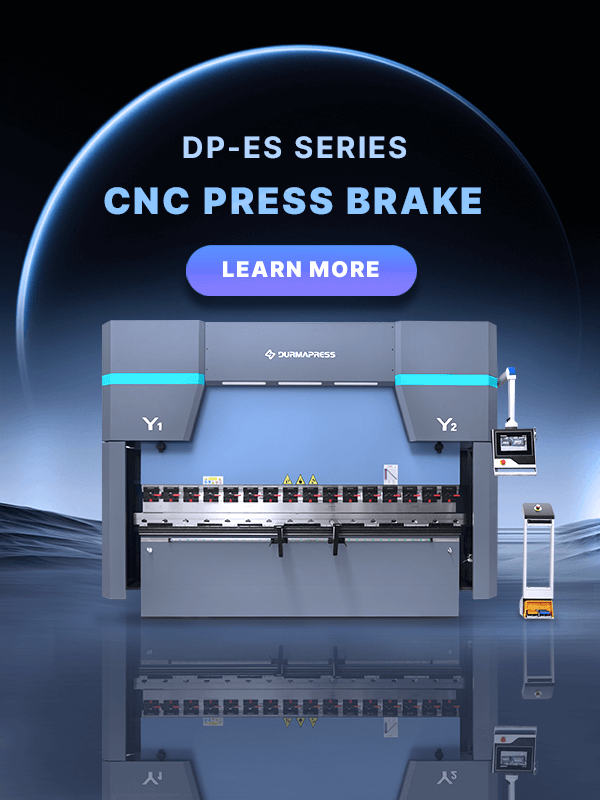
Mastering tandem press brake synchronicity is key for large-scale metal fabrication. Learn how CNC systems and servo technology ensure ±0.01mm accuracy across twin setups.
In the world of heavy-duty metal fabrication, size usually comes at the expense of precision. When you are bending a 12-meter high-mast lighting pole or a massive crane boom, the margin for error vanishes. A discrepancy of just a fraction of a millimeter at the hydraulic cylinders can result in a ruined workpiece worth thousands of dollars.
To solve this, industry leaders turn to the tandem press brake. But how do two independent machines move as one with a precision of 0.01mm? It isn’t just brute force; it is a symphony of high-speed electronics and closed-loop hydraulics.
Why Synchronicity is the "Holy Grail" of Tandem Bending
A tandem press brake configuration involves two (or more) CNC press brakes synchronized to work in unison. The primary challenge is that steel is not a homogeneous material—it has variations in grain, thickness, and tensile strength.
If the two rams do not move in perfect harmony, the machine risks:
Torsional Stress: Damaging the machine frames due to uneven loading.
Angle Inconsistency: Creating a "twisted" part where the angle at one end doesn't match the other.
Scrap Loss: Large-scale parts are expensive; one bad bend is a massive financial hit.
1. The Nerve System: Real-Time Communication via EtherCAT
In older generations, machines communicated via analog signals, which suffered from latency. Modern tandem press brake systems utilize EtherCAT (Ethernet for Control Automation Technology).
EtherCAT allows the CNC controller to communicate with servo drives at sub-millisecond speeds. The "Master" controller sends instructions to the "Slave" units, and the feedback loop happens 1,000 times per second. This ensures that even if one machine encounters a slightly harder spot in the metal, the other machine adjusts its speed instantly to maintain alignment.
2. The Eyes: High-Resolution Linear Scales
To achieve 0.01mm accuracy, the CNC system needs to know exactly where the ram is at all times. This is handled by high-resolution linear scales.
These scales are mounted on a "C-frame" independent of the main frame to ensure that frame deflection under pressure doesn't skew the readings.
The Closed-Loop: The scales measure the actual position of the Y1 and Y2 axes on both machines.
Thermal Compensation: Modern scales can even compensate for the thermal expansion of the machine's steel components in a non-climate-controlled factory.
3. The Muscle: Servo-Hydraulic Hybrid Technology
The transition from traditional hydraulic valves to Servo-Hybrid systems has revolutionized the tandem press brake.
In a traditional setup, oil flow is regulated by throttling valves, which are prone to heat and inconsistent flow. In a servo-hybrid tandem setup, a servo motor directly controls the bidirectional pump. This allows for "micro-stepping" of the ram. If the system detects a 0.005mm lag on Machine B, the servo pump accelerates instantly to compensate, providing a level of fluidity that pure hydraulics cannot match.
4. Deflection Compensation (Crowning)
Even with perfect ram synchronization, the bed of the machine will naturally deflect under hundreds of tons of pressure. To maintain a constant angle across a 12-meter length, a tandem press brake must use a dynamic crowning system.
Whether it is Hydraulic Crowning (using cylinders in the lower table) or Mechanical Crowning (using a system of wedges), the CNC calculates the required compensation in real-time based on material thickness, length, and tensile strength. This ensures that the "synchronized" rams result in a "synchronized" bend angle from end to end.
The ROI of Precision
Investing in a high-synchronicity tandem press brake isn't just about buying a bigger machine; it’s about expanding your capability to handle high-spec projects in aerospace, infrastructure, and renewable energy (like wind turbine towers).
When your setup maintains 0.01mm accuracy, you aren't just bending metal—you are engineering reliability. Discover the productivity and ROI benefits of tandem press brakes and learn how tandem solutions help manufacturers reduce costs and improve production output.
Quick Checklist for Buyers:
Does the system use EtherCAT or a similar high-speed bus?
Are the linear scales mounted on an independent C-frame?
Is the crowning system integrated into the CNC feedback loop?
Conclusión
Maintaining 0.01mm accuracy in a tandem press brake is a feat of modern engineering. By combining high-speed EtherCAT communication, precision linear scales, and hybrid servo technology, fabricators can now tackle the largest projects with surgical precision.
DurmaPress offers high-performance tandem press brake solutions, providing everything from custom CNC integration to expert foundation engineering and lifetime technical support. Maximize your efficiency and precision with a partner who understands heavy-duty fabrication.
FAQ: Tandem Press Brake Essentials
Q1: What is the maximum length a tandem setup can handle?
A: Usually 12 meters (by linking two 6m machines), but it is modular. Advanced setups can link three or four machines to exceed 20+ meters for infrastructure projects like utility poles.
Q2: Can the machines operate independently?
A: Yes. Modern CNC controllers feature an "Independent Mode" for small parts and a "Synchronized Mode" for large parts, maximizing machine uptime and workshop flexibility.
Q3: How often is calibration required?
A: Despite real-time 0.01mm self-correction, we recommend a professional calibration check every 6-12 months to account for foundation settling or extreme temperature shifts.
Q4: Mechanical or Hydraulic crowning—which is better?
A:Mechanical crowning is often preferred for tandem setups due to its stability over extreme lengths. However, Hydraulic crowning offers faster, integrated adjustments for thinner materials.
Q5: Does it require a specialized foundation?
A: Yes. A reinforced, heavy-duty concrete foundation is mandatory. Even a tiny shift in the floor can disrupt the synchronization and precision of the tandem press brake.
Stay Updated on Industrial Innovations
Subscribe to our newsletter for the latest insights on manufacturing technology, sustainability, and industry trends.