


Quiénes somos
Durmapress specializes in designing, manufacturing, and selling various metal processing equipment, including bending machines, shears, punches, and laser cutting machines. The company was founded in 2014, with years of experience and technology accumulation. DurmaPress has become one of the well-known brands in China's metal processing machinery industry.


Contáctenos
Entradas recientes


Categorías
Síganos
Nuevo vídeo semanal
Table of Contents
Rolling machines are among the most widely used equipment in metal processing. They all use rotating rolls to engage and process metal—but depending on the machine design, those rolls apply compressive force to reduce thickness, bending force to form curvature, or progressive shaping force to build a cross-sectional profile. A flat rolling mill, a plate bending machine, and a roll forming line are all rolling machines, but they work on different mechanical principles and produce entirely different results.
This article explains the working principle of rolling machines across the three main metalworking categories, what distinguishes each process mechanically, and how to determine which type applies to a given production requirement.
1. What Is a Rolling Machine?
A rolling machine is a metal-processing machine that uses rotating rolls to apply force to metal, causing it to change shape through plastic deformation. Depending on the machine type and process, the material may undergo:
- Thickness reduction: metal is compressed between rolls, becoming thinner and longer
- Curvature forming: metal is bent into arcs, cylinders, or cones through controlled roll position and pressure
- Cross-sectional profiling: metal strip is progressively shaped through a sequence of roll stations into a specific profile
The term "rolling machine" is applied broadly. It covers flat rolling mills, plate bending machines, ring rolling machines, and roll forming lines. Each represents a distinct process. Understanding which type is being discussed—and what its specific working principle is—matters when evaluating equipment or planning a production process.
2.Shared Physical Principles
2.1 Plastic Deformation Under Roll Contact
Metal deforms in two ways: elastically (temporary, recovers when force is removed) and plastically (permanent, retaining the new shape). Rolling produces a lasting shape change when the stress at the roll contact zone exceeds the material's yield strength.
The resulting shape change depends not only on force magnitude, but on roll geometry, machine configuration, material properties, and process conditions. The same force applied through different roll arrangements produces different outcomes—which is why machine type cannot be selected on force capacity alone.
2.2 Friction, Grip, and Material Feed
Rolls grip the metal surface through friction and drive material through the working zone. Friction and lubrication requirements vary by process:
- In rolling mills, controlled lubrication reduces friction, heat, and roll wear while maintaining sufficient traction for material entry into the roll gap.
- In plate bending machines, adequate grip between rolls and plate is essential for consistent feeding and curvature.
- In roll forming lines, friction conditions at each station affect forming forces and surface quality along the full profile length.
Insufficient grip from contamination, excess lubrication, or poor surface condition causes slipping rather than feeding—producing inconsistent results across all machine types.
2.3 Springback and How It Differs by Process
After the forming force is released, the elastic portion of deformation recovers and the workpiece partially springs back. How springback is managed differs meaningfully by process:
- Rolling mills: springback contributes to dimensional variation in final gauge. Compensation involves setting the roll gap tighter than the target thickness and accounting for elastic deflection of the roll system under load.
- Roll bending machines: springback affects the final bending radius. The forming roll is set to a tighter position than the target so the plate lands at the correct curvature after recovery. CNC machines store material-specific compensation values.
- Roll forming lines: springback accumulates across forming stations and affects final cross-sectional dimensions. Pass schedule design must account for cumulative elastic recovery to achieve the target profile at the exit station.
3. Three Main Categories of Rolling Machines
1. Rolling Mills: Thickness Reduction and Section Rolling
Rolling mills apply compressive force to reduce metal thickness, change its cross-sectional shape, or alter its mechanical properties. Metal is fed through a roll gap set narrower than the incoming thickness, forcing it to thin and elongate.
How it works: Metal enters the roll gap and is squeezed between work rolls. Because metal volume is conserved, what is lost in thickness becomes gain in length—the material elongates in the rolling direction and spreads slightly in width. The degree of thickness reduction per pass depends on the roll gap setting, roll diameter, rolling speed, and material properties.
Rolling mills operate in two temperature regimes:
- Hot rolling: performed above the metal's recrystallization temperature, where the material is more ductile and requires lower rolling force. Used for primary forming of slabs, billets, structural sections, and initial plate production. Dimensional precision and surface finish are generally lower than cold rolling due to scale formation and thermal effects.
- Cold rolling: performed below the recrystallization temperature. Requires greater force, but produces tighter dimensional tolerances, better surface finish, and improved mechanical properties through work hardening. Used for precision sheet, foil, bright bar, and strip.
Common mill configurations:
| Mill Type | Roll Arrangement | Typical Use |
|---|---|---|
| Two-high mill | One upper roll and one lower roll | Basic flat rolling and reversing mill operations |
| Three-high mill | Three stacked rolls | Reversing operations using upper-middle or middle-lower roll pairs |
| Four-high mill | Two work rolls and two large backup rolls | Thin sheet and precision rolling |
| Cluster mill | Small work rolls supported by multiple backup rolls | Very thin strip and foil |
| Shape / section mill | Grooved rolls with profiled pass geometry | Structural sections, rails, bars, and rod |
2. Roll Bending Machines: Curvature Forming
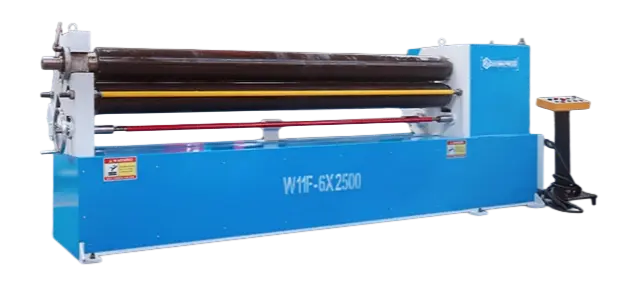
Roll bending machines—commonly called plate rolling machines or plate roll benders—bend flat metal sheet or plate into curved forms: cylinders, arcs, cones, and compound curves. The plate passes through and exits at the same thickness; the process changes shape, not section size.
How it works: The bending mechanism depends on the roll arrangement—specifically the number and position of forming and support rolls. In a typical configuration, a forming roll applies force at a controlled position relative to two support rolls. This creates a bending effect that curves the metal as it feeds through. The bending radius is set by adjusting the forming roll position—closer to the support rolls produces a tighter curve; further away opens the radius.
Forming is done in progressive passes, with the roll position adjusted incrementally until the target geometry is reached. This allows measurement and correction between passes and avoids overstressing the plate in a single aggressive pass.
Springback is managed by setting the forming roll slightly beyond the target radius so the plate recovers to the correct curve after pressure is released.
Pre-bending and end flats: The plate edge cannot receive curvature until it is fully engaged in the roll zone, leaving flat sections—end flats—at the leading and trailing ends. A deliberate pre-bending pass before full rolling forms these edge zones, improving roundness at the seam and fit-up quality before welding.
Main configurations:
| Configuration | Pre-bending Approach | Typical Application |
|---|---|---|
| 3-roll symmetrical | Edge pre-bending requires a separate setup step | General fabrication, varied job mix |
| 3-roll asymmetrical | Pre-bending integrated into the rolling sequence | Improved workflow on medium-volume work |
| 4-roll | Fully integrated; no plate repositioning needed | High-volume cylindrical shells, repeat production |
| 2-roll | Not applicable | Thin-gauge sheet, small-diameter cylinders, specialized high-speed production |
The 3-roll symmetrical design is the most common in general fabrication. The 4-roll design adds a bottom pinch roll that continuously clamps the plate, simplifying pre-bending and reducing repositioning steps—well suited to production environments with repeating dimensions.
3. Roll Forming Machines: Continuous Profile Forming
Roll forming is a continuous process in which flat metal strip is fed through a sequence of roll stations, each adding a small incremental bend to a specific zone of the cross-section, until the strip takes on the target profile at the exit.
How it works: Unlike roll bending—where bending force is applied across the full plate width—roll forming shapes specific areas of the strip's cross-section at each station. Each station's rolls are profiled to contact and bend particular zones while leaving others unchanged. As the strip progresses, these incremental changes accumulate into the finished geometry: a C-channel, hat section, Z-profile, hollow tube, or custom shape.
The number of forming stations required depends on the profile complexity, material, and acceptable bend increment per station. The pass schedule—the sequence of incremental cross-section changes across the stations—must be engineered for each specific profile. Changing to a different profile typically requires roll changeover or a separate production line.
The material exits as a continuous formed section, cut to length by a flying shear or end stop.
Springback across the line: Each station introduces a bend and partial springback. The pass schedule accounts for cumulative elastic recovery, and the final station is typically set to over-form slightly so the profile springs back to the target dimensions after the last contact point.
4. How the Three Processes Compare
| Rolling Mill | Roll Bending Machine | Roll Forming Machine | |
|---|---|---|---|
| Primary action | Compresses material to reduce thickness or change section | Bends flat plate into a curved shape | Progressively bends strip cross-section into a profile |
| What changes | Thickness and length | Shape (curvature) | Cross-sectional profile |
| What stays the same | Cross-sectional profile (flat rolling) | Plate thickness | Strip thickness |
| Input material | Slab, billet, coil, or bar | Cut sheet or plate | Coil or continuous strip |
| Output | Thinner/longer flat product or shaped section | Curved component (cylinder, arc, cone) | Continuous linear profile, cut to length |
| Production mode | Continuous or reversing passes | Batch, individual plate | Continuous high-speed |
| Springback management | Roll gap and roll system deflection compensation | Over-bending the forming roll position | Pass schedule design with cumulative compensation |
| Typical applications | Sheet, plate, structural sections, foil | Pressure vessels, tanks, pipe sections, ship panels | Roofing, wall panels, framing, rails, cable trays |
5.Key Components Across Rolling Machine Types
| Function | Notes by Machine Type | |
|---|---|---|
| Work rolls | Apply forming force, grip material, drive feed | Flat for mills; adjustable-position for bending; profiled for forming |
| Backup rolls | Support work rolls against deflection under load | Common in rolling mills; not typically used in bending or forming |
| Drive system | Provides torque and controls rotation speed | Mechanical, hydraulic, or electric; servo-driven for CNC precision |
| Frame and housing | Absorbs forming loads; maintains roll alignment | Must resist deflection under full operating load |
| Roll gap / position adjustment | Controls thickness, bending radius, or profile geometry | Manual, motorized, or servo-controlled |
| Sistema de control | Manages positions, speed, sequence, stored programs | From basic manual to full CNC with springback compensation |
| Material handling | Feeds and supports the workpiece | Coil stands for mills and forming; plate supports and outboard supports for bending |
Roll diameter affects capability differently in each process: in mills it influences the contact arc and reduction per pass; in plate bending it determines the minimum inside diameter achievable; in roll forming it affects force distribution and line speed at each station.
6. Material Behavior in Rolling
| Key Behavior | |
|---|---|
| Mild / low-carbon steel | Predictable and forgiving; standard reference for most machine capacity ratings |
| High-strength structural steel | Greater force and more springback; confirm machine capacity against actual material grade |
| Acero inoxidable | Work-hardens progressively during forming; intermediate annealing may be needed for complex shapes |
| Aluminio | Good formability; surface marks easily—use roll covers or protective film for visible surfaces |
| Copper and brass | Soft and formable; springback differs from steel; roll surface protection recommended |
| Wear-resistant and alloy plate | May require specific procedures or temperature control; seek technical guidance before rolling |
7. Applications
Rolling mills produce the starting material for downstream processes: hot-rolled plate, cold-rolled sheet, galvanized coil, structural sections, bar, and rail.
Roll bending machines produce curved fabricated components:
- Cylindrical shells for pressure vessels, storage tanks, silos, and industrial equipment
- Large-diameter pipe sections and transition pieces
- Ship hull panels, bulkheads, and structural rings
- Wind tower sections and offshore support structures
- Machine housings and architectural curved panels
Roll forming machines produce continuous linear profiles:
- Roofing and wall cladding panels
- Structural framing sections (C-stud, track, hat section, joist)
- Automotive roll-formed rails and reinforcement members
- Solar panel mounting rails and cable management systems
8.Choosing the Right Rolling Machine
The starting point is the production outcome—not the machine catalog.
To reduce metal to a thinner gauge or produce raw section material: a rolling mill is required. Mill configuration depends on target gauge, material, surface quality, and production volume.
To form cut plate into cylindrical, conical, or curved components: a plate bending machine is the appropriate category. Configuration—2-roll, 3-roll, or 4-roll—depends on plate thickness, required inside diameter, production volume, and pre-bending requirements.
To produce continuous linear profiles from coil or strip: a roll forming line is required. Pass schedule, station count, and roll geometry must be designed for the specific target profile.
Selecting a Rolling Mill
Key factors: target material and gauge range, hot or cold process, required surface quality and mechanical properties, production volume, and mill configuration for the desired cross-section.
Selecting a Plate Bending Machine
Published capacity tables assume mild steel at a reference yield strength and minimum rolling diameter. Before purchasing, provide the manufacturer with exact material grade and yield strength, plate thickness and working width, required minimum inside rolling diameter, and part geometry. Request written confirmation for those specific conditions—not just a check against the table maximum.
Selecting a Roll Forming Line
Key factors: target profile geometry and complexity, material and thickness range, required production speed, changeover requirements between profiles, and downstream cut-to-length and handling needs. Pass schedule and roll geometry must be purpose-designed for the profile.
9. Common Problems in Rolling Operations
| Process | Likely Cause | Solución | |
|---|---|---|---|
| Springback exceeds expectation | All types | Higher material yield strength than assumed | Measure springback on first piece; adjust gap, position, or CNC compensation |
| Incorrect final gauge | Rolling mills | Roll gap not accounting for elastic system deflection | Calibrate against measured thickness; use closed-loop gauge control |
| End flats at seam | Roll bending | Plate edge not pre-bent before full rolling | Pre-bend both edges before the main rolling sequence |
| Uneven radius or out-of-roundness | Roll bending | Plate misalignment, roll deflection, inconsistent passes | Square plate; add outboard support; use incremental pass adjustments |
| Profile distortion or bow | Roll forming | Insufficient stations; material outside design range | Review pass schedule; add stations; verify material is within line parameters |
| Surface marking | Roll bending and forming | Roll contamination; soft metal against bare steel | Clean rolls; use urethane covers or protective film |
10.FAQ
Q1: What is the working principle of a rolling machine?
Answer: Rolling machines use rotating rolls to apply force to metal, causing permanent plastic deformation beyond the material's yield strength. Rolling mills compress metal through a narrowed roll gap to reduce thickness. Plate bending machines apply bending force to curve flat plate into cylinders and arcs. Roll forming machines shape strip cross-sections progressively through sequential forming stations. The roll geometry, force direction, and process logic differ by type.
Q2: What is the difference between a rolling mill and a plate bending machine?
Answer: Rolling mills reduce metal thickness by compressing it through a roll gap—the material comes out thinner and longer. Plate bending machines curve flat plate into cylinders, cones, or arcs without changing its thickness. Both use rolls, but the forming mechanisms, machine configurations, and outputs are fundamentally different.
Q3: What is the difference between roll bending and roll forming?
Answer: Roll bending curves an individual flat plate across its full width into a cylinder, arc, or cone. Roll forming feeds continuous strip through sequential stations that progressively shape the cross-section into a linear profile such as a C-channel. Roll forming is a high-speed continuous process; roll bending is a batch operation on individual plates.
Q4: How is springback managed in each type of rolling machine?
Answer: In rolling mills, the roll gap is set tighter than the target gauge to compensate for elastic deflection of the roll system. In plate bending, the forming roll is positioned to a tighter radius so the plate recovers to the correct curve after release. In roll forming, the pass schedule is designed to account for cumulative springback across stations, typically over-forming at the final station.
Q5: How do I choose the right type of rolling machine?
Answer: Define the output first. For thinner sheet, strip, or structural sections, a rolling mill is required. For curved components from cut plate—cylinders, cones, arcs—a plate bending machine is appropriate. For continuous linear profiles at high volume from coil, a roll forming line is the right solution.
Q6: What determines plate bending machine capacity?
Answer: Published capacity tables are a starting point only, assuming mild steel at a reference yield strength and minimum rolling diameter. Actual capacity depends on material grade, plate width, required inside diameter, and part geometry. Request capacity confirmation from the manufacturer using your specific job conditions before selecting a machine.
11.Conclusion
Rolling machines cover a family of related but distinct metalworking processes. Rolling mills apply compressive force to reduce thickness and produce raw material. Plate bending machines apply bending force to form flat plate into curved components. Roll forming machines progressively shape strip cross-sections into continuous profiles through sequential stations. Each operates on different mechanics, requires different equipment, and suits different production outcomes.
For anyone evaluating rolling equipment, the clearest starting point is defining the finished part—and working back from that to the process and machine type that produces it. Configuration, capacity, and control system choices follow logically once the process category is correctly identified.
For equipment specifications, see rolling machine product range.