NC vs CNC Press Brake: Key Differences, Features & How to Choose
- Conocimientos, Noticias
- 90+ reading now
Durmapress specializes in designing, manufacturing, and selling various metal processing equipment, including bending machines, shears, punches, and laser cutting machines. The company was founded in 2014, with years of experience and technology accumulation. DurmaPress has become one of the well-known brands in China's metal processing machinery industry.

When purchasing a press brake for sheet metal fabrication, one of the most critical decisions is choosing between an NC (Numerical Control) press brake and a CNC (Computer Numerical Control) press brake. While both machines are designed to bend metal sheets with precision, they differ significantly in synchronization technology, bending accuracy, axis control, and overall production efficiency.
Understanding these differences will help you make a more informed investment—whether you're running a small job shop or scaling up a high-volume production line.
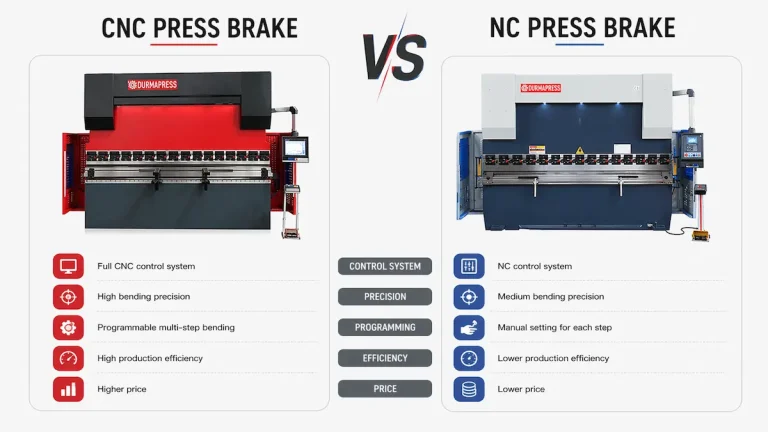
An NC press brake, also referred to as a torsion-bar press brake, uses a mechanical torsion shaft to synchronize the movement of the ram on both sides. The operator manually inputs parameters—such as back gauge position and ram stroke—through a basic control panel, typically a 2-axis controller like the E21 system.
NC press brakes are widely used in small to medium workshops where bending tasks are simple, repetitive, and do not require extremely tight tolerances. The machine's straightforward design makes it easier to operate and maintain, which explains its continued popularity in entry-level fabrication environments.

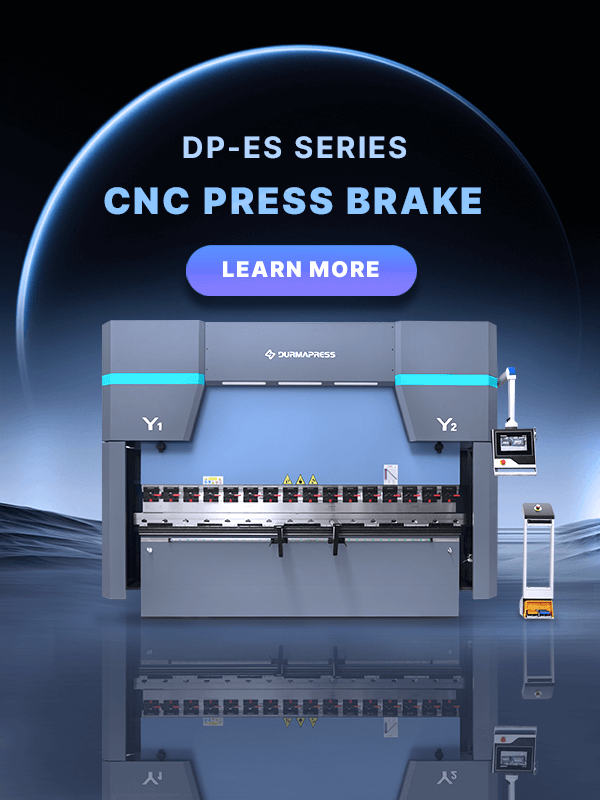
A Prensa plegadora CNC, also known as an electro-hydraulic synchronous press brake, uses a closed-loop control system consisting of a CNC controller, proportional valves, and dual linear encoders installed on both sides of the machine frame. The linear encoders continuously monitor the position of the ram and send real-time feedback to the controller. If any synchronization error is detected, the controller instantly adjusts the proportional valve to correct it.
This closed-loop mechanism ensures far superior bending accuracy, greater flexibility for complex parts, and significantly higher production speed compared to NC machines.

The fundamental differences between NC and CNC press brakes stem from their synchronization architecture, which in turn drives differences in accuracy, speed, flexibility, and the range of parts they can produce.
1. Ram Synchronization NC press brakes rely entirely on a mechanical torsion bar. This method offers no real-time feedback, making it impossible to detect or correct synchronization errors during bending. In contrast, CNC press brakes use dual linear encoders connected to a closed-loop control system, allowing the controller to detect deviations and correct them via proportional valves in real time.
2. Bending Accuracy Due to the absence of real-time feedback, NC press brakes achieve a bending angle accuracy of ≤30 arc minutes. CNC press brakes, with their closed-loop systems and automatic crowning compensation, achieve ≤18 arc minutes—a 40% improvement in angular precision.
3. Working Speed CNC machines are significantly faster. The higher cylinder ratio (13:1–15:1 vs 6:1–8:1 on NC) allows CNC press brakes to achieve ram down speeds of 160–200 mm/s and back gauge speeds up to 400 mm/s—roughly double the speed of NC machines.
4. Axis Control & Programming NC press brakes are limited to 2 axes with manual numeric programming. CNC press brakes support 3+1 to 8+1 axes, with graphic or 3D programming interfaces that dramatically reduce setup time and the risk of operator error.
5. Crowning Compensation NC press brakes typically require manual crowning adjustment before each job, consuming time and material. CNC press brakes calculate and apply crowning compensation automatically based on the material properties and bending parameters entered into the controller.
6. Partial Load Performance NC press brakes should not be operated under partial loading conditions for extended periods, as this causes torsion bar deformation. CNC press brakes handle partial loads without issue, as Y1 and Y2 axes operate independently.

The table below provides a side-by-side comparison of the key technical specifications and capabilities of NC and CNC press brakes.
| Feature | Plegadora NC | Plegadora CNC |
|---|---|---|
| Synchronization | Mechanical torsion bar | Closed-loop: linear encoder + proportional valve |
| Ram Down Speed | 80–100 mm/s | 160–200 mm/s |
| Back Gauge Speed | ~100 mm/s | Up to 400 mm/s |
| Bending Angle Accuracy | ≤30 arc min (±0.5°) | ≤18 arc min (±0.3°) |
| Axis Control | 2 axes (Y, X) | 3+1 to 8+1 axes |
| Sistema de coronación | Manual or optional | CNC automatic |
| Programming | Manual numeric | Graphic / 3D digital |
| Partial Load | Not recommended | Supported |
| Tooling Clamp | Manual fast clamp | Hydraulic / robotic options |
| Advanced Automation | Not available | Laser measurement, robotic arm |
| Ideal Application | Simple, repetitive bends | Complex, high-precision, high-volume |
Price is often the deciding factor when choosing between an NC and CNC press brake. However, focusing solely on the purchase price can lead to a misleading picture of the total cost of ownership.
Purchase Price For machines with a rated capacity below 200 tons, a CNC press brake typically costs more than twice the price of an equivalent NC press brake. For machines above 200 tons, the price difference narrows—the CNC model is generally less than twice the cost of the NC equivalent. This means that for heavier, higher-capacity applications, CNC represents a proportionally better value.
Total Cost of Ownership While the upfront cost of a CNC press brake is higher, the long-term economics often favor CNC:
For low-volume, simple bending operations, NC press brakes offer an unmatched cost-per-machine advantage. For medium-to-high volume, complex, or precision-critical applications, the CNC press brake's efficiency gains typically justify the higher initial investment within 2–3 years of operation.
Choosing the right press brake depends on a combination of your production requirements, budget, operator capabilities, and long-term business goals. Use the following framework to guide your decision:
Choose an NC Press Brake if:
Choose a CNC Press Brake if:
The choice between an NC and CNC press brake ultimately comes down to the complexity of your parts, the volume of your production, and the level of accuracy your customers demand. NC press brakes offer a cost-effective entry point for straightforward bending work, while CNC press brakes deliver the precision, speed, and automation needed to compete in today's demanding manufacturing environment.
If you're unsure which model is right for your application, our team can help you evaluate your requirements and recommend the most suitable press brake solution—whether you need a reliable NC machine for everyday jobs or a high-performance CNC system for complex production demands.
Rellene la siguiente información para recibir un presupuesto gratuito y un folleto de productos. Le responderemos en 24 horas.