Punch Press Punching vs Stamping: Key Differences Explained | Durmapress
- Conocimientos, Noticias
- 90+ reading now
Durmapress specializes in designing, manufacturing, and selling various metal processing equipment, including bending machines, shears, punches, and laser cutting machines. The company was founded in 2014, with years of experience and technology accumulation. DurmaPress has become one of the well-known brands in China's metal processing machinery industry.

In modern metal fabrication, punch presses and stamping presses are two of the most commonly used machines. At first glance, they may look similar — both use dies and high pressure to shape metal sheets. But their working principles, production efficiency, and ideal applications are quite different.
Understanding the difference between punching and stamping is essential for choosing the right machine for your production line. Whether you are producing simple sheet metal holes or complex automotive components, this guide will help you make an informed decision.
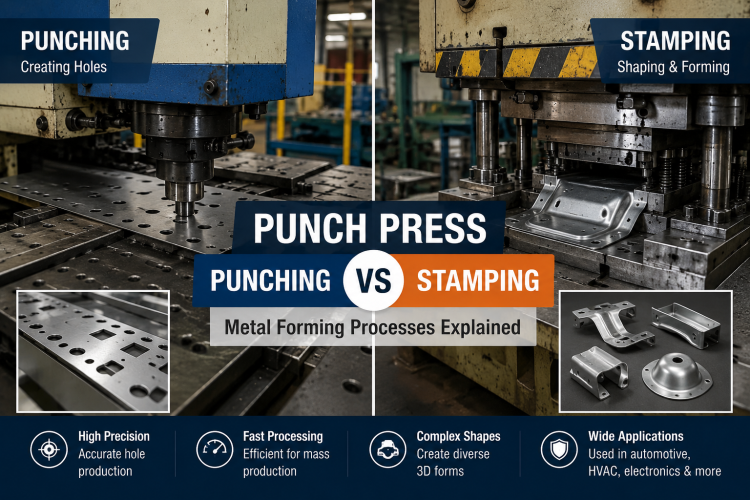
A punch press is a metal forming machine that uses a punch and die to remove material from a sheet, creating holes or cutouts. Each stroke of the press completes one operation at one station. The removed material — called a slug — is discarded.
Common punching operations include:
Key feature: Single operation per stroke
Punch presses can be operated manually, mechanically, or with CNC control, offering varying levels of precision and automation. They work well with mild steel, aluminum, and stainless steel up to a certain gauge.
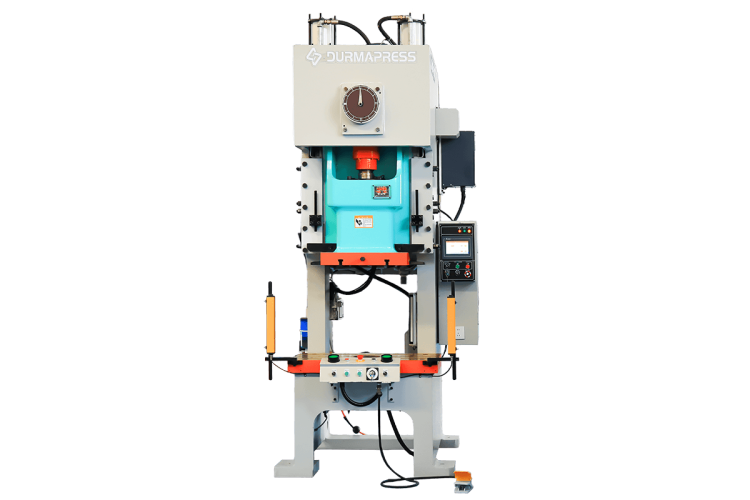
✔ For a full range of punch press solutions, explore Durmapress punch press machines.
Stamping is a broader metal forming term that covers multiple operations — including bending, embossing, flanging, coining, and punching — all performed using high-pressure dies.
In a progressive stamping press, a metal strip feeds through multiple stations inside a single die set. Each station performs a different operation step by step, and the finished part is completed and separated at the final station — all in one continuous automated process.
Key feature: Multiple operations in one continuous process
Progressive stamping presses are designed for high-speed, high-volume production. Because cutting and forming happen in a single pass, secondary operations are minimized and dimensional consistency is excellent.


| Factor | Punch Press | Stamping Press |
|---|---|---|
| Production Method | Single-step | Multi-station continuous |
| Eficacia | Moderate | Very high |
| Labor Requirement | More operators | Minimal, fully automated |
| Part Complexity | Simple holes & cutouts | Complex multi-form parts |
| Tooling Cost | Low to medium | High upfront |
| Changeover Time | Minutes | Hours or days |
| Ideal Volume | 1–10,000 pcs/month | 10,000+ pcs/month |
| Edge Quality | Good; may need deburring | Excellent with fine-blanking |
| Precisión | Operator-dependent | High consistency |
| Material Thickness | Lighter gauge | Heavy gauge + HSLA |
Choose a punch press if:
Choose a progressive stamping press if:
Not sure which machine fits your production needs?
→ Póngase en contacto con Durmapress for a customized solution
Punch presses are widely used across industries where flexibility and moderate volume are priorities:
Punch presses are widely used across industries where flexibility and moderate volume are priorities:
Q1: Can the same press be used for both punching and stamping?
Many hydraulic presses support quick-change tooling systems, allowing you to switch between punch tooling and stamping dies on the same frame — provided the press tonnage is sufficient for both operations. However, progressive stamping typically requires dedicated high-speed presses optimized for continuous feed production.
Q2: How do I reduce burr formation in punching?
Fine-tune the punch-to-die clearance to match your material thickness — typically 5–10% of the material thickness per side. Regularly sharpen or replace worn tooling, and select the correct punch geometry for your material. CNC punch presses with automatic tool management significantly reduce burr-related issues.
Q3: What materials are best suited for progressive stamping?
High-strength low-alloy steels (HSLA) and aluminum alloys such as 5052 and 6061 are among the most commonly used. Their combination of ductility and strength makes them ideal for deep drawing, complex forming, and tight-tolerance applications in automotive and electronics manufacturing.
Choosing between punch press punching and progressive stamping comes down to three core factors: part complexity, production volume, and budget.
If you need flexible, cost-effective production for simple holes and moderate volumes, a punch press is the right choice. If your operation demands high-speed, automated production of complex parts at scale, a progressive stamping press delivers the precision and efficiency you need.
At Durmapress, we offer a full range of metal forming equipment — from punch presses to advanced stamping solutions — designed for the demands of modern manufacturing.
→ [Póngase en contacto con Durmapress for a customized solution]
Rellene la siguiente información para recibir un presupuesto gratuito y un folleto de productos. Le responderemos en 24 horas.