



Quiénes somos
Durmapress specializes in designing, manufacturing, and selling various metal processing equipment, including bending machines, shears, punches, and laser cutting machines. The company was founded in 2014, with years of experience and technology accumulation. DurmaPress has become one of the well-known brands in China's metal processing machinery industry.



Contáctenos
Entradas recientes



Categorías
Síganos
Nuevo vídeo semanal
Table of Contents
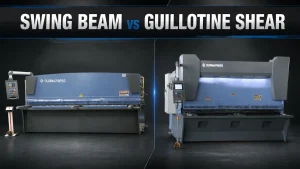
Choosing between a swing beam shear and a guillotine shear usually comes down to one practical question: which machine produces the parts your shop needs, at a cost you can justify? Both machines belong to the broader category of cizalla hidráulica equipment and cut straight lines in sheet or plate using opposed blades, but the way the upper blade moves changes how the cut behaves, how often you adjust the machine, and how much the blades cost to keep sharp.
This guide walks through the mechanical difference, what to check on your own materials and parts, and how to compare throughput and ownership cost instead of relying on a brochure thickness rating. It ends with a short RFQ and trial checklist you can send to suppliers before you commit to either design.
1. Swing Beam vs Guillotine Shear: Key Differences
A swing beam shear moves its upper blade through a pivoting arc from a fixed rear axis. A guillotine shear moves its upper blade along linear guides in a straight vertical path. That difference affects rake angle, blade clearance adjustment, and usable blade edges — but the degree to which it does varies by manufacturer and model.
Neither design is automatically "better." A swing beam that passes your required jobs at a lower price is the right choice for that shop. A guillotine earns its premium only when its verified adjustment range, cut quality, or capacity solves a problem the swing beam cannot.
| Factor | Swing Beam Shear | Guillotine Shear |
|---|---|---|
| Upper blade path | Pivoting arc | Straight vertical travel |
| Rake angle | Generally fixed on conventional designs | Adjustable on many models |
| Blade clearance adjustment | Manual or motorized, model-dependent (often an eccentric mechanism) | Manual, motorized, or CNC-controlled, model-dependent |
| Usable blade edges | Often 2 usable edges on conventional upper blades — verify blade geometry | Often 4 usable edges on suitable upper blade designs — verify the supplied tooling |
| Typical purchase price | Often lower for comparable capacity | Often higher; confirm against your quote |
| Confirm with a trial on | Your thinnest sheet and narrowest strips | Your heaviest plate and tightest-tolerance parts |
Treat clearance adjustment method and blade edge count as typical tendencies tied to conventional blade geometry, not a fixed rule for every machine in the category. Some swing beam models offer automatic clearance adjustment, and some guillotine models adjust clearance manually. Verify the actual mechanism on the specific model you are quoted.
2. How Swing Beam and Guillotine Shears Work
Both machines share the same basic setup: a sheet rests on the table, a backgauge positions it to length, hold-down clamps secure it, and the upper blade shears against a fixed lower blade. The difference is what happens between the hold-down and the cut.
On a swing beam shear, the beam carrying the upper blade pivots from a rear axis, so the blade travels in an arc. The blade gap and the effective rake angle are set largely by that fixed geometry on conventional designs. After the cut, the blade swings slightly away from the lower blade, which some manufacturers note helps a cut strip clear the backgauge without jamming.
On a guillotine shear, the upper blade rides on guided rails and travels in a straight line. Because the path is linear, the blade gap can stay consistent across the full cutting width, and many designs allow the rake angle to be changed for different material thicknesses.
Two settings matter more than the motion path itself:
- Rake angle — the angle between the upper and lower cutting edges along the cut. A higher rake engages less material at once, lowering peak force but increasing how far the strip is progressively displaced, which can add twist on thin or narrow pieces.
- Blade clearance — the lateral gap between the cutting edges as they pass each other. Clearance that is too wide leaves room for rollover and burr; clearance that is too tight can cause secondary shearing and faster blade wear. In short, blade clearance has a direct, measurable effect on burr height — it is not a cosmetic setting.
A pivoting beam or a guided ram does not by itself guarantee correct rake or clearance. Ask any supplier to show you the actual adjustment mechanism, its range, and how it is set, rather than relying on the machine category name.
3. Cutting Capacity and Cut Quality Comparison
Published thickness ratings describe performance under specific test conditions, usually a stated material grade and cutting length. A shop running higher-strength steel, longer cuts, or tighter finished-part tolerances needs supplier confirmation for that exact combination, not just the brochure maximum.
Build a short job list before comparing machines: material grade and condition, thickness range including upper tolerance, cutting length, minimum strip width, and the acceptance limits your downstream process actually requires (length, squareness, straightness, burr, and distortion). This list becomes the basis for both the technical comparison and the eventual cutting trial checklist.
3.1 Capacity and Edge Quality
Capacity and edge quality depend on more than the blade motion. Clearance setting, blade sharpness, alignment, hold-down pressure, and material support all affect the result, which is why two machines with the same thickness rating can produce different edges on the same part.
Which shear is better for thick plate? Neither design wins by default. Thick-plate performance depends on the specific machine's rated capacity at that material grade, frame rigidity, and blade condition — not the swing beam or guillotine label. Request written capacity confirmation for your actual plate grade and thickness, then confirm it with a trial cut.
Can a swing beam shear cut stainless steel? Yes, within the machine's rated capacity for that grade. Stainless steel's higher strength and work-hardening behavior reduce the usable thickness compared with mild steel at the same nominal rating, and blade clearance needs to be set for the specific grade. Do not apply a mild-steel thickness chart to stainless steel; ask the supplier for a capacity rating specific to the stainless grade you run.
When comparing capacity, ask each supplier to confirm, in writing, the rake and clearance settings used to reach their stated thickness rating. Then check:
- Finished length and squareness — measured from your locating datum, not just "accuracy" on a spec sheet.
- Cut-edge straightness — maximum deviation from a straight reference along the cut.
- Burr height — how it changes as blades dull or clearance drifts from the set value.
- Rollover — the rounded shoulder where the blade first deforms the edge, relevant if the squareness and edge condition feed into press brake bending accuracy without secondary finishing.
Inspect the retained part itself, not a single best-looking sample, and record whether measurements were taken as-cut or after any permitted deburring.
3.2 Twist and Flatness on Thin Sheets and Narrow Strips
Thin sheet and narrow strips expose a weakness that a thickness rating never shows: distortion. Twist is a rotation along the strip's length, bow is lengthwise curvature, and camber is sideways curvature within the sheet plane. A part can meet its length and edge-quality limits and still fail a flatness check.
Which shear produces less distortion on narrow strips? It depends on the rake setting actually used, not the machine category. A fixed, low rake angle on a conventional swing beam can produce twist-free results on moderate-to-thick material. A guillotine's adjustable rake can reduce distortion on thin strips, but only if the operator sets it correctly for that job — a guillotine run at the wrong rake does not automatically outperform a well-set swing beam.
Test your narrowest and thinnest real parts specifically, supported without forcing them flat, and investigate the setup — hold-down restraint, sheet support, blade condition — before concluding the machine type is the cause of a failed result.
H2: Blade Clearance, Rake Angle and Adjustment
A shop that runs one material and thickness most of the time has different needs from one that switches between gauges and alloys several times a day. Adjustment range and changeover time matter most in the second case.
Verify on the actual quoted model, not the category in general:
- Whether rake angle is fixed or adjustable, and its usable range if adjustable.
- How blade clearance is set — manual eccentric or hand-wheel, motorized, or CNC-driven from entered material parameters — on the specific swing beam or guillotine model you are quoting.
- Backgauge programming capability, including stored jobs and repeat positioning.
- How long a real changeover takes between two representative jobs, timed from the last accepted part of one batch to the first accepted part of the next.
Do not assume "guillotine" means CNC-controlled or "swing beam" means manual adjustment. Both designs exist across a range of control sophistication, and the control package is often quoted separately from the base machine. If your shop frequently switches between prensa plegadora hidráulica feed stock and standalone cutting jobs, changeover speed on the shear can matter as much as the cut quality itself.
Are swing beam and guillotine shear blades interchangeable? Generally no. Swing beam upper blades are typically curved to follow the arc path, while guillotine blades are straight to match linear travel, so the two blade types are not interchangeable between machine categories — and blade sets are often model-specific even within the same category.
4. Production Efficiency and Operating Costs
A faster stroke rate is not the same as higher output. Loading, positioning, cutting, unloading, inspection, and any rework all consume time, and a quick cutting cycle does not help if the operator spends extra minutes straightening twisted strips afterward.
Time a representative batch end to end, including:
- Retrieving, loading, and squaring the stock.
- Backgauge positioning and repositioning between cuts.
- Cutting, part extraction, and scrap removal.
- Inspection, unloading, and stacking.
- Any correction work, counted separately and only added to output once the part meets the acceptance limit.
Calculate accepted parts per hour as accepted output divided by total elapsed time for that workflow, and track labor-hours separately so extra staffing on one machine does not get credited to the shear itself. A machine with a longer changeover can still lose to a slightly slower one if it needs frequent adjustment between batches.
Ownership cost extends beyond the purchase price. Compare:
- Blade cost — usable edges, regrinding limits, and replacement cost, verified for the actual blades on each quoted machine. More usable edges can reduce how often a blade set is replaced, but it does not by itself determine blade life — material hardness, cutting volume, clearance setting, and the number of regrinds matter just as much.
- Maintenance — guide or pivot wear, lubrication needs, and parts availability.
- Scrap and rework — driven mainly by distortion and burr issues on your specific jobs.
- Downtime exposure — spare-parts lead time and whether service requires a technician.
Once you have these figures, calculate the cost of each accepted part over a defined period — a full year or the expected service life of the machine, for example — using the same period for every cost input:
Cost per Accepted Part = (Purchase Cost + Operating Cost + Maintenance Cost + Quality Loss − Resale Value) ÷ Total Accepted Parts
- Purchase Cost — delivered, installed machine price.
- Operating Cost — energy and operator labor for the period.
- Maintenance Cost — blades, service, and spare parts for the period.
- Quality Loss — scrap and rework cost for the period.
- Resale Value — expected value at the end of the ownership period, if applicable.
A higher-priced machine only wins if its measured savings recover the price difference within a timeframe your business accepts — and every number in the formula needs to come from the same ownership period for the comparison to be valid.
5. Swing Beam vs Guillotine: Which Should You Choose?
Once you have job requirements, trial results, and cost data, the decision usually falls into one of a few patterns.
| Production Scenario | Lean Toward |
|---|---|
| Mostly uniform thickness, standard tolerance, budget-sensitive | Swing beam, if it passes your trial requirements |
| Frequent material or thickness changes, tight tolerance, narrow strips | Guillotine, if its adjustment range actually covers your jobs |
| High-volume, multi-shift operation with mixed batches | Guillotine, but confirm real changeover time first |
| Long cuts across several meters with tight straightness requirements | Compare frame rigidity, blade-beam deflection, support arrangements, and full-length cutting performance under the same material conditions — do not assume either design wins by default |
| Feeding a CNC press brake where blank accuracy drives bend quality | Whichever machine demonstrably holds your required squareness and flatness in trial |
If a shortlisted swing beam passes every required job at lower total cost, there is no technical reason to pay more for a guillotine. If it fails on distortion, strip width, or a tolerance you cannot relax, the guillotine's adjustment range becomes a requirement rather than a preference. If neither machine passes a hard requirement, look at outsourcing that specific job or re-examining the process before assuming a bigger shear will fix it.
6. RFQ and Cutting Trial Checklist Before You Buy
A side-by-side demonstration only means something if both suppliers are tested against the same requirements. Use one request for quotation and one trial sequence for every shortlisted machine — the same approach used in a well-documented shearing machine application case.
- Send an identical job matrix to each supplier: material grades and strength range, thickness with upper tolerance, cutting length, minimum strip width, and required accepted parts per hour.
- Require written capacity confirmation for each job combination, including the rake, clearance, and any operating limits the supplier's approval assumes.
- Select four trial cases: your heaviest required cut, your thinnest sheet, your narrowest strip, and your tightest-tolerance part — these may be four different jobs, not one combined extreme.
- Record the setup for each trial: material identification, measured thickness, blade condition, clearance, rake if adjustable, and hold-down settings.
- Measure as-cut quality before any deburring or straightening: length, squareness, straightness, burr, and relevant twist, bow, or camber.
- Time the full batch workflow, including setup, handling, inspection, and any permitted correction, then calculate accepted parts per hour.
- Put the acceptance limits, trial configuration, and included equipment in writing as part of the purchase agreement, not just the demonstration notes.
7. FAQ
Q1: Can a swing beam shear cut stainless steel?
Answer: Yes, within the machine's rated capacity for that grade. Stainless steel's higher strength and work-hardening behavior reduce the usable thickness compared with mild steel, and blade clearance must be set for the specific grade — confirm the stainless-specific rating with the supplier rather than using a mild-steel chart.
Q2: Which shear is better for cutting thick metal plates?
Answer: Neither type is automatically better. Thick-plate performance depends on the specific machine's rated capacity at that material grade, frame rigidity, and blade condition. Request written capacity confirmation and run a trial cut at your actual plate thickness before deciding.
Q3: Can swing beam and guillotine shear blades be interchanged?
Answer: Generally no. Swing beam upper blades are curved to follow the arc path, while guillotine blades are straight to match linear travel, so the blade sets are not interchangeable between the two machine types and are often model-specific as well.
8. Need Help Choosing the Right Shearing Machine?
Choosing between a swing beam and a guillotine shear depends on your material thickness, cutting length, production requirements, and finished-part tolerances.
Contact DURMAPRESS with your material specifications and cutting requirements. Our team can help you evaluate suitable shearing machine configurations for your production needs.
9.Conclusion
A shear that passes your real job list at the lowest justified cost is the right machine, regardless of which category it falls into. The blade-motion difference between swing beam and guillotine designs explains why their adjustment options and typical strengths differ, but the purchase decision should rest on your own material range, tolerance requirements, and measured cost per accepted part — confirmed through a written RFQ and a trial on your actual work, not a thickness chart alone.