



Fiber Laser vs. Plasma Cutting: Which Process Fits Your Shop?
- Conhecimento, Notícias
- 90+ reading now
Sobre nós
Durmapress specializes in designing, manufacturing, and selling various metal processing equipment, including bending machines, shears, punches, and laser cutting machines. The company was founded in 2014, with years of experience and technology accumulation. DurmaPress has become one of the well-known brands in China's metal processing machinery industry.



Contate-nos
Publicações recentes


Categorias
Siga-nos
Novo vídeo semanal
Table of Contents
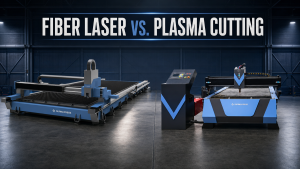
Shops comparing fiber laser vs plasma cutting — or searching the broader question of laser cutting vs plasma cutting — are usually trying to solve one of two problems: a part isn't coming out right on the current machine, or it's time to buy new cutting capacity. Either way, the answer isn't "laser is better" or "plasma is better." It's which process matches your material thickness, tolerance requirements, and production volume — and whether your current machine configuration can actually deliver what the job needs.
This guide walks through how each process works, where they typically diverge in performance and cost, and how to turn that comparison into a decision you can defend to a purchasing committee or a customer asking why a part costs what it does.
For manufacturers already leaning toward laser technology, selecting the right system takes more than comparing laser power on a spec sheet. Cutting thickness, material type, production volume, and automation requirements all shape real-world performance — points covered in detail below before you look at fiber laser cutting machines for your own production line.
1. Fiber Laser vs. CNC Plasma: The Short Answer
Fiber laser cutting tends to win on thin-to-mid gauge sheet, fine features, and edge quality. CNC plasma tends to win on thick plate, lower capital outlay, and tolerance to dirty or coated material. Where your parts actually fall between those tendencies depends on machine power, cut quality target, and the mix of work on your floor — not a single thickness number that applies to every shop.
The table below summarizes general tendencies reported across equipment manufacturers and fabricators. Treat it as a starting point for your own evaluation, not a spec sheet for a specific machine.
| Factor | Fiber Laser | CNC Plasma |
|---|---|---|
| Typical sweet spot | Thin sheet to mid-gauge plate | Mid-gauge to thick plate |
| Cut accuracy | Tighter tolerances, narrower kerf | Looser tolerances, wider kerf |
| Edge finish | Generally smoother, less dross | May need grinding or deburring |
| Heat-affected zone | Smaller | Larger |
| Upfront investment | Higher | Generally lower |
| Material surface tolerance | Prefers clean, consistent stock | More forgiving of rust, mill scale, coatings |
| Common strength | Fine detail, repeatable precision parts | Thick plate, bevels, high-volume heavy fabrication |
Both processes cut electrically conductive metals — mild steel, stainless steel, aluminum, and more — so material type alone rarely settles the decision. Thickness, required tolerance, and total job cost usually do.
2. How the Two Cutting Processes Work
Fiber laser cutting generates a laser beam through doped optical fiber, then focuses that beam through a cutting head onto the workpiece. The concentrated energy melts or vaporizes the metal along the cut path, while an assist gas — typically oxygen, nitrogen, or compressed air — blows the molten material out of the kerf. Because the beam is tightly focused, the heat input stays localized, which is why fiber laser cuts tend to show narrow kerfs and minimal distortion.
CNC plasma cutting works differently. An electric arc passes through a gas — oxygen, nitrogen, or an argon-hydrogen blend, depending on the system — and ionizes it into plasma at extremely high temperature. That plasma jet melts the metal and blows it away through the cut. Plasma needs an electrically conductive workpiece to complete the circuit, which is why it cuts steel, stainless, and aluminum but not non-metallic materials.
Both processes are commonly paired with CNC motion control and nesting software, so automation and programming aren't differentiators on their own. The real performance gap comes from how each process concentrates and delivers energy to the material — a narrow, intense beam versus a broader, high-velocity ionized jet.
3. Compare Performance on the Factors That Affect Your Parts
Generic claims about "laser is faster" or "plasma is cheaper" break down once you look at a specific part. The comparison is more useful when you separate it into the variables that actually show up on a drawing or a quote.
3.1 Thickness and Cutting Speed
Fiber laser is typically fastest and most efficient on thin-to-mid gauge sheet, where it can outpace plasma by a wide margin. As material gets thicker, that speed advantage narrows. The American Welding Society's own cutting-process comparisons place the operating-cost crossover for mild steel somewhere around 12–25 mm (roughly 1/2 to 1 inch), with plasma typically taking the lead above that range on standard-power laser sources.
| Mild Steel Thickness | Fiber Laser Cutting | CNC Plasma Cutting |
|---|---|---|
| Under 6 mm | Generally faster, with finer detail capability | Suitable for less demanding tolerances |
| 6–12 mm | Often holds a speed and precision advantage | Effective for less precision-critical parts |
| 12–20 mm | Performance depends heavily on laser power | Increasingly competitive on cutting speed |
| Above 20 mm | Needs high-power equipment to stay competitive | Often more economical for heavy plate |
These ranges are general selection guidelines, not fixed crossover points. Actual cutting speed and cost depend on laser power, plasma amperage, material grade, assist gas, and the edge quality you require. Request cutting tests on your own material and thickness before comparing specific machines.
High-power fiber lasers (40 kW and above) can extend the laser's practical cutting range further into plate territory. That doesn't automatically mean better productivity or lower operating cost at that power level — duty cycle, heat input, gas consumption, and machine cost all increase along with power, so the comparison still needs to be made on cutting speed, edge quality, and total operating cost rather than wattage alone.
The practical takeaway: the "crossover thickness" isn't fixed. It shifts with laser power, plasma amperage, material type, and the cut quality you're willing to accept. Don't rely on a single number from a brochure — ask for cut speed data at your actual thickness and material grade.
3.2 Accuracy, Tolerance, and Edge Quality
Fiber laser generally holds tighter positional accuracy and produces a smaller kerf, which helps with nesting efficiency and fine features like small holes, narrow slots, or tight-radius contours. Modern high-definition plasma systems have closed much of that gap on cut quality — the American Welding Society references the ISO 9013 standard for grading thermal-cut edges by angularity, with fiber laser typically achieving Classes 1–2 and high-definition plasma typically achieving Classes 2–4.
| Quality Factor | Fiber Laser | High-Definition Plasma |
|---|---|---|
| Cutting precision | Generally higher | Lower than laser in most applications |
| Kerf width | Narrower | Wider |
| Edge angularity | Typically better | Improved with modern HD systems |
| Small holes and fine detail | Better suited | More limited |
| Edge finishing needed | Often less, on thin material | Depends on thickness and cut settings |
| ISO 9013 performance | Commonly Classes 1–2 | Commonly Classes 2–4 |
ISO 9013 classifications are useful for comparing thermal-cut edge quality, but they are not a stand-in for every dimensional or positional tolerance on a drawing — the standard specifically classifies cut-edge angularity and surface roughness. High-definition plasma can produce weld-ready edges for many fabrication applications, so fiber laser shouldn't be assumed necessary for every job just because it's labeled "precision" work.
High-definition plasma gets there through torch design, controlled gas delivery, and tuned cutting parameters rather than a fundamentally different process. Compared with conventional plasma, HD plasma produces cleaner cuts and less secondary finishing — but fiber laser still has the edge on very fine detail, narrow kerfs, and the tightest dimensional control.
Edge finish differences matter most when the part goes straight into assembly or welding without secondary work. A rougher edge or wider heat-affected zone isn't a defect if the drawing tolerance allows for it — it only becomes a cost problem when the part needs a tighter fit than the process can reliably deliver.
3.3 Heat-Affected Zone and Material Utilization
A smaller heat-affected zone (HAZ) means less distortion and better dimensional stability, which is why fiber laser is common on parts that get welded, press-braked, or assembled with other precision components. Plasma's wider HAZ and kerf can affect how tightly parts nest on a sheet, which has a small but real effect on material yield over a production run.
3.4 Secondary Operations
This is where total part cost often diverges more than the cutting step itself. Count what happens after the part comes off the table:
- Deburring or grinding — more likely with plasma-cut edges, especially on thicker material cut with conventional (non-HD) systems.
- Drilling bolt holes — some plasma systems can produce bolt-ready holes directly; otherwise this becomes a separate operation on either process.
- Beveling for welding — mature on dedicated plasma bevel heads; available on some laser systems but not universal.
- Straightening or stress relief — more relevant where HAZ or distortion affects downstream fit-up.
Modern high-definition plasma systems can produce clean, weld-ready edges in many applications, particularly on medium and thick plate. How much secondary finishing a part actually needs depends on material thickness, cutting parameters, and the required edge quality — not on which process name is on the machine.
A part that looks cheaper to cut on paper can end up costing more once these steps are added. Sheet metal finishing services can absorb some of that gap, but it's still a cost that belongs in the comparison.
4. Material, Surface Condition, and Part Geometry
Both processes handle the common structural and fabrication metals, but surface condition and geometry change how well each one performs in practice.
- Surface condition: Plasma is more forgiving of rust, mill scale, paint, and uneven thickness because the arc doesn't depend on a clean, consistent surface to initiate the cut efficiently. Laser cutting generally performs best on clean, properly stored stock; scale and coatings can slow the cut and affect edge quality.
- Reflective metals: Highly reflective materials like bare copper and brass are historically harder for lasers to cut reliably without sufficient power, while plasma handles them without that limitation.
- Fine features: Small holes, narrow slots, and tight-radius contours favor fiber laser's narrower kerf and tighter positioning accuracy.
- Bevels and bolt-ready holes: Plasma systems built for plate fabrication often include dedicated processes for these features, reducing or eliminating a separate drilling or beveling step.
If your incoming material regularly arrives dirty, painted, or inconsistently stocked, that alone can be a stronger argument for plasma than the thickness chart suggests — cleaning or prepping stock for laser cutting is its own line-item cost.
5. Compare the Real Cost per Finished Part
Purchase price is the easiest number to compare and the least useful one on its own. A plasma table typically costs less upfront than a comparable fiber laser system, sometimes by a wide margin, but that gap doesn't automatically translate into a lower cost per part.
Build the comparison around these cost drivers instead:
- Capital cost and depreciation — the purchase price, financing terms, and how depreciation affects your income statement over the equipment's useful life.
- Energy consumption — plasma arcs and fiber lasers draw power differently; high utilization changes how much this matters.
- Consumables — plasma electrodes, nozzles, and shields wear with every pierce and need regular replacement; laser consumables (nozzles, protective windows, assist gas) wear more slowly but aren't free.
- Labor and finishing — grinding, deburring, or drilling time that one process needs more than the other for a given part.
- Scrap and rework — parts that miss tolerance or have unacceptable edge quality cost more than the material itself.
- Machine utilization — a high-capital laser running at low utilization is hard to justify; the same machine running near capacity can pay back faster than the sticker price suggests.
| Cost Factor | Fiber Laser | CNC Plasma |
|---|---|---|
| Initial investment | Generally higher | Generally lower |
| Electricity consumption | Depends on laser power and utilization | Depends on plasma power and cutting load |
| Consumables | Nozzles, protective windows, assist gas | Electrodes, nozzles, shields, gases |
| Maintenance | Optical components and cutting-head upkeep | Torch and consumable maintenance |
| Post-processing | Often lower on thin precision parts | May need more finishing depending on cut quality |
| Typical cost advantage | High-volume thin-sheet production | Thick-plate fabrication |
The lowest machine purchase price doesn't necessarily mean the lowest cost per finished part. Plasma can offer a lower total cutting cost for many thick-plate applications, largely due to lower equipment investment and competitive productivity at that thickness — but actual operating cost still depends on power consumption, gas usage, consumables, labor, and machine utilization, not on equipment price alone.
A useful exercise is pulling your five or six most common parts and pricing each cost driver separately for both processes, rather than comparing a single blended hourly rate. Metal fabrication cost estimating tools can help structure that comparison, but the inputs — your actual parts, your actual volumes — are what make the output meaningful.
6. Machine Safety and Facility Requirements
Cutting technology choice isn't just a performance and cost question — it also affects what your shop floor needs to look like day one.
6.1 Laser Safety and Enclosure Requirements
Fiber laser systems operate at power levels and wavelengths that require enclosed work envelopes, interlocked access panels, and beam containment to protect operators from direct and reflected exposure. Most industrial systems are sold as enclosed cutting cells for this reason, and the enclosure is a fixed cost that adds to the initial investment. Exact requirements depend on the machine's laser class and your local safety regulations — confirm them with the equipment manufacturer rather than assuming a generic enclosure spec.
6.2 Plasma Cutting Ventilation and Fume Extraction
Plasma cutting generates metal fume, particulate, and UV radiation from the arc, so adequate ventilation or a downdraft/water table extraction system is a standard requirement rather than an optional add-on. Shops running plasma need to plan for fume capture and filtration regardless of material thickness, since the arc produces fume on both thin and thick plate.
6.3 Material Handling and Workspace
Both processes need a stable, properly supported table and a plan for loading and unloading sheet or plate safely. Fiber laser cells are often sized around automated load/unload and sheet-handling systems that match their throughput; plasma tables can scale up by lengthening the cutting bed rather than adding automation, which keeps facility requirements simpler for shops without automated material handling. Neither process inherently needs more floor space — the actual footprint depends on the specific machine, automation package, and material flow you design around it.
7. Which Process Fits Your Production Profile?
Fiber laser tends to fit shops that:
- Run mostly thin-to-mid gauge sheet metal.
- Need tight tolerances, clean edges, or minimal post-processing.
- Produce repeatable parts with fine features — brackets, enclosures, panels, precision components.
- Have enough volume to justify the higher capital cost through utilization.
CNC plasma tends to fit shops that:
- Cut mostly mid-to-thick plate — structural steel, heavy equipment components, trailer frames.
- Need bevels or bolt-ready holes as part of the cutting step.
- Work with material that arrives rusty, painted, or inconsistently stocked.
- Want to enter cutting capability with a lower initial investment.
A dual-process setup often makes sense when:
- Your part mix genuinely spans thin sheet and heavy plate.
- You currently outsource one category of parts because your single machine can't handle it efficiently.
- Welders are spending significant time hand-grinding bevels that a dedicated plasma bevel head could produce directly.
Industry examples — automotive and electronics leaning toward laser, shipbuilding and structural fabrication leaning toward plasma — are useful as a sanity check, not a substitute for looking at your own drawings. Fiber laser cutting systems come in configurations that shift these tendencies, so match the machine spec to the job, not just the category.
8. A Practical Checklist for Choosing or Specifying a System
Before committing to either process — or a specific machine — work through these steps with real production data rather than vendor brochures:
- Pull a representative sample of jobs, at least six months to a year, and group them by material, thickness, tolerance, and volume.
- Flag the parts that are hardest to produce today — tight-tolerance features, bevels, bolt-ready holes, or anything requiring significant secondary finishing.
- Check your facility readiness: floor space, electrical service, gas supply, fume extraction, and material handling equipment.
- Request cut samples and cycle times from vendors using your own drawings and material, not standard demo parts.
- Confirm consumable availability and service response time in your region — a machine that's down for two weeks waiting on a part costs more than its hourly rate suggests.
- Document the acceptance criteria for each part type — the tolerance and edge finish that actually need to be met, not a generic "best possible" standard.
This process takes longer than reading a comparison chart, but it's the difference between buying equipment that matches last year's brochure claims and buying equipment that matches this year's parts.
9. Frequently Asked Questions
Q1: Is fiber laser always more accurate than plasma?
Answer: Generally yes, fiber laser holds tighter tolerances and a narrower kerf. But high-definition plasma systems have narrowed that gap substantially on thinner material, so the practical difference depends on the specific machines being compared.
Q2: What is the maximum thickness a fiber laser can cut compared with plasma?
Answer: Standard-power fiber lasers are most efficient up to roughly 20–25 mm on mild steel, while plasma systems routinely handle much thicker plate. High-power fiber lasers (40 kW and above) extend that range further, but at a significant jump in machine cost and gas/electricity use — so "maximum thickness" is really a question of what power level you're willing to buy.
Q3: Can both processes cut stainless steel and aluminum?
Answer: Yes. Both handle common conductive metals, though fiber laser typically produces cleaner edges on thinner stainless and aluminum, while plasma remains effective on thicker sections of the same materials.
Q4: Which process costs less to run?
Answer: It depends on thickness and utilization. Fiber laser often has lower operating cost on thin material cut at high volume; plasma often costs less per cut on thick plate, driven by a combination of equipment cost, power consumption, gas usage, and consumables rather than any single factor.
Q5: Does a shop ever need both technologies?
Answer: Often, yes — particularly shops with a part mix spanning precision sheet and heavy structural plate. Running both lets each process handle the work it's best suited for instead of forcing one machine to cover the whole range.
Q6: Is a fiber laser cutting machine worth the investment for a small fabrication shop?
Answer: It depends on five factors: initial equipment cost, monthly cutting volume, the material and thickness you cut most, your tolerance and finishing requirements, and how fully you expect to utilize the machine. A shop running thin precision parts at steady volume typically recovers the investment faster than one with occasional, mixed-thickness work.
10. Make the Decision Using Your Own Part Mix
Neither fiber laser nor CNC plasma cutting is the universally correct choice — each one matches a different combination of thickness, tolerance, and production volume. The shops that get the most value from either technology are the ones that match machine capability to their actual parts instead of a brochure comparison.
If your part mix sits near the crossover zone, the most reliable next step is a drawing-based review: send representative parts to a few vendors or fabrication partners, request real cut samples and cycle times, and compare the total cost — not just the machine price — before deciding.
Looking for a fiber laser cutting solution for your production needs? Contact DURMAPRESS to discuss your material requirements, cutting capacity, and machine configuration.