How to Choose Hydraulic Oil for Press Brakes: ISO VG 32, 46 or 68?
- Conhecimento, Notícias
- 110+ reading now
Durmapress specializes in designing, manufacturing, and selling various metal processing equipment, including bending machines, shears, punches, and laser cutting machines. The company was founded in 2014, with years of experience and technology accumulation. DurmaPress has become one of the well-known brands in China's metal processing machinery industry.


A press brake is often the most important machine in a sheet-metal workshop. It forms sharp, accurate bends in seconds, but only if the hydraulic oil inside it is correct. Oil is not a commodity; it is the machine’s blood, lubricant, coolant and seal protector., its lubricant, its coolant and its sealant. Choose the wrong grade and the ram will creep, the pump will whine, the seals will leak and the repair bill will arrive sooner than expected. This article explains, in plain language, how to pick the right oil for any press brake, anywhere in the world, this guide explains how to choose press brake hydraulic oil based on tank temperature, pump requirements, ISO viscosity grade, oil class, seal compatibility and maintenance conditions.
For a complete maintenance routine covering cleaning, lubrication, inspection and scheduled service, see our guide to [press brake maintenance].
For many industrial press brakes, an OEM-approved ISO VG 46 anti-wear hydraulic oil is a common starting point. However, the final choice between ISO VG 32, 46 and 68 should be based on actual tank temperature, pump viscosity limits and the press brake manufacturer’s recommendation.
Note: This guide focuses on hydraulic oil selection for press brakes. It is not intended for hydraulic presses, gearboxes, compressors, power steering systems or other unrelated hydraulic equipment. Always follow the press brake manufacturer’s oil specification first.
For many industrial press brakes, ISO VG 46 anti-wear hydraulic oil is the common starting point. ISO VG 32 or ISO VG 68 should only be selected after checking tank temperature, pump viscosity limits and OEM approval.
| ISO Grade | When It May Be Suitable | Main Advantage | Important Check |
|---|---|---|---|
| ISO VG 32 | Lower tank temperature, easier cold start, faster response | Better low-temperature flow | Check pump minimum viscosity and internal leakage risk |
| ISO VG 46 | Normal industrial press brake operation | Balanced flow, lubrication and sealing | Confirm tank temperature and OEM approval |
| ISO VG 68 | Higher tank temperature, heavier load or slower-duty operation | Thicker lubricating film | Check cold-start viscosity and pump suction limits |
ISO VG 32, ISO VG 46 and ISO VG 68 describe viscosity, not the complete quality or additive package of a hydraulic oil. The correct grade depends on the oil temperature inside the tank, the pump’s approved viscosity range and the machine manufacturer’s recommendation.
ISO VG 32 is generally considered when lower temperatures, easier cold starting or faster hydraulic response is important. However, an oil that is too thin can increase internal leakage and reduce the lubricating film between moving parts.
ISO VG 46 is the common starting grade for many industrial press brakes operating in a normal workshop environment. It offers a practical balance between flow, lubrication and sealing, provided that it is approved for the pump and the machine.
ISO VG 68 may be suitable for higher tank temperatures, heavier loads or slower-duty applications where a thicker lubricating film is useful. It can also increase suction resistance during cold starts, so the minimum startup temperature and pump limits must be checked before changing from VG 46 to VG 68.
Do not select VG 32, VG 46 or VG 68 by number alone. Confirm the required anti-wear class, pump type, operating temperature, seal compatibility and OEM approval before filling the reservoir.
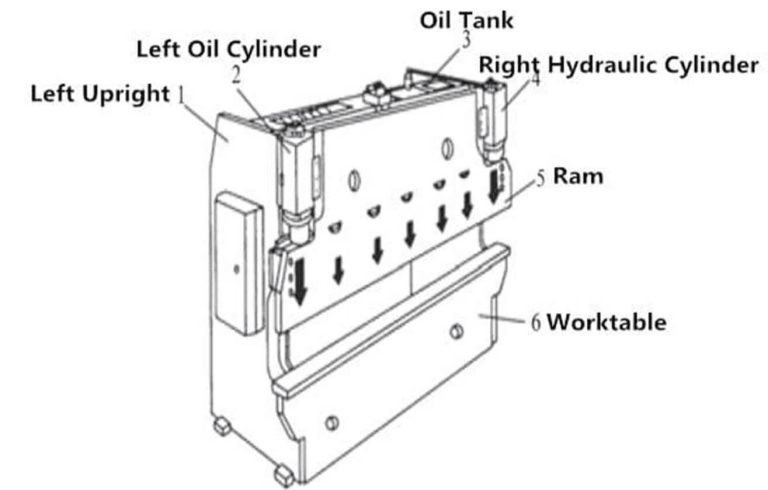
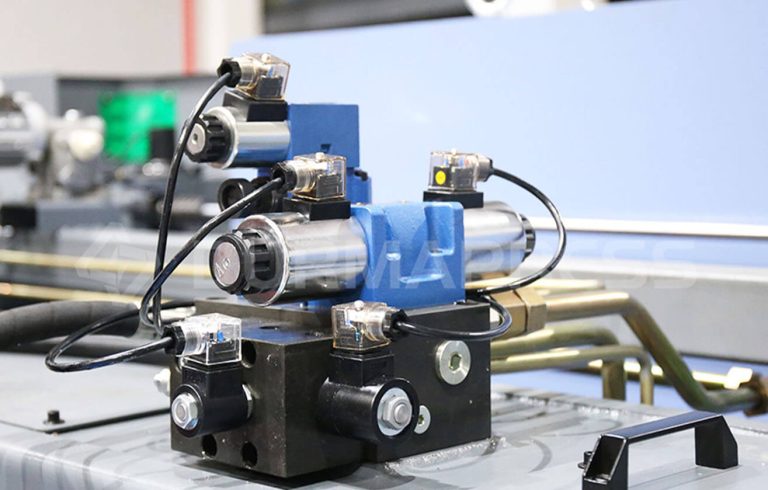
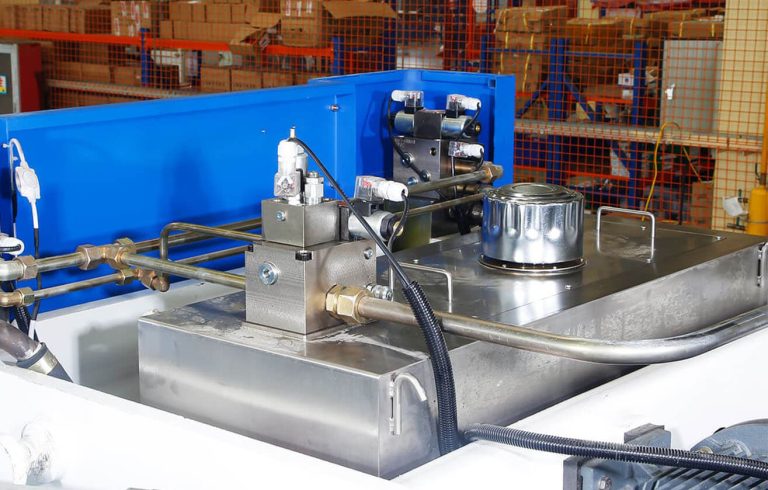
The electric motor drives a gear or piston pump. The pump converts mechanical energy into hydraulic energy. Oil must carry this energy, at 20 - 30 MPa (3000 - 4500 psi), through hoses and valves to the cylinders that move the ram. If the oil is too thin, internal leakage drops the ram speed and the bend angle becomes inconsistent. If the oil is too thick, the pump cavitates and the electric overload relay trips.
Piston slippers, gear teeth, spool valves and rod seals operate on oil films only a few micrometres thick. Anti-wear additives form sacrificial layers that prevent metal-to-metal contact. Without sufficient anti-wear protection, pumps and other hydraulic components can wear much faster.
During the press cycle, especially during pressure holding, almost all input energy becomes heat. Oil carries the heat back to the reservoir where it is dissipated through the walls or through an external cooler. Oil with a high viscosity index (VI) keeps the same thickness whether the tank is cold at start-up or hot after a long run.
Oil must keep O-rings and lip seals supple, and it must prevent rust on cast-iron valve bodies, bronze bearings and chrome-plated rods. Some low-cost oils contain active sulphur that attacks yellow metals; some biodegradable esters attack standard nitrile rubber. Matching the oil chemistry to the elastomer chart in the machine manual is critical.
Entrained air reduces bulk modulus—ram speed becomes “spongy”. Entrained air can create noise, unstable ram movement and reduced hydraulic control consistency. Good hydraulic oils should release entrained air quickly and resist persistent foaming.

| ISO Grade | When It May Be Suitable | Main Advantage | Important Check |
|---|---|---|---|
| ISO VG 32 | Lower tank temperature, easier cold start, faster response | Better low-temperature flow | Check pump minimum viscosity and internal leakage risk |
| ISO VG 46 | Normal industrial press brake operation | Balanced flow, lubrication and sealing | Confirm tank temperature and OEM approval |
| ISO VG 68 | Higher tank temperature, heavier load or slower-duty operation | Thicker lubricating film | Check cold-start viscosity and pump suction limits |
Mineral HM anti-wear oil (ISO 11158, DIN 51524-2)
Base stock: paraffinic or naphthenic
Zinc dialkyl-dithiophosphate (ZDDP) anti-wear package
Typical drain interval: 2000-3000h
Cost benchmark: low
Suitable for: single-shift shops, ambient 10-70°C, fixed displacement pumps
Mineral HV or multigrade oil (DIN 51524-3)
High VI (≥140), pour-point ≤-30°C
Good for outdoor containers or unheated buildings
Drain interval: 3000 - 4000h
Cost: +10 % over HM
Semi-synthetic HG oil
Mineral oil + synthetic ester
Friction modifier added for “stick-slip” suppression
Preferred for CNC crowning systems with proportional valves
Drain interval: 4000–5000 h
Cost: +40 %
The relationship between hydraulic oil, proportional valves and bending accuracy is also explained in our guide to [CNC press brake systems].
Fully synthetic PAO or ester
VI ≥160, oxidation life five times mineral oil
Operates 90-110°C continuously
Drain interval: 8000–10000 h
Cost: double mineral oil, but life-cycle cost lower when machine utilisation is high
Biodegradable synthetic ester
28-day biodegradation >60 % (OECD 301)
For food, river-front, offshore or military applications where spill fines are high
Cost: triple mineral oil
Seal compatibility must be checked (FKM recommended)
Fire-resistant fluids
Water-glycol (HFC) or polyol ester (HFDU)
Only needed when the press brake shares a power pack with furnaces or when local insurance mandates a fire-resistant fluid
Lubricity lower; pump rated pressure must be de-rated 15-20 %
The letters on a hydraulic-oil label describe more than viscosity. They indicate the type of protection or performance the formulation is designed to provide.
| Oil class | Main property | Typical press-brake application | Main caution |
|---|---|---|---|
| HL | Rust and oxidation protection | Light-load or lower-pressure systems | Not the default choice for high-pressure pumps |
| HM | Anti-wear protection | Common industrial hydraulic systems | Confirm pressure, pump and additive requirements |
| HV | Higher viscosity index | Wide temperature swings or cold-start conditions | Check shear stability and OEM approval |
| HG | Anti-stick-slip or friction-control properties | Precision proportional systems or shared sliding surfaces | Use only when the system requires or approves it |
For most press-brake applications, the decision is not simply “Which oil is thicker?” It is “Which viscosity grade and performance class are approved for this pump, pressure range and temperature range?”
For most press brakes, HM 46 or OEM-approved HV 46 is a more common starting point than HL oil, especially when the hydraulic system operates at medium or high pressure.
Start with the actual oil tank temperature, not the room temperature. The same workshop may have very different oil temperatures depending on duty cycle, cooling condition and production load.
<40°C: ISO VG 32
40-70°C: ISO VG 46
>70°C: ISO VG 68 or HV 46 synthetic
If the machine starts below -20°C, use HV 32 or PAO 32 to avoid pump cavitation. If it runs three shifts in a hot factory, use HV 68 or synthetic 46. Gear pumps tolerate a wider viscosity range than piston pumps; most press brakes use gear pumps, so VG 46 is the universal starting point.
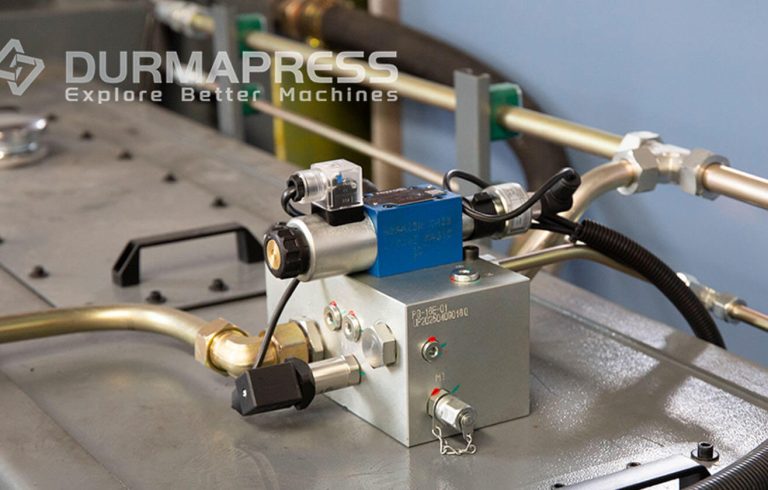
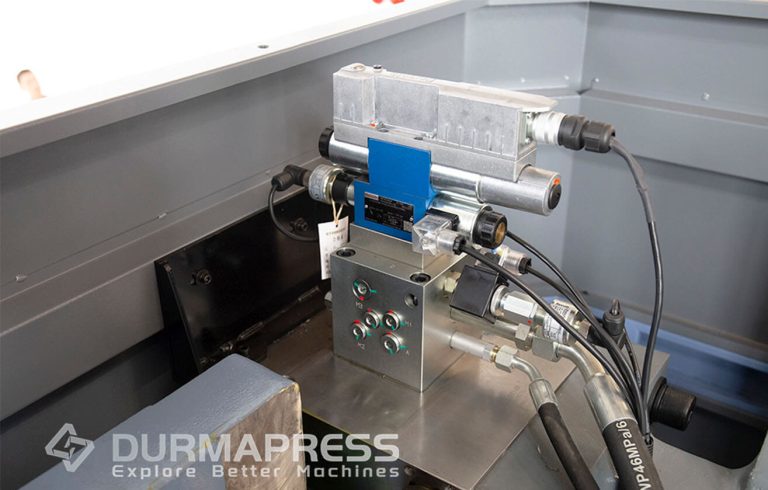
For system pressure above 14 MPa (2000 psi) always specify HM, HV or HG. Do not use HL (R&O only) oils; they lack anti-wear additives and will shorten pump life by 50 %. If the machine has servo-proportional valves, choose HG to obtain the lowest static friction coefficient.Stable hydraulic control is especially important when the machine is used for precision bending, automatic crowning or complex [press brake tooling] applications.
The hydraulic pump is one of the most important factors in oil selection. Gear pumps, vane pumps, axial-piston pumps and radial-piston pumps can have different viscosity, anti-wear and cleanliness requirements. A fluid that works in one press brake should not automatically be transferred to another machine without checking the pump manual.
As a general starting point, low-pressure systems may use an HL fluid when the manufacturer permits it, while medium- and high-pressure pumps normally require an anti-wear formulation such as HM or HV. Systems with proportional valves or sliding surfaces may require an HG formulation when the OEM specifies anti-stick-slip performance.
| Pump or system condition | Possible oil direction | What to verify |
|---|---|---|
| Low-pressure gear or vane pump | HL or OEM-approved HM | Pressure, temperature and minimum viscosity |
| Medium- or high-pressure pump | HM or HV | Anti-wear class and pump approval |
| Axial- or radial-piston pump | OEM-approved HM, HV or another specified class | Pressure, cleanliness and viscosity limits |
| Proportional valves or shared sliding surfaces | HG when specified by the OEM | Friction behavior and seal compatibility |
This table should not replace the equipment manual. The pump manufacturer’s specification takes priority over a general oil-class recommendation.
Mineral HM oils oxidise twice as fast for every 10°C above 70°C. If your tank normally runs 80°C, a synthetic HV or HG will pay for itself in the first year by doubling oil life and halving filter changes. Conversely, if starting below -25°C, a mineral 46 oil will be thicker than 1 000 cSt and the electric motor will not start; use HV 32 or PAO 32.
A high oil temperature is not always caused by the oil itself. It can also indicate a cooling, pressure, flow or component problem. Before changing to a thicker or more expensive fluid, check the complete hydraulic circuit.
Common causes include:
| Possible cause | Typical sign | First check |
|---|---|---|
| Dirty cooler | Temperature rises during long production cycles | Cooler and radiator surfaces |
| Incorrect viscosity | Hard startup or excessive internal leakage | Oil grade and tank temperature |
| Excessive pressure | High power consumption and heat | Relief-valve setting and pressure gauge |
| Pump starvation | Noise, vibration or foaming | Oil level, suction line and strainer |
| Internal leakage | Slow ram movement or pressure loss | Pump, valve and cylinder leakage |
If the oil temperature remains high after the basic checks, test the oil and inspect the hydraulic components rather than treating the problem as a simple oil-grade issue.
Standard nitrile (NBR) seals are compatible with mineral oils, PAO and most esters. FKM (Viton) seals are required for phosphate ester or for continuous >100°C. Polyurethane seals dislike water and high acid numbers; keep AN <0.2 mg KOH/g. Check the machine manual for warnings such as“zinc-free oil required”; some silver-plated valve parts suffer galvanic corrosion with ZDDP.
Mineral HM 46 is cheapest if the machine runs one shift and oil disposal cost is low. Synthetic HG 46 costs twice as much but lasts four times longer and reduces unscheduled downtime; it is cheaper overall when machine utilisation exceeds two shifts. Biodegradable oil avoids environmental fines where leakage could reach water courses. Fire-resistant fluid is mandatory when local fire codes say so; factor in the 20 % pump de-rating when you size the system.
ISO VG 32 and ISO VG 46 are viscosity grades, not complete fluid specifications. Mixing them does not create a guaranteed standard oil grade, and the final viscosity and performance depend on the base oils, additive packages and mixing ratio.
A small top-up should be made only when the replacement fluid is confirmed compatible with the oil already in the system. Do not assume that two products are compatible because both are labelled 32 or 46. Mineral oil, synthetic oil, water-glycol fluid, phosphate ester and biodegradable ester fluids should not be mixed unless the equipment manufacturer and lubricant supplier specifically approve the combination.
If the oil history is unknown, take a sample before topping up. When incompatible fluids have already been mixed, the safer correction may require draining, flushing, replacing the filters and refilling with one approved fluid rather than repeatedly adding more oil.
Mistake 1: Draining the factory-fill “expensive” synthetic oil and replacing it with low-cost mineral oil. Result: servo valves corrode in 500 h, bending accuracy drops, customer blames the machine.
Mistake 2: Using transformer oil because “it is also 32 cSt”. Transformer oil has no anti-wear additives; the pump score marks appear within a week.
Mistake 3: Buying “re-refined” oil with acid number 0.5 mg KOH/g. The acidic oil attacks bronze swing bearings and black sludge blocks the return filter.
Mistake 4: Mixing water-glycol and mineral oil in a shared tank. The mixture emulsifies, viscosity rises to 200 cSt, and the ram stalls.
Mistake 5: Changing only the oil in the tank, leaving 30 % old oil in the cylinders. The new oil’s additive package is instantly depleted by the acidic residue.
Mistake 6: Installing a high-pressure filter rated 6000 psi but forgetting the return filter; dirt particles circulate at high speed and valve lap marks appear.
Mistake 7: Adding an aftermarket “anti-wear booster” containing chlorinated paraffins. The chlorine forms hydrochloric acid with any moisture and destroys the copper cooler tubes.
Mistake 8: Using a zinc-containing HM oil in a system that specifies zinc-free. Silver-plated servo valve spools turn black and stick.
Mistake 9: Choosing biodegradable ester and forgetting to upgrade seals from NBR to FKM; the seals swell and block the valve ports within days.
Mistake 10: Deciding the change interval by calendar time only. After 2000 h at 90°C the oil is already beyond salvation, while another machine running 40°C could safely reach 5000 h.
Preparation: Buy new oil one week ahead and send a sample for analysis to confirm viscosity, acid number, water and particle count (ISO 4406). Have new suction, return and air breather filters ready. Bring a vacuum filter cart rated β10 ≥ 200.
Draining: Operate the machine until the oil reaches 50°C. Move the ram to the bottom dead centre so cylinders are fully collapsed. Open the drain valve and remove the drain plug in each cylinder head. Use a vacuum wand to suck oil from the reservoir corners. Allow at least 10 min to drain completely.
Flushing: Fill with new oil to 50 % normal level. Run the pump for 5 min with the relief valve de-pressurised to create turbulent flow. Drain again. If the old oil was heavily oxidised, add 5% system cleaner, heat to 60°C and circulate 30 min, then drain.
Filter replacement: Replace all filters. Write the date on the filter canister with a paint pen.
Refill: Use the filter cart to pump new oil through a 10 µm filter into the tank. Never pour directly from the drum. Install the breather cap immediately.
Bleeding: Start the motor in jog mode. Crack the high-point vent screws on cylinders and manifolds until oil without bubbles appears. Cycle the ram slowly from top to bottom five times. Check the tank level after the oil has cooled; top up if necessary.
Test: Run the machine at maximum pressure for 5 min. Record temperature, noise level and holding pressure drop. Keep the oil analysis report in the service file.
Colour: clear honey → brown → black. Black with acid number >0.5 means change now.
Odour: sharp sour smell = oxidation; burnt smell = local overheating.
Viscosity finger test: at the same temperature, compare a fresh sample with the used oil on a metal plate; if the used oil runs noticeably faster or slower, investigate.
Foam shake test: 100 ml in a closed bottle, shake 30 s. Foam should disappear within 60 s. Persistent foam indicates antifoam depletion.
Blot test: one drop on filter paper. A dark centre with a clear halo means good dispersancy; a solid black spot means sludge is forming.
Water crackle: 10 ml in a test tube, heat with a lighter. Any crackling sound means >0.1 % water. A separate water layer means free water is present and the oil must be dehydrated or changed.
Assume a 200 L reservoir, three-shift operation, 6000 h per year.
Mineral HM 46: oil cost USD 3 per litre, life 2000 h, three changes = USD 1800 oil + 6h downtime×USD 200 = USD 3000 total.
Synthetic HV 46: oil cost USD 7 per litre, life 8000 h, one change = USD 1400 oil + 2h downtime×USD 200 = USD 1800 total.
Saving: USD 1200 per year, plus fewer filter elements, less waste oil disposal and lower component wear. The synthetic oil pays for itself in the first six months.If you are evaluating a press brake for continuous production, compare the machine’s pump design, duty cycle and hydraulic-system requirements in our [Prensa dobradeira CNC] range.
One litre of used oil can contaminate one million litres of ground water. Never pour into the soil or sewer. Collect in labelled drums and hand to a certified recycler. Biodegradable oil is not exempt; it still contains additives and must be re-refined or incinerated. Keep the disposal certificate for five years; environmental auditors may ask for it.
Longer-life oils: PAO/ester blends with antioxidant packages that last 15000 h are already in field trials. The target is “fill for life” matching the machine’s first major overhaul.
Greener fluids: ISO 6743-4 is preparing a new category “HEOG” for ester-based oils derived from waste cooking oil, cutting carbon footprint by 70 %.
Smart sensors: USD 200 particle counters and moisture probes now communicate by Bluetooth to a phone app. The app predicts remaining oil life and orders fresh oil automatically, eliminating guesswork.
Choosing hydraulic oil for a press brake is not complicated: match the viscosity to the operating temperature, pick the right anti-wear class, check seal compatibility and then balance price against total cost of ownership. Do that once, record it in the maintenance manual, and the machine will deliver accurate bends for a decade. Ignore it, and the first pump failure will cost more than all the oil you ever “saved”. Good oil is cheap insurance—keep it clean, keep it cool, and your press brake will never let you down.
There is no single best hydraulic oil for every press brake. For many industrial press brakes, an OEM-approved HM 46 oil is a practical starting point. HV oil may be more suitable when the machine faces large temperature swings or cold starts, while HM or HV 68 may be considered for higher tank temperatures or heavy-duty operation when the pump and manual support the higher viscosity. Always confirm the oil class, viscosity grade, seal compatibility and cleanliness requirements before filling the system.
Use the grade that keeps viscosity within the pump manufacturer’s approved operating range at the measured tank temperature. ISO VG 46 is a common starting point for many industrial press brakes. ISO VG 68 can be appropriate when operating temperature or duty requires a thicker film and cold-start viscosity remains within pump limits.
Start with the press brake and pump manuals. Confirm the required oil class, viscosity range, seal compatibility and cleanliness level. Then measure actual tank temperature during production and select an approved ISO VG grade that stays within the pump’s viscosity limits.
ISO VG 32 may improve cold-start flow where the manufacturer permits it. ISO VG 46 is commonly used when it provides the required balance of flow, lubrication and internal sealing at normal tank temperature. The correct choice depends on the pump’s viscosity limits, not on the number alone.
Mixing ISO VG 32 and ISO VG 46 does not create a guaranteed standard grade or prove compatibility. Final viscosity and performance depend on the blend ratio, base oils and additive systems. Only top up with fluid confirmed compatible by the equipment manufacturer or lubricant supplier.
ISO VG 46 identifies a kinematic-viscosity grade at 40°C; it does not by itself specify anti-wear protection, base-oil type or compatibility. An OEM-approved VG 46 anti-wear fluid is widely used in industrial hydraulic systems when it meets the pump’s viscosity and performance requirements.
Preencha as informações abaixo para receber um orçamento gratuito e uma brochura do produto. Responderemos dentro de 24 horas!