Press Brake Guide: Types, Working Principle, Tooling, Calculation, and Selection
- Conhecimento, Notícias
- 90+ reading now
Durmapress specializes in designing, manufacturing, and selling various metal processing equipment, including bending machines, shears, punches, and laser cutting machines. The company was founded in 2014, with years of experience and technology accumulation. DurmaPress has become one of the well-known brands in China's metal processing machinery industry.
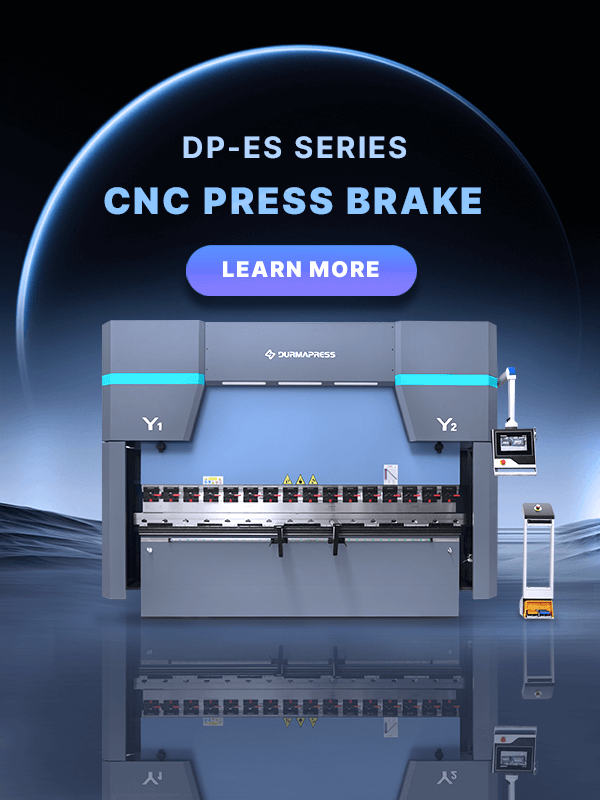
A travão de prensa is the machine that turns a flat sheet into a finished three-dimensional part — a bracket, an enclosure, a cabinet, a structural frame. It is one of the most versatile forming machines in any fabrication shop, and also one of the easiest to specify incorrectly. This guide covers what a press brake is, how it works, its types and key components, tooling and the bending process, how tonnage is calculated, how to select the right machine, where press brakes are used, and how to maintain one.
A press brake is a machine tool that bends sheet metal and plate along a straight line by pressing an upper tool — the punch — into a lower tool — the die. As the punch drives the material into the die opening, the metal is pushed past its elastic limit and takes on a permanent, controlled bend.
Its defining strength is flexibility: you can put several different bends into the same part on the same machine without rebuilding the setup, which is how one press brake produces everything from a simple 90° flange to a deep box or a complex multi-bend part. That sets it apart from its neighbours on the shop floor — stamping forms a part in one hit with a dedicated die, shearing only cuts material to size, and plate rolling makes curves rather than sharp angles. The press brake owns the middle ground: precise straight bends, produced flexibly, with fast tooling changes. It works across mild steel, stainless steel, aluminum, galvanized steel, and high-strength steel — each behaving differently under the punch.
Every bend follows the same five-step rhythm; only the drive that powers the stroke changes between machines.
The quality of the bend is not decided by the drive motor, but by four things together: backgauge accuracy, the control program, the chosen tonnage, and how the punch-and-die geometry is matched to the job.
Press brakes are classified by drive type — how the ram is powered. CNC is not a drive type but a control system, so it is treated separately below.
Hydraulic cylinders move the ram, making this the mature, general-purpose workhorse of the industry — strong, dependable, and comfortable with medium-to-thick plate and higher tonnages. The trade-offs are higher energy use and the routine care a hydraulic system needs.
Servo motors drive the ram instead of oil. Electric machines excel on thinner material, precision parts, and high-frequency, small-batch work — quieter, cleaner, more energy-efficient, and lower-maintenance. Their limit is raw force; the heaviest plate still calls for hydraulic.
A hybrid pairs a hydraulic power source with servo-electric control, keeping hydraulic force while capturing much of the efficiency, quietness, and positioning precision of electric drive. It suits shops that want high tonnage without hydraulic-level running costs.
The original design, driven by a flywheel and clutch. Mechanical machines are simple and can deliver high force, but offer poor control over ram speed and lower bending accuracy, so they have largely been displaced by hydraulic and electric machines in modern shops.
CNC is not a drive type — it is a control-and-programming layer that sits on top of a hydraulic, electric, or hybrid machine. It adds multi-axis backgauge positioning, stored part programs, angle control, and the ability to reproduce a complex multi-bend part identically across an entire run. CNC control is now the standard wherever precision and repeatability matter.
A press brake's accuracy comes from how its core components work together. The main ones are:
Supporting parts round out the machine: the bed/workbench holds the die (and often a crowning system to counter deflection), the clamping system secures tooling, and optional sheet supports/followers hold up large or heavy blanks during the stroke.
The punch and die do the actual shaping — two machines with identical specs produce different parts if the tooling differs. The punch sets the internal bend angle, corner access, and forming style (straight, gooseneck, and acute-angle profiles reach geometry a standard punch cannot). The die, especially its V-opening, drives the inside radius, the tonnage required, and the surface finish; the V-opening is chosen in proportion to material thickness, and picking the wrong one is a leading cause of both excess tonnage and surface marking. Tool height, clamping style, and interface standard must all match the machine, since tooling from one standard is not interchangeable with another without an adapter.
For a deeper look at tooling selection, standards, and common configurations, explore our press brake tooling guide.
Press brake bending is the core process that transforms flat sheet metal into precise angles. The bending method selected — including air bending, bottoming, and coining — directly affects bending force, accuracy, springback, and tooling requirements. For a complete overview of press brake bending processes, methods, and accuracy factors, see our Press Brake Bending Guide.
Air bending is the everyday default. The punch presses the sheet only part way into the die, so the angle is set by ram depth, not die shape. One tool set can produce a wide range of angles just by changing depth, and force is the lowest of the three — but the angle is sensitive to thickness and springback variation, which modern CNC machines counter with in-process angle measurement.
Bottoming presses the sheet fully into the die so it conforms to the die walls; the angle is defined by die geometry, giving tighter, more repeatable angles and less springback. The cost is more force and less flexibility — each target angle needs its own die.
Coining presses hard enough to imprint the die shape into the metal and effectively eliminate springback, delivering the highest precision — but at very high force that wears tooling and frame far faster, so it is reserved for small, ultra-precise parts.
The principle: precision always costs something — force, tooling, or machine life. Air bending spends the least and suits most work; coining spends the most for the tightest tolerance.
Before choosing a machine or tool set, you need to estimate the bending force (tonnage) a job requires.For a detailed explanation of formulas, factors, and calculation methods, see our press brake tonnage calculation guide.
A widely used simplified formula for air bending is:
P = (650 × S² × L) / (1000 × V)
Bending 3 mm mild steel, 2 m long, in a 24 mm V-die (V ≈ 8 × thickness):
P = (650 × 3² × 2) / (1000 × 24) ≈ 24 tons for the full 2 m bend. Switch to 304 stainless and it rises to about 36 tons; go to 4 mm thickness and it jumps to roughly 43 tons, showing how sharply force climbs with thickness.
Most shops skip the arithmetic and read a tonnage chart: find the row for your material thickness and the column for your V-die opening, and the cell gives tons-per-metre — multiply by your bend length. The chart already bakes in the thickness-squared relationship and the standard V-die, so it is faster and less error-prone for daily work. Whichever method you use, size the machine with headroom above your typical worst case, but not so much that you pay for capacity you never use.
There is no single best press brake — only the right one for your parts and production pattern. Work through six questions, then match against the quick guide below.
When comparing specific machines, check these numbers side by side:
| Spec | Why it matters |
|---|---|
| Tonnage | Maximum bending force; must cover your thickest/longest bend |
| Comprimento de dobragem | Effective working length; must cover your longest part |
| Stroke | Ram travel; affects deep parts and multi-bend clearance |
| Daylight / open height | Vertical space for tooling and tall parts |
| Throat depth | How far in from the frame you can reach — governs deep-box work |
| CNC axes | Backgauge and beam axes; more axes = more complex parts automated |
Press brakes appear across almost every metal-working sector:
Wherever flat metal needs precise, repeatable straight bends — mass-produced or one-off — the press brake is the tool that does it.
A structured routine preserves accuracy, extends machine and tooling life, and prevents unplanned downtime. For a complete checklist covering inspection schedules, hydraulic care, tooling maintenance, and calibration procedures, see our press brake maintenance guide.
On safety, a few rules are non-negotiable: confirm tooling is clamped and loaded before every setup, never exceed rated capacity, use appropriate guarding, and plan support for long or heavy parts.
CNC control delivers excellent positioning and repeatability, but the final angle also depends on material consistency, tooling condition, springback, and setup — the control system is necessary, not sufficient, on its own.
With proper maintenance a quality press brake commonly serves for decades; tooling also lasts many years, though wear items like hydraulic oil, seals, and filters need periodic replacement.
Yes. Stainless requires more force than mild steel of the same thickness (roughly 1.5×) and springs back more, so tonnage and springback compensation must be set accordingly.
Material thickness and strength variation, springback, tool condition and V-die choice, backgauge positioning, bed/ram deflection (addressed by crowning), and operator setup all contribute.
learn more:Press Brake Bending Angle Inaccuracy: Causes, Fixes & Accuracy Tips & Standards
Hydraulic suits thicker plate and higher tonnage; electric suits thinner, precise, high-frequency work with lower energy use and maintenance.
Select it in proportion to material thickness (commonly 6–10× thickness); it drives the inside radius, required tonnage, and surface finish.
Preencha as informações abaixo para receber um orçamento gratuito e uma brochura do produto. Responderemos dentro de 24 horas!