



Press Brake Tonnage Chart: Formula, Calculator & Bending Force Guide
- Conhecimento, Notícias
- 90+ reading now
Sobre nós
Learn how to calculate press brake bending force using a tonnage formula and reference tonnage chart. Includes examples, material factors, and practical bending tips.



Contate-nos
Publicações recentes



Categorias
Siga-nos
Novo vídeo semanal
In sheet metal fabrication, accurately calculating the required press brake tonnage is essential for safe and efficient bending operations. If the bending force is too low, the material may not bend properly. If it is too high, the máquina de prensagem or tooling may be damaged.
Engineers and press brake operators typically rely on a press brake tonnage chart combined with a bending force formula to determine the correct machine capacity for a specific bending job.
This guide explains how tonnage works, how to calculate bending force, and how to use a tonnage chart in real manufacturing scenarios.This press brake tonnage chart provides bending force references for different material thicknesses, V-die openings, and bending lengths, helping operators quickly select the right machine capacity.
Press brake tonnage is one part of the complete press brake selection process. For a broader overview of press brake types, working principles, tooling, and machine selection, see our Press Brake Guide.

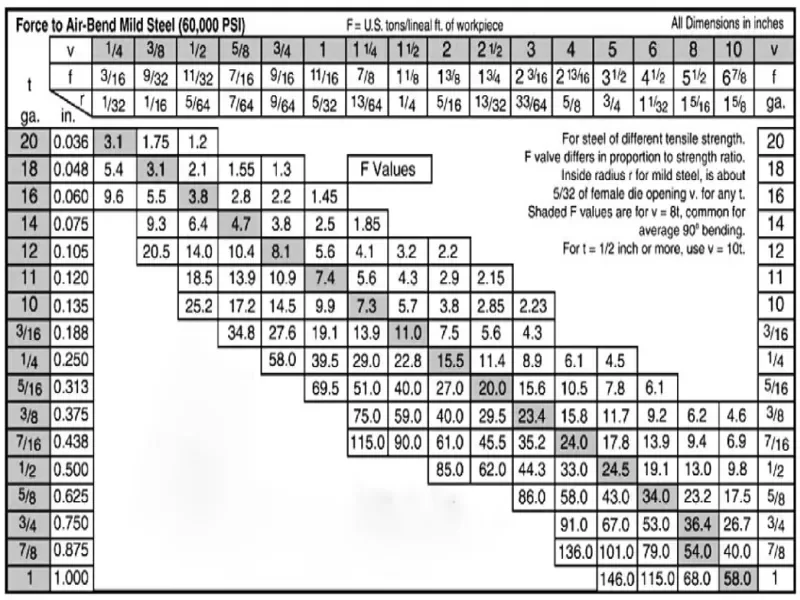
Imperial air-bending force chart: This chart is based on 60,000 PSI mild steel. Force values are given in U.S. tons per linear foot, and all dimensions are in inches. These values should not be compared directly with the metric tonnage table without converting both the force and bending-length units.
What Is Press Brake Tonnage?
Press brake tonnage refers to the amount of force required to bend sheet metal during the press brake forming process.
It is usually measured in:
- Tons
- Kilonewtons (kN)
The required tonnage depends on several factors, including:
- material type
- sheet thickness
- bending length
- die opening
For example, bending 3 mm mild steel requires significantly less force than bending 3 mm stainless steel, because stainless steel has higher tensile strength.
Understanding the correct tonnage requirement helps ensure:
- accurate bends
- longer machine life
- improved production efficiency
Why Tonnage Calculation Is Important
Calculating the correct bending force is critical for several reasons.
Preventing Machine Overload
Every press brake has a maximum tonnage capacity. Exceeding this limit can lead to:
- machine frame deformation
- tooling damage
- safety risks
Proper tonnage calculation prevents these problems.
Ensuring Accurate Bending
If the tonnage is insufficient, the metal may not fully form to the desired angle. This leads to:
- incomplete bends
- inconsistent angles
- increased scrap rate
Selecting the Right Press Brake
When purchasing a press brake, manufacturers must determine the required tonnage for their typical bending applications.
Common machine capacities include:
- 80T press brake
- 100T press brake
- 160T press brake
- 220T press brake
Choosing the correct capacity ensures stable long-term production.
Press Brake Tonnage Chart (Reference Table)
Below is a metric press brake tonnage chart for 90° air bending of mild steel with an assumed tensile strength of 450 MPa. The values show the approximate metric ton-force required per meter of bending length, using a V-die opening approximately eight times the material thickness.
| Thickness (mm) | V-Die Opening (mm) | Tonnage per Meter |
|---|---|---|
| 1 | 8 | 8.3 T |
| 1.5 | 12 | 12.4 T |
| 2 | 16 | 16.6 T |
| 2.5 | 20 | 20.7 T |
| 3 | 24 | 24.9 T |
| 4 | 32 | 33.1 T |
| 5 | 40 | 41.4 T |
| 6 | 48 | 49.7 T |
| 8 | 64 | 66.3 T |
| 10 | 80 | 82.9 T |
Important notes:
Values are based on mild steel with 450 MPa tensile strength
Stainless steel typically requires 1.5× more tonnage
Aluminum requires about 50% less force
Press brake operators often use this chart as a quick reference before calculating exact bending force.
These values are estimates based on standard air-bending conditions. Actual force may vary with material grade, tensile strength, tooling, and bending method.
Press Brake Tonnage Chart by Material
| Material | Relative Tonnage Factor | Compared with Mild Steel | Typical Application Notes |
|---|---|---|---|
| Mild Steel (Carbon Steel) | 1.0× | Reference value | Standard tonnage calculation basis |
| Aço inoxidável | 1.4–1.5× | Requires about 40–50% more force | Higher strength and work hardening increase bending force |
| Alumínio | 0.5–0.6× | Requires about 40–50% less force | Lower tensile strength reduces required force |
| Cobre | 0.7–0.8× | Requires less force than mild steel | Soft material but varies by alloy |
| Latão | 0.8–1.0× | Similar or slightly lower than mild steel | Depends on alloy composition |
Press Brake Tonnage Chart by Sheet Thickness
The following table provides a quick reference for the approximate press brake tonnage required for common mild steel thicknesses.
These values are based on 90° air bending with a V-die opening of approximately 8 times the material thickness and a bending length of 1 meter.
| Material Thickness | Recommended V-Die Opening | Required Tonnage (per meter) |
|---|---|---|
| 1 mm | 8 mm | 8.3 tons |
| 2 mm | 16 mm | 16.6 tons |
| 3 mm | 24 mm | 24.9 tons |
| 4 mm | 32 mm | 33.1 tons |
| 5 mm | 40 mm | 41.4 tons |
| 6 mm | 48 mm | 49.7 tons |
| 8 mm | 64 mm | 66.3 tons |
| 10 mm | 80 mm | 82.9 tons |
Example: How Much Tonnage Is Needed for 3mm Steel?
For 3 mm mild steel with a 1-meter bending length:
- Material thickness: 3 mm
- V-die opening: 24 mm
- Required force: approximately 25 tons
If the bending length increases to 2 meters, the required tonnage will approximately double to 50 tons.
Press Brake Tonnage Formula
While charts are convenient, the bending force can also be calculated using a formula.
Press brake tonnage formula:
P = (650 × S² × L) / V
Where:
| Symbol | Meaning |
|---|---|
| P | Required bending force in kilonewtons (kN) |
| S | Material thickness (mm) |
| L | Bending length (m) |
| V | Die opening (mm) |
The formula returns the bending force in kilonewtons. To convert the result to metric tons of force, divide the value in kN by 9.80665.
This formula estimates the force required for air bending mild steel with an assumed tensile strength of 450 MPa.
Example: How to Calculate Press Brake Tonnage
Let’s calculate the bending force for a real example.
Material: Mild steel
Thickness: 3 mm
Bending length: 1 meter
V-die opening: 24 mm
Step 1 – Insert values into the formula:
Step 2 – Calculate:
P = 243.75 kN
Convert to metric tons of force:
243.75 ÷ 9.80665 ≈ 24.9 metric tons
Therefore, air bending 3 mm mild steel over a length of 1 meter with a 24 mm V-die requires approximately 243.8 kN, or 24.9 metric tons of force.
This result matches the 3 mm row in the metric tonnage chart above.
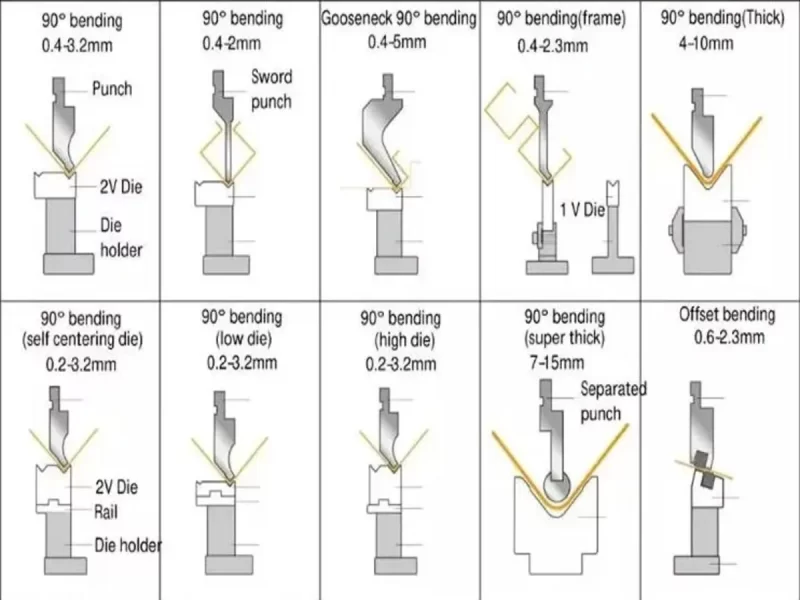
Factors That Affect Press Brake Tonnage
Several variables influence the required bending force.
Material Type
Different metals require different bending forces.
| Material | Relative Force |
|---|---|
| Mild Steel | 1.0 |
| Aço inoxidável | 1.5 |
| Alumínio | 0.5 |
| Cobre | 0.6 |
Stainless steel usually requires significantly more tonnage due to its higher strength.
Material Thickness
Thickness has the greatest impact on bending force.
The relationship is quadratic:
This means doubling the thickness requires roughly four times the force.
Die Opening (V-Die)
The width of the V-die strongly affects tonnage.
A common rule:
Example:
3 mm sheet → V-die between 18 mm and 30 mm
Larger dies reduce required tonnage.
Bending Length
The longer the bending length, the greater the required force.
For example:
- 500 mm bend → half the tonnage
- 2000 mm bend → double the tonnage
This is why large sheet metal parts require higher-capacity press brakes.
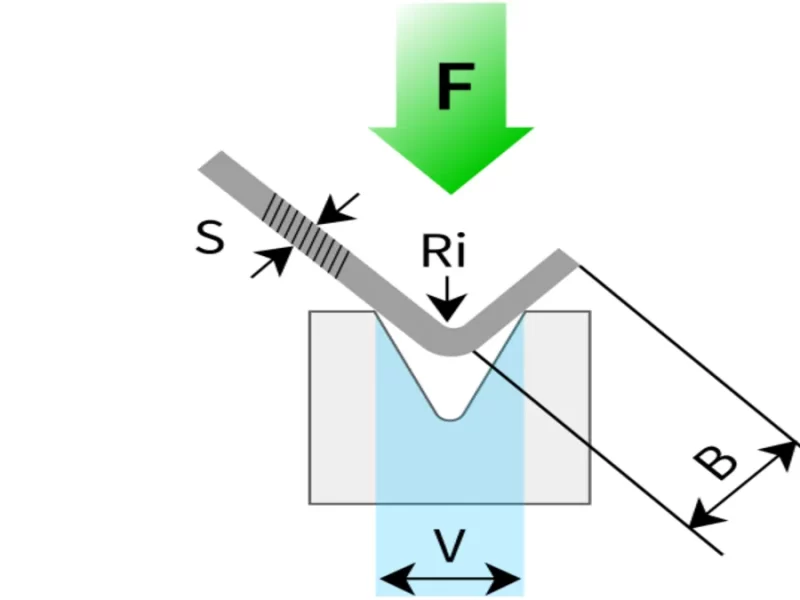
Practical Tips for Using a Press Brake Tonnage Chart
To use a tonnage chart effectively, follow these practical guidelines.
Always Verify Material Type
Charts are usually based on mild steel. Adjust the tonnage when working with stainless steel or aluminum.
Check Machine Capacity
Ensure the required tonnage is within the press brake's rated capacity.
Operating too close to the limit can reduce machine lifespan.
Use the Correct Tooling
Tooling selection affects bending force. Always match the punch and die to the sheet thickness.
Perform Test Bends
Before large production runs, perform sample bends to verify tonnage and bending angle accuracy.
Conclusão
A press brake tonnage chart is an essential reference for sheet metal fabrication. By understanding how bending force is calculated and how different variables affect tonnage, engineers and operators can ensure accurate, safe, and efficient bending operations.
Using the correct tonnage helps prevent machine overload, improves bend accuracy, and ensures optimal press brake performance.
FAQ
What is press brake tonnage?
Press brake tonnage is the amount of force required to bend sheet metal using a press brake machine.
How do you calculate press brake tonnage?
Tonnage can be calculated using the formula:
Where S is thickness, L is bending length, and V is die opening.
How much tonnage is required to bend 3mm steel?
Bending 3 mm mild steel over 1 meter typically requires about 25 tons of force, depending on the die opening.
Does stainless steel require more tonnage?
Yes. Stainless steel generally requires about 50% more bending force than mild steel.
What happens if the tonnage is too low?
If the bending force is insufficient, the material may not reach the required angle, resulting in incomplete or inaccurate bends.
What is the press brake tonnage formula?
The press brake tonnage formula is used to calculate the bending force required for sheet metal forming.
For air bending mild steel, a commonly used formula is:
P = (650 × S² × L) / V
Where:
- P = bending force (kN)
- S = material thickness (mm)
- L = bending length (m)
- V = die opening (mm)
The actual tonnage may vary depending on material strength, tooling, and bending method.
How do you calculate press brake tonnage from a chart?
To calculate press brake tonnage from a chart, find the required force based on:
- material thickness
- material type
- V-die opening
- bending length
For example, if a chart shows 25 tons per meter for 3 mm mild steel, a 2-meter bend requires approximately:
25 × 2 = 50 tons
Always confirm the result with the actual material grade and tooling conditions.
How much tonnage is required for stainless steel bending?
Stainless steel usually requires about 1.5 times more tonnage than mild steel because of its higher tensile strength.
The exact bending force depends on:
- stainless steel grade
- material thickness
- bending length
- die opening