Struggling with labor shortages? Learn how robotic bending cells with offline programming (OLP) and sheet following tech can triple your press brake output.
As manufacturers face rising labor costs and increasing demand for consistency, robotic bending cells have become a key solution in modern sheet metal fabrication.
Instead of relying on manual operations, companies are moving toward integrated automation systems that combine precision, efficiency, and scalability.
Quick Answer
A robotic bending cell is an automated system that integrates a press brake, industrial robot, tooling, and control software to perform sheet metal bending with minimal human intervention. It improves efficiency, reduces labor costs, and ensures consistent quality in high-volume production.
What Is a Robotic Bending Cell?
A robotic bending cell is a complete automation setup designed to handle the entire bending process.
This transforms bending from a manual task into a repeatable, system-driven process.
Key Components of a Robotic Bending Cell
Understanding the system structure is essential for evaluating automation solutions.
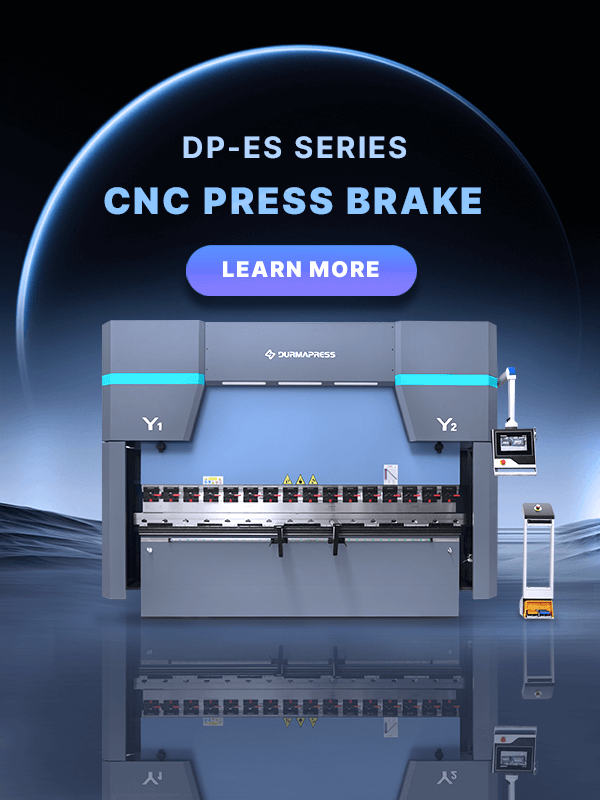
Freio de prensa
The core machine that performs the bending operation. It must be compatible with automation and capable of repeatable accuracy.
Industrial Robot Arm
Responsible for loading, positioning, rotating, and unloading the workpiece throughout the bending process.
Gripper System
Custom-designed to handle different part shapes and sizes, ensuring stability during movement.
Control & Software System
Coordinates the robot and press brake, often integrating CNC programming and automation logic.
How Robotic Bending Cells Work
A typical automated bending cycle includes:
Loading sheet metal
Positioning by the robot
Performing the bend
Repositioning for multiple bends
Unloading finished parts
This workflow allows continuous production with minimal manual input.
Evolution of Press Brake Automation
The development of bending technology can be simplified into four stages:
Manual bending → operator-dependent
CNC press brake → improved precision
Semi-automation → assisted handling
Robotic bending cells → fully automated systems
Today’s systems represent the shift from machine operation to process automation.
Benefits of Robotic Bending Cells
This is where automation creates real value.
Higher efficiency
Robotic systems operate continuously with consistent cycle times, making them ideal for large production runs.
Reduced labor cost
Automation reduces dependence on skilled operators.
A simple ROI model:
ROI = (Annual Labor Savings + Productivity Gain) / Total Investment
Many systems achieve payback within 1–3 years.
Consistent quality
Robotic bending ensures repeatable accuracy and minimizes variations caused by human factors, especially when managing springback in sheet metal bending.
Scalability
Once programmed, the system can scale production without increasing labor.
Applications of Robotic Bending Cells
Robotic bending is widely used in industries that require high consistency and volume:
Automotive components
Electrical enclosures
Metal furniture
Appliance manufacturing
These environments benefit most from automation due to repetitive production.
Robotic Bending Cell vs Traditional Press Brake
Factor
Traditional Press Brake
Robotic Bending Cell
Labor
High
Low
Eficiência
Medium
High
Consistency
Operator-dependent
Highly stable
Setup
Fast
Programming required
Best Use
Small batch
Mass production
For a deeper comparison, see manual vs robotic press brake differences in real production scenarios.
How to Choose the Right Robotic Bending Cell
Selecting the right system depends on your production needs.
Consider the following:
Production volume (high volume favors automation)
Part complexity (affects programming and gripping)
Labor cost (higher cost increases ROI)
Required precision and repeatability
A well-matched system delivers both efficiency and long-term cost savings.
Future Trends in Robotic Bending (2026)
Automation is continuing to evolve with new technologies:
AI-assisted programming
Digital twin simulation
Smart factory integration
These innovations are making robotic bending systems easier to deploy and more flexible than ever before.
Conclusão
Robotic bending cells represent the next stage in sheet metal fabrication. By combining machines, robotics, and software into a unified system, manufacturers can achieve higher efficiency, lower costs, and more consistent quality.
For companies moving toward high-volume and standardized production, press brake automation is no longer optional—it is a competitive advantage.
FAQ
What is a robotic bending cell? It is an automated system that integrates a press brake and robot to perform bending operations with minimal manual input.
How much does a robotic bending cell cost? Costs vary depending on configuration, but most systems achieve ROI within 1–3 years through labor savings.
Is robotic bending suitable for small batch production? Not always. Manual press brakes are often more efficient for highly variable, low-volume work.
What industries use robotic bending cells? Common industries include automotive, appliances, electrical cabinets, and metal fabrication.
Stay Updated on Industrial Innovations
Subscribe to our newsletter for the latest insights on manufacturing technology, sustainability, and industry trends.