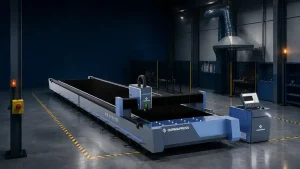
Durmapress specializes in designing, manufacturing, and selling various metal processing equipment, including bending machines, shears, punches, and laser cutting machines. The company was founded in 2014, with years of experience and technology accumulation. DurmaPress has become one of the well-known brands in China's metal processing machinery industry.
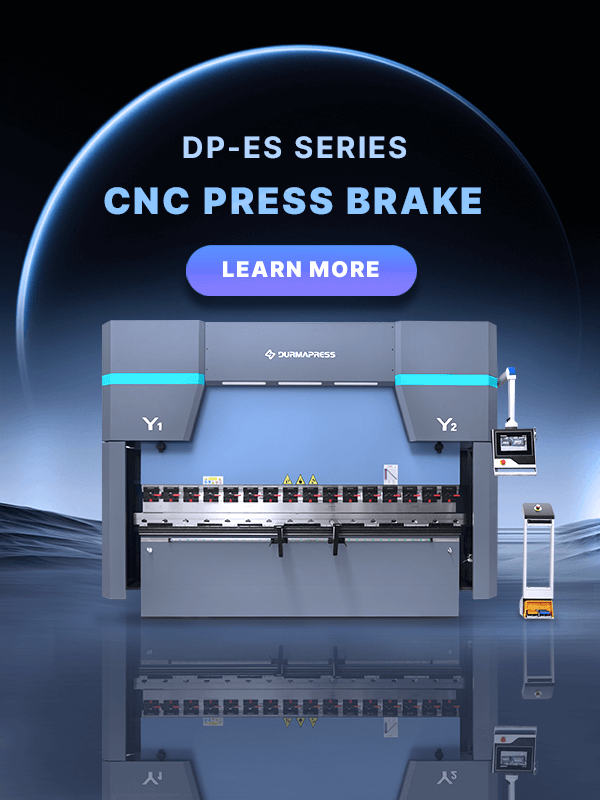
A CNC press brake machine is a computer-controlled piece of sheet metal fabrication equipment that uses programmable force to bend metal into precise angles and shapes. Unlike manual or conventional press brakes, a CNC press brake integrates a digital control system that manages every movement of the machine — from the ram stroke to the backgauge position — delivering consistent, repeatable results across every production cycle.
2.Is Every Press Brake a CNC Machine?
Not all press brakes are CNC-enabled. Traditional press brakes can be purely mechanical or basic hydraulic machines operated manually. A CNC press brake, however, incorporates a computer numerical control system that automates positioning, angle control, and bending sequences. In short: every CNC press brake is a press brake, but not every press brake is a CNC machine.
3. How Does a CNC Press Brake Machine Work?
The working process of a CNC press brake follows a clear sequence:
1. Programming The operator inputs the bending parameters into the CNC control system — including bend angle, sheet dimensions, material type, and bending sequence. Advanced systems allow direct import from CAD/CAM software.
2. Material Positioning The sheet metal is placed onto the machine bed. The CNC backgauge automatically moves into position to ensure the sheet is aligned accurately before each bend.
3. Punch and Die Action The ram drives the punch downward into the die with precisely controlled force, bending the sheet metal to the programmed angle.
4. Automatic Adjustment The CNC system continuously monitors and corrects pressure, alignment, and positioning throughout the bending cycle, compensating for variables such as springback.
4. Key Components of a CNC Press Brake Machine
Understanding the main components helps explain why CNC press brakes deliver such high precision.
1.Bed: The bed is the fixed lower platform of the press brake, where the die is mounted and the sheet metal rests during bending. A rigid, stable bed prevents vibration and misalignment — critical for accurate results, especially on wider machines.
2.Ram: The ram is the moving upper beam that drives the punch into the die. In CNC machines, the ram is controlled along independent Y1 and Y2 axes, allowing precise tilt adjustment for complex or tapered bends.
3. Punção e Matriz:The punch and die are the tooling pair that directly forms the sheet metal. Punches come in profiles such as straight, gooseneck, or radius types, while dies are commonly V-shaped or U-shaped. Selecting the correct combination depends on the material, thickness, and required bend geometry.
4. Backgauge:The backgauge is an automated positioning device that sets the sheet metal in the correct location before each bend. In CNC machines, the backgauge moves along multiple axes (X, R, Z1, Z2), enabling precise repositioning between bends without operator intervention.
5. Sistema de controlo CNC:The control system is the brain of the machine. Operators program bending sequences via touchscreen interfaces, and advanced systems support 3D simulation to detect collisions or overloads before production begins. Common systems include Delem and ESA controllers.
The most widely used type in heavy-duty fabrication. Hydraulic cylinders generate high tonnage, making this machine ideal for thick plates and long production runs in industries such as structural steel, shipbuilding, and automotive manufacturing.
Powered by servo motors instead of hydraulic fluid, electric press brakes offer superior energy efficiency, cleaner operation, and micrometre-level accuracy. They are best suited for precision work in electronics, aerospace, and industries with strict environmental requirements.
Hybrid machines combine hydraulic power with electric precision control. This design delivers the high tonnage capacity of hydraulics while reducing energy consumption and improving response speed — a balanced solution for medium to heavy production environments.
6. What Factors Affect CNC Press Brake Bending Quality?
Even with advanced CNC technology, bending quality is influenced by several variables:
Material type and thickness : Harder or thicker materials require higher tonnage and more springback compensation.
Punch and die selection: The wrong tooling combination leads to poor bend quality or surface damage.
Springback: Metal tends to return partially to its original shape after bending. CNC systems compensate by over-bending to achieve the target angle.
Back gauge accuracy: Precise positioning before each bend is critical for consistency across multiple bends.
Machine tonnage: Exceeding the machine's rated capacity risks tool or machine damage.
7. Advantages of CNC Press Brake Machines in Modern Manufacturing
CNC press brakes offer clear advantages over conventional bending methods:
Precision and repeatability: Every bend matches the programmed specification, even across thousands of parts.
Speed: Automated setups reduce changeover time and accelerate production cycles.
Flexibility: One machine can handle multiple materials, thicknesses, and complex bend geometries.
Reduced material waste: Simulation software detects errors before production, minimizing scrap.
Integration with automation: Modern CNC press brakes can be paired with robotic arms for fully automated bending cells.
8. Conclusion
A CNC press brake machine is one of the most important investments in modern sheet metal fabrication. Its combination of programmable precision, flexible tooling, and automation capability makes it essential for manufacturers who need consistent quality at scale. Whether you are selecting a hydraulic, electric, or hybrid model, understanding how the machine works and what drives bending quality helps you make a better purchasing decision.
Stay Updated on Industrial Innovations
Subscribe to our newsletter for the latest insights on manufacturing technology, sustainability, and industry trends.