Sobre nós
Discover how panel benders work, the advantages of automatic panel bending, and when to choose a panel bending machine over a press brake. Ideal guide for cabinet, enclosure, and sheet metal manufacturers.
Contactar-nos
Publicações recentes
Categorias
Siga-nos
Novo vídeo semanal
What Is a Panel Bender?
A dobrador de painéis is a CNC-driven sheet metal folding machine that bends material using a clamping tool and two independent blades—an upper blade and a lower blade. Unlike a press brake that forces material into a punch and die, a panel bender uses an upward or downward folding motion to form angles.
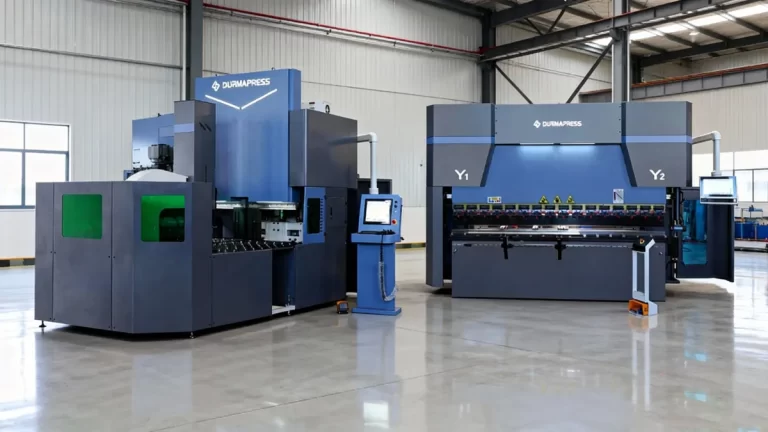
Panel Bender vs. Press Brake (Key Differences)
| Feature | Dobrador de painéis | Freio de prensa |
|---|---|---|
| Operation | Automated folding beams | Punch-die pressing |
| Skill Level | Low (operator-free possible) | High |
| Repeatability | Very high | Depends on operator |
| Setup Time | Zero tool change | Requires tooling setup |
| Best For | Cabinets, doors, enclosures | Thick plates, simple bends |
This structural difference makes the automatic panel bender ideal for industries where consistency, speed, and automation matter.
How a Panel Bender Works — Step-by-Step Technical Breakdown
Step 1: Loading the Sheet
The sheet can be loaded manually or via an automatic panel loading system or robotic arm. This step determines cycle time and automation level.
Step 2: Clamping and Positioning
A blankholder clamps the sheet precisely in place.
The CNC system automatically positions the sheet for the required bends.
Step 3: Folding Motion
Two blades—upper and lower—rotate to perform the bending motion.
This movement folds the sheet upward or downward to the programmed angle.
Step 4: Automatic Rotation for Negative Bends
The panel bender automatically rotates or repositions the sheet, enabling multiple sides of a panel to be formed without manual intervention.
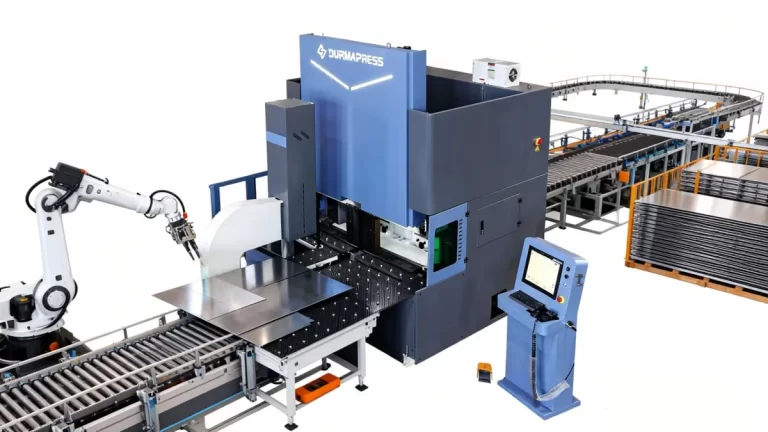
Key Components of a Panel Bender
- Blankholder (Clamping Tool) – Holds the sheet securely.
- Upper/Lower Folding Beams – Perform upward/downward bending.
- Servo Motors – Deliver high-precision motion.
- Backgauge System – Automatically adjusts sheet position.
- CNC Control – Allows fast programming and offline simulation.
Looking for high-precision solutions? Explore our CNC bending brake machines for comparison.
Why This Technology Achieves Higher Accuracy
- No die interference or misalignment
- Servo-driven motion with consistent force
- Zero-tool-change design for various sizes
- Automated repositioning that eliminates human error
This is why many manufacturers consider the panel bender a flexible bending center rather than just a machine.
Types of Panel Benders (Choosing the Right Machine)
1. Manual or Semi-Automatic Panel Benders
- Suitable for medium-volume production
- Lower investment
- Basic automation but higher operator involvement
2. Full Automatic Panel Benders
- Ideal for high-mix, high-precision production
- Minimal labor required
- Integrated with automatic panel loaders/unloaders
- Fully automated, 24/7 production
- Perfect for lights-out manufacturing
- Used in advanced sheet metal factories
4. Flexible Bending Centers
- Handles different sizes without die change
- Best for cabinets, enclosures, and multi-bend parts
Advantages of Using a Panel Bender in Modern Metal Fabrication
A panel bender offers multiple advantages for today’s sheet metal manufacturers, especially those dealing with diverse SKUs or high-mix production. Because panel benders require zero tooling changeover, there is no need to replace punches or dies, which dramatically reduces setup time and tooling costs. Their servo-driven motion ensures high repeatability and accuracy, allowing every part to maintain consistent bending quality. Another major benefit is the low operator skill requirement—even inexperienced operators can produce precise bends, eliminating dependency on highly trained press brake technicians. Panel benders also excel at handling complex bend sequences, automatically rotating and repositioning the sheet without manual flipping, making them ideal for boxes, frames, and cabinets. In addition, the technology is designed for full automation, integrating easily with robots, conveyors, and automatic loading systems. With such efficiency, a single panel bender can often replace multiple traditional bending brake machines, significantly boosting productivity in thin-sheet fabrication environments
Limitations and Considerations Before Choosing a Panel Bender
Despite its strengths, a panel bender is not suitable for every production scenario, and several considerations should be evaluated before investing. The first is the higher initial cost, as the advanced CNC systems and automation features increase the price compared with standard bending equipment. Additionally, material thickness limits must be considered—most panel benders are optimized for 0.5–2.0mm sheet metal depending on the material type, meaning very thick or heavy plates are still better processed with a traditional press brake. Panel bender systems, especially robotic cells, also require more floor space, which may be challenging for smaller workshops. Ultimately, the technology performs best in thin-sheet, box-type, or enclosure production, making it an excellent choice for manufacturers producing cabinets, drawers, doors, HVAC components, or electrical enclosures, but less suitable for heavy-duty or oversized parts.
What Machines Can a Panel Bender Replace?
Panel benders can replace or reduce reliance on:
- 1–3 press brakes for thin sheet jobs
- Skilled operators frequently needed for manual bending
- Multiple workstations for box and panel production
- Manual flipping operations for reverse bends
For factories dealing with many SKUs, a panel bender becomes the core automation hub.See our comparison of press brake vs panel bender to understand which is better for your factory.
Applications — Where Panel Benders Are Used
Industries benefiting most from panel bender technology include:
- Electrical cabinet manufacturing
- HVAC ducts and panels
- Metal furniture and drawers
- Appliance outer shells
- Switchgear and enclosures
- Door panel manufacturing
- Storage systems and industrial racks
Any industry requiring flat panels, formed edges, or multiple side folds is an ideal candidate.Discover how a máquina de corte a laser de fibra can further automate cabinet and enclosure production.
How to Choose the Right Panel Bender: Buying Guide
Maximum Panel Size & Part Dimensions — Ensure the machine supports your required length, width, and bending height.
Material Type & Thickness — Steel, stainless steel, and aluminum each behave differently and require the right tooling and force.
Bending Frequency & Production Volume — High-volume or high-frequency bending usually justifies full automation.
Automation Requirements — Consider robot loading, automatic flipping, material storage, or integration with conveyor lines.
Software Capabilities — Offline programming, simulation, and intelligent nesting greatly impact efficiency and error reduction.
Budget & ROI — Panel benders deliver strong ROI in high-mix, medium-volume environments; evaluate long-term labor and output savings.
Conclusion — Why Panel Benders Are the Future of Sheet Metal Bending
As manufacturers face growing demands for flexibility, speed, and precision, the panel bender stands out as one of the most efficient solutions in modern sheet metal fabrication. Its automation capabilities, zero-tool-change operation, and consistent bending quality make it a powerful replacement for traditional bending brake machines in thin-sheet production.
Whether you’re producing electrical cabinets, HVAC panels, metal furniture, or industrial enclosures, adopting a panel bender or automatic panel bender can dramatically improve your workflow, reduce labor costs, and enhance output quality.Looking for more bending solutions? Visit our full range of sheet metal machines, including press brakes, shearing machines, and panel benders.
FAQ — Common Questions About Panel Benders
It is used for bending thin sheet metal panels, typically for cabinets, drawers, enclosures, and HVAC components.
For thin sheet and multi-side parts—yes. For thick plate bending, press brakes are still necessary.
Most machines support 0.5–2.0mm, depending on material type.
Cycle times range from 12–40 seconds per part depending on complexity.
Yes—robotic panel bending cells enable lights-out production.
For factories with many SKUs, varied sizes, and high precision needs, a panel bender offers a very fast ROI.