



О нас
Durmapress specializes in designing, manufacturing, and selling various metal processing equipment, including bending machines, shears, punches, and laser cutting machines. The company was founded in 2014, with years of experience and technology accumulation. DurmaPress has become one of the well-known brands in China's metal processing machinery industry.


Свяжитесь с нами
Последние сообщения



Категории
Следуйте за нами
Еженедельное новое видео
Оглавление
Choosing between a tandem press brake vs single large press brake is not only a question of maximum bending length. It is a production decision that affects machine utilization, bending accuracy, installation cost, operator workflow, maintenance risk, and long-term return on investment.
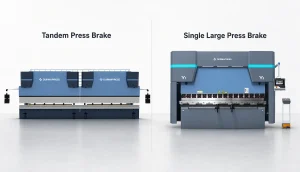
A tandem press brake links two CNC press brakes so they can work together for long parts and, depending on the system design, operate separately for standard-length jobs. A single large press brake uses one extended frame, bed, and ram to bend long parts on one continuous machine.
The practical answer is straightforward: a tandem press brake is usually better for mixed production with both long and short parts; a single large press brake is usually better for dedicated, repeat long-part production. The correct choice depends on your real part drawings, production mix, workshop layout, load requirements, and budget—not on machine length alone.
1.Tandem Press Brake vs Single Large Press Brake: What Is the Real Difference?
A tandem press brake is a linked bending system made from two or more CNC press brakes. In tandem mode, the machines coordinate their ram movement, backgauge positioning, and bending sequence to process one long workpiece. When the system is designed for independent operation, each press brake can also be used as a separate bending station.
A single large press brake, also called a single long-bed press brake, is one purpose-built machine with a continuous frame and extended bed. It is designed for long or heavy workpieces that fit within its rated bending length and forming capacity.
The real difference is how each solution uses production resources:
| Question | Тандемный листогибочный пресс | Single Large Press Brake |
|---|---|---|
| How is long bending achieved? | Two machines work together in synchronized mode | One continuous long-bed machine processes the part |
| Can it handle short parts efficiently? | Often yes, if the two machines can run independently | Yes, but the whole long-bed machine is occupied |
| What is the main advantage? | Production flexibility and utilization | Simpler one-machine workflow for dedicated long parts |
| What is the main risk? | Synchronization, alignment, and setup complexity | Idle capacity and single-point downtime risk |
This is why the decision should begin with the workload, not only the machine catalog.
2. How to Choose Based on Your Production Mix
Many buyers start by asking, “What is the longest part I need to bend?” That matters, but it can lead to overbuying if the longest part represents only a small share of production.
A better starting point is to separate three numbers:
- Maximum part length: the longest part you may need to bend.
- Typical part length: the length range you produce most often.
- Long-part frequency: how often extra-long bending appears in the schedule.
If most daily parts are short or medium length, a single oversized machine may spend much of its time doing work that smaller machines could handle more efficiently. A tandem system can be more valuable because it provides long-part capability without sacrificing standard production capacity.
If most jobs are long, heavy, and repetitive, a single large press brake may be easier to justify. The machine, tooling, material handling, and operators can all be organized around a stable long-part workflow.
2.1 When Long Parts Are Occasional
A tandem press brake is often the better choice when long parts are important but not continuous.
This fits production environments such as:
- Contract fabrication shops with changing customer drawings
- Manufacturers that occasionally bend long channels, poles, panels, or structural profiles
- Plants that produce both large components and standard sheet metal parts
- Workshops where machine utilization is more important than having one dedicated long-bed station
In this scenario, tandem mode handles the long work. Independent mode allows the two machines to return to normal production when long jobs are finished.
2.2 When Long Parts Dominate Production
A single large press brake can be the better choice when long-part production is stable and repeatable.
This fits factories that produce similar long components across many shifts, such as large structural profiles, heavy trailer components, long beams, or other repeat large-format parts. In this case, a dedicated machine can simplify the workflow:
- One machine setup
- One material-handling path
- One operator control interface
- One long-bed production station
- Consistent tooling and support equipment
The single large machine becomes easier to justify when it is heavily used for the work it was designed to perform.
3. Bending Length, Tonnage, and Load Distribution
Bending length and bending force must be evaluated separately. A long thin sheet may require an extended bed but moderate forming force. A shorter thick plate may require much higher tonnage.
For accurate press brake selection, buyers should not compare machines only by nominal length or total rated tonnage. The evaluation should include:
- Material type and thickness
- Bend length
- Die opening
- Tensile strength, if available
- Required bend angle
- Flange dimensions
- Number of bends
- Required tolerance
- Tooling setup
- Workpiece support method
A tandem press brake can increase available bending length, but it does not remove the need to verify force distribution along the bend. A single large press brake may offer a continuous structure, but it still needs enough rated capacity, crowning, and tooling support for the actual workpiece.
3.1 Rated Tonnage Is Not Just a Simple Addition
One common mistake is assuming that two machines in tandem automatically provide full combined tonnage at any point along the bend line. That is not how the decision should be made.
For engineering review, separate these concepts:
Single-machine rated tonnage
Each press brake has its own maximum rated forming capacity.System-level capability
In tandem mode, the system can process longer parts by coordinating multiple machines, but the usable force depends on how the load is distributed.Load distribution along the bend line
The workpiece must be supported so that the forming load is shared correctly between the machines.Local concentrated load limits
A heavy bend concentrated near one machine or near a specific section of the tooling may be limited by that machine’s local capacity, tooling capacity, or frame design.Application-specific verification
Final selection should be checked against real drawings, material data, bend length, die opening, and required tolerance.
A supplier should not confirm a tandem solution only by adding two machine tonnage ratings together. The correct evaluation must confirm where the force is applied, how the workpiece spans the beds, and whether both machines remain within their rated operating range.
4. Accuracy, Synchronization, and Crowning
Accuracy in long-part bending is influenced by more than the choice between tandem and single large machines. A continuous frame does not automatically guarantee better precision, and synchronized machines are not accurate simply because they are linked.
Bending accuracy depends on the complete system:
- Frame rigidity
- Ram and bed deflection
- CNC control quality
- Hydraulic or servo response
- Linear scale or position feedback
- Crowning compensation
- Tooling alignment
- Machine leveling
- Workpiece support
- Operator setup and programming
A single large press brake may simplify control because the bend occurs within one continuous machine structure. This can be useful for repeat long parts with tight process control.
A tandem system can also produce accurate long bends when the machines are properly aligned, synchronized, and calibrated. However, it requires more attention to setup because two separate machines must behave like one coordinated bending system.
4.1 Why Crowning Matters More on Long Bends
Long bending increases the effect of deflection. Under forming load, the ram and bed can deflect, causing angle variation along the workpiece if compensation is not properly applied.
A single long-bed press brake needs a crowning system capable of compensating across the extended bed. A tandem system typically uses the crowning systems of the individual machines, coordinated through the control strategy and setup process.
This is why buyers should discuss the press brake crowning system
1together with tooling, material support, and accuracy requirements. Crowning is not a separate feature; it is part of the full bending accuracy system.
4.2 Synchronization Quality Should Be Verified, Not Assumed
For tandem systems, synchronization quality should be reviewed carefully. Buyers should confirm:
- Whether the machines are designed for true tandem operation
- How the CNC control coordinates both units
- Whether each machine can safely run independently
- How ram position feedback is measured
- How tooling alignment is set and checked
- How crowning is adjusted in tandem mode
- What operator procedures are required for long parts
A basic mechanical connection or simple linked control should not be treated the same as a professionally engineered tandem system.
5. Workshop Layout and Installation Requirements
A machine may meet the bending specification and still fail the installation reality. Long-part bending requires space for the machine, the workpiece, the operator, the tooling, and the material-handling system.
A single large press brake usually needs a long straight bay, suitable foundation, adequate crane access, and enough clearance to move long blanks and finished parts. Transportation and rigging may also be more difficult when the machine frame is oversized.
A tandem press brake can be easier to ship and position because each machine is smaller than one oversized frame. However, it is not automatically easy to install. The two machines still require:
- Sufficient straight-line working space
- Proper foundation or floor load capacity
- Accurate leveling and alignment
- Safe long-part loading and unloading space
- Tooling alignment across both machines
- Control and safety system setup
- Enough room for operators and supports
The workpiece length often creates more layout pressure than the machine length itself.
5.1 Facility Constraints That Can Decide the Machine Choice
Before selecting either configuration, check the actual workshop conditions:
- Can the equipment enter the building?
- Is the ceiling high enough for cranes, tooling changes, and sheet handling?
- Is the floor strong enough for the machine and forming loads?
- Is there enough front space for long sheets?
- Can operators safely support and rotate the workpiece?
- Will the layout block other production lines?
- Is future relocation or expansion likely?
A tandem system may solve some transportation and installation problems, but it still requires a well-planned bending area. A single large press brake may be efficient in the right facility, but costly or impractical in a building that cannot support it.
6. Total Cost of Ownership and ROI
Purchase price alone is not enough to compare a tandem press brake and a single large press brake. The better method is to compare total cost of ownership using the same production assumptions for both options.
A practical TCO comparison should include:
| Cost Item | Тандемный листогибочный пресс | Single Large Press Brake |
|---|---|---|
| Equipment purchase | Two machines plus tandem control and synchronization configuration | One large long-bed machine configuration |
| Transportation and installation | Separate transport, positioning, leveling, alignment, and commissioning | Oversized transport risk, heavy rigging, and long-machine installation |
| Tooling and auxiliary equipment | Tooling alignment across two machines, long-part supports, possible independent tooling sets | Long-bed tooling, support systems, and handling equipment |
| Operation and maintenance | Maintenance for two machines and tandem control system | Maintenance for one large machine and its long-bed systems |
| Capacity utilization | Value depends on real use of tandem and independent modes | Value depends on long-part utilization rate |
| Downtime impact | Must verify whether one machine can safely remain productive after certain faults | Full machine downtime may stop the entire long-bed station |
A simplified annual cost model can be expressed as:
Annual total cost = annualized equipment investment + annualized transportation and installation cost + annual maintenance cost + energy and labor cost + measurable downtime loss
This formula does not require invented prices. It gives buyers a fair way to compare supplier quotations using the same production volume, part specifications, labor assumptions, and evaluation period.
6.1 How to Compare Two Supplier Quotations Fairly
To avoid misleading ROI conclusions, compare both options under the same conditions:
- Use the same representative workpieces.
- Use the same annual production volume.
- Use the same material types and thicknesses.
- Use the same tolerance requirements.
- Include installation and foundation costs.
- Include tooling and support equipment.
- Estimate machine utilization for long and short parts separately.
- Ask how downtime affects production in each configuration.
A tandem system may look more expensive if only purchase price is considered. It may become more economical if independent operation increases daily utilization. A single large press brake may look expensive at first but become justified if it runs long parts at high utilization across most shifts.
6.2 Example Selection Scenario: Mixed-Length Fabrication Shop
Consider a fabrication shop that regularly bends 2–4 meter parts but also receives weekly orders for extra-long profiles. This is a common situation in contract manufacturing.
If the shop buys one oversized long-bed machine, that machine can process the long profiles. However, it may also be occupied by standard parts during the rest of the week, even though those parts do not require the full bed length.
If the shop chooses a tandem system, both machines can work together for long profiles. During standard production, the machines may run separately, allowing two jobs to be scheduled at the same time.
This example does not prove that tandem is always better. It shows why the production mix must be calculated. If the long profiles become the dominant workload, a single large press brake may become the stronger option. If mixed-length work remains the normal pattern, tandem flexibility may produce better utilization.
7. Maintenance, Downtime, and Production Continuity
Maintenance and downtime should be evaluated realistically. A tandem system is not automatically a full backup solution, and a single large press brake is not automatically simpler in every application.
A single large press brake has one control system and one machine structure. This can simplify operator training and maintenance planning. The risk is that one serious fault may stop the whole long-bed bending station.
A tandem system has more components: two machine frames, two hydraulic or servo systems, two backgauge systems, two crowning systems, and a synchronization control layer. This adds maintenance points and requires more technical understanding.
However, depending on the design and fault condition, one machine may still be usable independently. This must be verified before purchase. Independent operation after a fault depends on:
- Machine configuration
- Safety control design
- Electrical and CNC architecture
- Type of failure
- Tooling and support setup
- Whether the remaining machine can process the required parts safely
Buyers should ask the supplier for specific operating modes, not general claims about redundancy.
8. Tandem Press Brake vs Single Large Press Brake: Comparison Table
Use this table as a practical selection summary.
| Decision Factor | Тандемный листогибочный пресс | Single Large Press Brake |
|---|---|---|
| Best fit | Mixed production with long and standard parts | Dedicated long or heavy repeat parts |
| Main value | Flexibility and utilization | Simple long-bed production workflow |
| Long-part capability | Achieved through synchronized operation | Achieved through one continuous long bed |
| Short-part production | Can be efficient if machines run independently | Possible, but the whole long machine is occupied |
| Tonnage evaluation | Must verify single-machine capacity, system range, and load distribution | Must verify rated capacity across the required bend length |
| Accuracy factors | Synchronization, crowning, alignment, tooling, installation | Frame rigidity, crowning, tooling, installation |
| Installation | Modular, but requires precise alignment and enough long-part space | Requires long straight space, rigging, and possible foundation planning |
| Техническое обслуживание | More systems to maintain; possible partial operation depends on configuration | Simpler system count; one major fault can stop the station |
| ROI driver | Independent-mode utilization plus long-part capability | High utilization in repeat long-part production |
| Main buying risk | Assuming all tandem systems provide the same synchronization and redundancy | Buying too much machine for occasional long parts |
9. Buyer Checklist Before Requesting a Quotation
A good quotation should be based on real production data, not only desired machine length. Before contacting a supplier, prepare the following checklist.
9.1 Workpiece and Bending Data
- Longest workpiece length
- Typical workpiece length range
- Material type and thickness
- Bend length and angle
- Flange dimensions
- Required tolerance
- Annual or monthly production volume
- Share of long parts versus standard parts
9.2 Machine Capacity and Configuration
- Single-machine rated tonnage
- Required forming force for representative parts
- Tandem working range, if applicable
- Allowed load distribution in tandem mode
- Crowning system type
- Backgauge configuration
- Tooling length and die opening
- Sheet support or follower requirements
9.3 Factory and Operation Conditions
- Available floor space
- Floor load capacity
- Foundation requirements
- Crane capacity and ceiling height
- Machine entry route
- Loading and unloading direction
- Operator skill level
- Maintenance capability
- Safety control requirements
- Future expansion plans
This checklist helps the supplier recommend a configuration based on actual conditions. It also helps buyers compare quotations on the same basis.
10. Final Recommendation
The best solution in the tandem press brake vs single large press brake comparison is the one that matches your real production pattern.
Choose a tandem press brake if you need long-part capability but still process many standard-length parts. Its main advantage is the ability to combine machines for long work and use them separately when the schedule changes.
Choose a single large press brake if most of your production is dedicated to long, heavy, repeat parts and your facility can support the installation, handling, and maintenance requirements.
Before making the final decision, compare both options using real drawings, material data, bending force requirements, load distribution, workshop layout, and total cost of ownership. If you are preparing an equipment inquiry, provide your part drawings, material thickness, maximum bend length, expected production volume, and factory layout so the supplier can evaluate the most suitable configuration.
For buyers already comparing machine options, the next practical step is to review your requirements with a supplier that can offer both tandem press brake systems and Листогибочный пресс с ЧПУ solutions. This makes the recommendation more application-based and less dependent on promoting only one machine type.