How to Select the Right Press Brake V-Die Opening: Rule of 8 & Material Chart
- Conocimientos, Noticias
- 90+ reading now
Durmapress specializes in designing, manufacturing, and selling various metal processing equipment, including bending machines, shears, punches, and laser cutting machines. The company was founded in 2014, with years of experience and technology accumulation. DurmaPress has become one of the well-known brands in China's metal processing machinery industry.

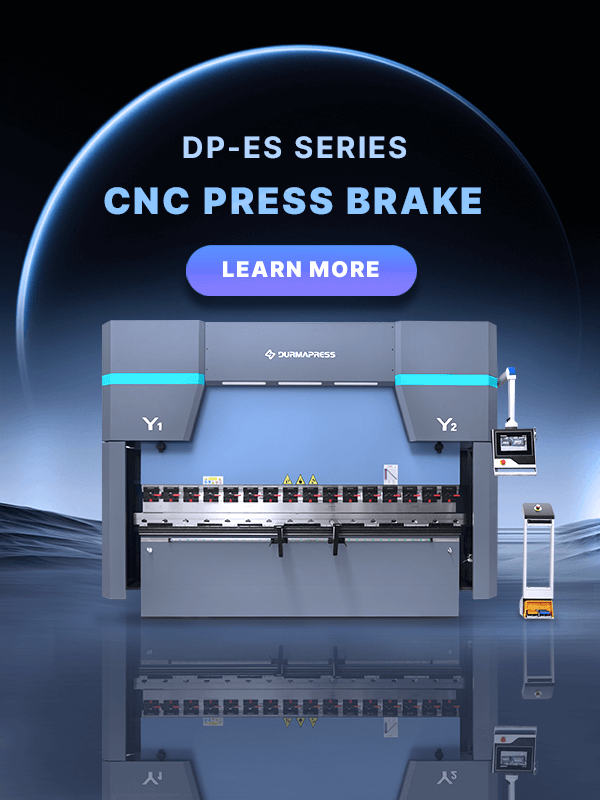
Choosing the right press brake V-die opening is one of the most decisive—and most misunderstood—variables in sheet metal bending. The V-opening directly controls bending tonnage, inside bend radius, minimum flange length, springback, and surface quality. Get it right, and you achieve consistent angles with minimal tooling wear. Get it wrong, and you risk cracked parts, deep indentation, angle deviation, and even machine overload.
The short answer most fabricators know is the Rule of 8 (V-opening ≈ 8× material thickness). But as this guide explains, 8× is a starting point for air bending mild steel—not a universal law. Below, you'll learn how the V-opening actually behaves, how to adjust it by material, and how to follow a repeatable selection process that holds up on the shop floor.
Quick answer: For air bending common mild steel, start at V ≈ 8T, then verify inside radius, minimum flange, and tonnage before you commit. Harder or thicker materials usually need a wider opening; soft materials can often use a smaller one.
A V-die is the lower die in a press brake. It features a V-shaped opening that supports the sheet while the upper punch forces the material down into the V, forming the bend. Together, the punch tip and the V-opening determine the bend angle, inside radius, and how the material flows.
V-die sizes are named by the width of the opening in millimeters:
You'll also encounter multiple tooling formats:
The wider the opening, the longer the support span under the sheet—and that single geometric fact drives almost everything else about bending performance.
A narrow V-opening shortens the support span and concentrates deformation into a tiny zone, sharply increasing the tonnage required. A wider opening reduces force but enlarges the bend. Tonnage also scales with bend length y material tensile strength, so opening size can never be judged in isolation from the machine's capacity.
In air bending, the inside radius is formed largely by the V-opening—not the punch tip. As a rule of thumb, larger openings produce larger inside radii, and smaller openings produce tighter radii. When a drawing specifies a required inside radius, the V-die must be selected to hit it; ignoring this is a common reason parts fail dimensional inspection even when the angle looks correct.
The opening cannot be so wide that the part's short edge loses stable support and slides into the V during pressing. Every V-opening has a corresponding minimum flange length—always confirm it before finalizing your choice.
Material strength, opening width, punch penetration depth, and bending method all influence springback. High-strength and stainless materials spring back more, which is why they usually need a wider opening and careful angle compensation.
Too-small an opening can overstress the outer fiber and cause cracking, especially on hard alloys or tight bends. Excess contact pressure—or a worn die shoulder—can leave visible marks on decorative surfaces. Protective inserts or film help on aluminum, copper, and coated sheet.
The Rule of 8 is the industry's most popular starting formula:
V ≈ 8 × T
where V is the V-die opening and T is the sheet thickness.
Worked example (mild steel): For 3 mm mild steel → 3 × 8 = 24 mm, so a V24 is a solid air-bending starting point. This balances bending force, inside radius, and die life for ordinary low-carbon steel in the ~1–3 mm range.
Think of 8× as a first estimate—a way to get into the right neighborhood quickly—before you verify radius, flange, and tonnage.
Blindly applying 8× to every job is a leading cause of scrap, overload, and die damage. Adjust as follows:
The takeaway: material type, method, and thickness together decide the opening—not thickness alone.
Use this as a starting range for air bending, then verify with radius, flange, and tonnage checks.
| Material | Typical starting range | Main concern |
|---|---|---|
| Acero dulce | 6T–8T | Balance of accuracy and tool life |
| Acero inoxidable | 8T–10T | Springback and cracking |
| Aluminio | 4T–6T | Surface marking, temper |
| Acero galvanizado | 6T–8T | Coating damage |
| Cobre | 4T–6T | Indentation, very ductile |
| High-strength steel | 10T–12T | Cracking risk, high tonnage |
Important: These ranges are air-bending starting points, not mandatory standards for every grade. Final selection must account for the specific alloy/grade, target inside radius, bend length, machine tonnage, and your tooling supplier's rated load data.
Example 1 — 3 mm mild steel (air bending): 8× → V24. Verify the inside radius (~roughly one-sixth of the opening as a starting estimate), confirm minimum flange, and check tonnage for your bend length. In most cases V24 works cleanly.
Example 2 — 3 mm stainless steel: The same part in stainless springs back more and needs more force. Move toward the upper end of the range (≈ 8T–10T, so ~V24–V30) to reduce cracking and tool load—proof that you can't reuse the mild-steel opening mechanically.
Example 3 — 2 mm aluminum with a cosmetic surface: Start around 4T–6T (~V8–V12), but prioritize surface protection—clean die shoulders, protective film—and trial-bend to confirm no marking before running the batch.
A four-way (multi-V) die puts several openings on one rotatable block—ideal for high-mix, low-volume work where thickness changes often.
The payoff: less setup time, fewer die changes, and lower tooling cost versus buying many single-V dies.
| Problem | Likely V-die cause | Corrective action |
|---|---|---|
| Outer-surface cracking | Opening too small / radius too tight | Widen the opening; verify minimum radius |
| Deep indentation | Excess contact pressure / worn shoulder | Check opening, shoulder, add protection |
| Machine overload | Opening too small / bend too long | Recalculate tonnage |
| Radius too large | Opening too wide | Choose a smaller opening within tonnage limits |
| Short edge slips into V | Opening exceeds flange support | Use a smaller opening or revise design |
| Inconsistent angle | Worn die / material variation / springback | Inspect tooling; recalibrate parameters |
LMRM Tool supplies a full range of V-die solutions built for real production demands:
Our team provides selection guidance—matching the correct opening to your material thickness, bend geometry, and machine capacity—so you can reduce scrap, protect tooling, and stabilize delivery. Industries served include sheet metal fabrication, enclosures and cabinets, automotive components, and architectural metalwork.
No. 8× is a starting point for air bending mild steel. Harder or thicker materials usually need a wider opening, and bottoming/coining use different rules.
Generally yes—stainless has higher strength and springback, so a wider opening (≈8T–10T) reduces cracking and tool load.
Higher tonnage, deeper marks, tighter radius, and greater cracking and overload risk.
An oversized inside radius, more springback, and possible dimensional failure; the short flange may also lose support.
In air bending the opening largely forms the radius—wider openings produce larger radii.
Selecting the right press brake V-die opening is a technical decision that protects part quality, machine safety, and tool life. Thickness sets your initial range; material properties set the correction; inside radius and minimum flange set the geometric limits; tonnage sets the safety boundary; and a trial bend confirms the final parameters. Master these together—not a single multiplier—and your bending becomes faster, safer, and far more consistent.
Rellene la siguiente información para recibir un presupuesto gratuito y un folleto de productos. Le responderemos en 24 horas.