О нас
Compare all-electric vs hydraulic press brakes: precision, energy savings (up to 70%), tonnage, maintenance & costs. 2026 expert guide with tables and tips to choose right.
Свяжитесь с нами
Последние сообщения
Категории
Следуйте за нами
Еженедельное новое видео
In 2026, with energy costs surging and sustainability mandates tightening, choosing between all electric and hydraulic press brakes can make or break shop efficiency. Manufacturers upgrading equipment seek machines that balance precision, power, and long-term ROI—this guide delivers data-driven comparisons, mechanics breakdowns, and real-world scenarios to guide your decision.

How a All Electric Press Brake Work
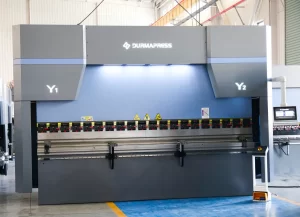
All electric press brakes use servo motors and ballscrews to drive the ram directly, eliminating pumps, valves, and fluids for precise, on-demand control. This design achieves repeatability of ±0.003-0.005mm, ideal for complex bends on thin materials like aerospace alloys or electronics housings. Cycle speeds hit 15-25 bends per minute, with power draw under 1kW at idle—slashing energy use by 50-70% compared to traditional systems.
Key features include:
Servo precision: Closed-loop feedback adjusts force mid-stroke.
Compact footprint: No bulky reservoirs, saving 20-30% floor space.
Applications: High-mix/low-volume jobs like medical devices or EV battery trays, where tolerances under 0.01mm matter.

How a Hydraulic Press Brake Function
Hydraulic press brakes rely on pressurized fluid in cylinders to generate massive force, often exceeding 1000 tons for bending thick steel (>10mm). Pumps build pressure over 2-5 seconds per stroke, delivering reliable power for heavy-duty tasks but introducing heat loss and potential leaks. Repeatability sits at ±0.01-0.02mm, sufficient for structural parts but prone to valve drift over time.
Core components:
Cylinders and valves: Distribute force evenly across long bends.
Reservoirs: Hold 50-200 gallons of fluid, requiring filtration.
Applications: Automotive frames, construction beams, or shipbuilding where tonnage trumps speed.

Comprehensive Feature Comparison
This table pits the two head-to-head across critical metrics, based on 2026 industry benchmarks.
| Aspect | All-Electric | Гидравлика | Winner & Why |
|---|---|---|---|
| Energy Efficiency | 50-70% savings, servo on-demand | 30-50% waste via heat/pumps | Electric (ROI in 2-3 years) |
| Точность | ±0.003-0.005mm, real-time feedback | ±0.01-0.02mm, drift over time | Electric (tight tolerances) |
| Tonnage Capacity | Up to 500 tons | 1000+ tons standard | Hydraulic (heavy fabrication) |
| Cycle Speed | 15-25 bends/min | 8-15 bends/min | Electric (high-volume runs) |
| Техническое обслуживание | Annual checks, no fluids (~$1K/yr) | Seals/fluids every 2000 hrs (~$5K/yr) | Electric (less downtime) |
| Noise Levels | <70 dB | 85-95 dB | Electric (worker-friendly) |
| Upfront Cost | 20-50% higher | Lower entry | Hydraulic (CAPEX-sensitive) |
| Eco-Friendliness | Zero spills, low emissions | Fluid disposal challenges | Electric (green compliance) |
| Lifespan | 20+ years, minimal wear a | 15 years with rebuilds | Tie |
| Programming | AI-adaptive touchscreens | Basic CNC, manual calibration | Электрический |
Electric models dominate in modern shops prioritizing efficiency, while hydraulics hold ground in raw power needs.
Detailed Pros, Cons
Substantial energy reductions save $10K-$30K yearly for mid-sized shops operating two shifts.
Low noise levels (<70 dB) enhance worker focus, lifting productivity by up to 15%.
Sustainability alignment supports 2026 mandates like expanded EU carbon taxes and US green incentives.
Недостатки: Limited tonnage excludes extreme heavy fabrication; higher initial outlay challenges small operations.
Hydraulic Advantages:
Unrivaled versatility for non-standard bends and one-off high-force jobs.
Field-proven durability in harsh, dusty shop conditions.
Недостатки: Annual fluid servicing hits $2K, compounded by 20% higher unplanned downtime from seal failures.
Real-World ROI Formula:
For electric upgrades:
Annual ROI=(Energy Savings−Maintenance Costs)Initial Investment×100Annual ROI=Initial Investment(Energy Savings−Maintenance Costs)×100
Example: ($20K savings - $1K maintenance) / $200K = 9.5% IRR over 3 years. Hydraulics typically yield 5-7% due to ongoing expenses.
Quick decision checklist:
- Budget below $150K? Go hydraulic.
- Require <0.01mm precision or energy optimization? Select electric.
- Need >500 tons? Stick with hydraulic.
- Prioritizing ESG goals? Electric dominates.
2026 Trends & Future-Proofing
Emerging hybrid electric-hydraulic presses now achieve 800 tons, merging precision with power for transitional shops. AI-driven predictive maintenance slashes downtime by 40%, while US Inflation Reduction Act extensions subsidize electric adoption. Full servo-electric dominance looms by 2030, with component costs falling 15% amid scale.
ЧАСТО ЗАДАВАЕМЫЕ ВОПРОСЫ
- Can electric press brakes process 1/4-inch steel?
Yes, models up to 300 tons handle most grades effectively—verify tonnage specs for your alloy. - What are essential hydraulic maintenance tips?
Replace filters quarterly, inspect for leaks daily, and flush reservoirs annually to extend seal life. - Electric vs. hybrid for 2026 shops?
Pure electric for max efficiency; hybrids bridge to high-tonnage needs. - Is 2-3 year ROI realistic?
Absolutely for shops exceeding 10K annual hours, per industry benchmarks. - How do noise regulations factor in?
Electric models easily meet OSHA's 85 dB threshold, minimizing hearing protection requirements.