О нас
Learn how the crowning system compensates for press brake deflection to improve bending accuracy, reduce angle deviation, and ensure consistent sheet metal fabrication results.

Свяжитесь с нами
Последние сообщения

Категории
Следуйте за нами
Еженедельное новое видео
Введение
Bending accuracy is one of the most critical performance indicators of a press brake. Whether manufacturing stainless steel panels, electrical cabinets, elevator components, or heavy steel parts, even a small deviation in bending angle can lead to assembly problems, rework, and increased production costs.
However, many operators notice an interesting phenomenon:Even high-quality CNC press brakes may produce inconsistent bending angles, especially when processing long or thick workpieces.Why does this happen?The answer often lies in machine deflection — and this is exactly where the crowning system plays a vital role.

What Causes Bending Inaccuracy in Press Brakes?
During the bending process, the press brake applies significant force to the workpiece. This force does not only act on the sheet metal but also affects the machine structure itself.
Key factors contributing to inaccuracy include:
- Ram deflection – The upper beam slightly bends under load
- Bed deflection – The lower table deforms due to pressure
- Uneven force distribution – Especially in long bends
- Material thickness – Thicker plates require higher tonnage
As bending force increases, the machine frame experiences elastic deformation. This leads to:
✔ Different bending angles along the length of the workpiece
✔ Center angle deviation
✔ Edge angle variation
Even a precision-built гидравлический листогибочный пресс или Листогибочный пресс с ЧПУ cannot fully eliminate this physical effect.
What Is a Crowning System?
A crowning system is a compensation mechanism designed to counteract the natural deflection of the press brake bed during bending.
In simple terms:
It slightly adjusts the shape of the lower beam to ensure uniform pressure distribution along the entire bending line.
Without compensation, the ram and bed do not remain perfectly parallel under load. Crowning corrects this deviation.
How the Crowning System Works
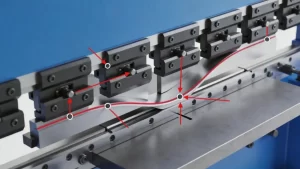
Crowning systems introduce a controlled upward curve in the lower table, offsetting the downward deflection caused by bending force.
Common crowning types include:
Механическая коронка
- Manual adjustment via wedges or screws
- Низкая стоимость
- Suitable for basic applications
Limitations:
1. Less precise
2.Requires operator experience
3.Not ideal for frequent parameter changes

Гидравлическая коронка
- Automatically controlled by hydraulic cylinders
- High compensation accuracy
- Ideal for variable bending conditions
Преимущества:
✔ Precise adjustment
✔ Even load distribution
✔ Consistent bending results
CNC Controlled Crowning
- Integrated with press brake control system
- Adjusts based on material thickness & bend length
- Found in advanced CNC press brakes
Benefits:
✔ Fully automatic
✔ No manual intervention
✔ Optimized for high-mix production
How Crowning System Improves Bending Accuracy
The crowning system directly addresses one of the biggest challenges in sheet metal bending: angle inconsistency caused by deflection.
Key improvements include:
✔ Uniform bending angle across the entire workpiece
✔ Reduced center deviation
✔ Improved repeatability
✔ Less trial bending
✔ Lower scrap rates
By compensating for bed deformation, crowning ensures that the punch and die maintain consistent interaction with the material.
Without Crowning vs With Crowning
| Without Crowning System | With Crowning System |
|---|---|
| Angle deviation along bend | Uniform bending angle |
| Center bending errors | Corrected deflection |
| More manual adjustments | Reduced setup time |
| Higher scrap risk | Better part consistency |
| Inconsistent batch quality | Stable repeat accuracy |
This comparison highlights why crowning is no longer considered a luxury but a necessity for precision fabrication.
When Do You Need a Crowning System?
While smaller machines or short bends may tolerate minimal deflection, crowning becomes essential in the following situations:
✔ Long Workpieces
Deflection increases with bending length.
✔ Thick Plate Bending
Higher tonnage = greater machine deformation.
✔ High-Precision Industries
- Elevator panels
- Stainless steel decorative parts
- Electrical enclosures
- Architectural metalwork
✔ Batch Production
Consistency is critical for repeat manufacturing.
Crowning System in Modern CNC Press Brakes
Today’s CNC press brake machines frequently integrate hydraulic or CNC-controlled crowning systems to ensure high bending precision.
Why this matters:
✔ Adaptive compensation
✔ Reduced operator dependency
✔ Faster job switching
✔ Superior bending consistency
Modern control systems can automatically calculate the required crowning compensation based on:
- Material thickness
- Bend length
- Applied tonnage
This significantly enhances production efficiency.
Practical Benefits for Manufacturers
Implementing a crowning system leads to measurable operational advantages:
✔ Less rework
✔ Shorter setup cycles
✔ Improved dimensional accuracy
✔ Higher product quality
✔ Increased customer satisfaction
For manufacturers focused on precision sheet metal fabrication, crowning directly impacts profitability.
Заключение
Machine deflection is a natural physical phenomenon in press brake operations — it cannot be completely avoided. However, its negative impact on bending accuracy can be effectively minimized through a crowning system.
Whether mechanical, hydraulic, or CNC-controlled, crowning ensures:
✔ Consistent bending angles
✔ Higher precision
✔ Improved production stability
ЧАСТО ЗАДАВАЕМЫЕ ВОПРОСЫ
Q1: Is a crowning system necessary for all press brakes?
Not always. For short bends or low-tonnage applications, deflection impact may be minimal. However, for long or thick workpieces, crowning is highly recommended.
Q2: Mechanical vs hydraulic crowning – which is better?
Hydraulic crowning offers higher accuracy and automatic adjustment, making it ideal for CNC press brakes and variable production environments.
Q3: Does crowning improve bending angle consistency?
Yes. It compensates for bed deflection, ensuring a uniform angle along the bending line.
Q4: Can crowning be CNC controlled?
Absolutely. Advanced CNC press brakes integrate crowning compensation directly with the control system.