О нас
Durmapress specializes in designing, manufacturing, and selling various metal processing equipment, including bending machines, shears, punches, and laser cutting machines. The company was founded in 2014, with years of experience and technology accumulation. DurmaPress has become one of the well-known brands in China's metal processing machinery industry.

Свяжитесь с нами
Последние сообщения


Категории
Следуйте за нами
Еженедельное новое видео
Оглавление
Sheet metal warping during laser cutting happens when heat, residual stress, weak support, or poor cutting sequence causes the material to bend, bow, twist, or lift out of flatness. For manufacturers and fabrication buyers, the result is more than a cosmetic issue. Warped laser-cut parts can affect dimensional accuracy, assembly fit, welding quality, surface appearance, and production efficiency.
The good news is that warping is usually not random. It is a process-control problem. By reducing heat input, improving cutting sequence, supporting the sheet correctly, choosing stable material, and reviewing part geometry before production, fabricators can significantly reduce distortion.
This guide explains why laser cutting warping occurs, which materials and designs are most vulnerable, and how to prevent it in real industrial sheet metal fabrication.
1. What Is Warping in Laser Cutting?
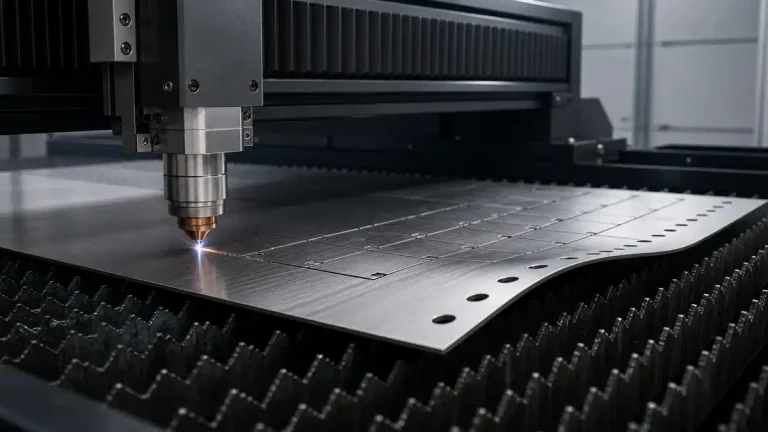
Warping is the unintended bending, twisting, bowing, or lifting of a laser-cut part or sheet. A part may still have a clean edge and accurate cut profile, but if it no longer lies flat enough for assembly or inspection, it can become a production problem.
In laser cutting, warping may appear as:
- A thin sheet lifting during cutting
- A finished part bowing after being released from the skeleton
- Long strips curling along their length
- Perforated panels developing waves
- Thin stainless steel or aluminum parts twisting after denesting
- “Oil-canning,” where the sheet pops up and down under stress
Warping can occur during the cutting process, immediately after the part is separated, during manual removal, or later during welding and fabrication. For industrial parts, the key question is not only whether the part looks flat, but whether it meets the required flatness, fit-up, and functional tolerance.
2. Why Does Sheet Metal Warp During Laser Cutting?
Laser cutting uses concentrated thermal energy to melt and eject material from a narrow kerf. That localized heat changes the stress balance in the sheet. If the sheet cannot absorb, release, or resist those stresses evenly, it deforms.
The main causes of laser cutting distortion are:
- Thermal stress from localized heating and cooling
- Residual stress already present in the sheet
- Material removal that weakens the stress balance
- Low stiffness in thin materials
- Poor support or clamping
- Cutting sequence that concentrates heat
- Part geometry that removes too much material
Understanding which cause is dominant matters because the corrective action is different. Turning down laser power may help with excessive heat input, but it will not fully solve warping caused by a high-stress cold-rolled sheet or a weak perforated design.
2.1 Thermal Stress from Localized Heat
During cutting, the laser heats a narrow zone around the cut path. The heated metal expands, but the surrounding cooler metal resists that movement. As the cut zone cools, it contracts. This expansion and contraction cycle creates residual stress.
If the stress is small, the part may remain flat. If the stress exceeds what the sheet can resist, the material bends or buckles.
Thermal distortion becomes worse when:
- Laser power is higher than necessary
- Cutting speed is too slow
- The laser remains in one area for too long
- Focus position is incorrect
- Assist gas or nozzle condition causes unstable cutting
- Multiple adjacent parts are cut in sequence without cooling time
Thin sheet metal is especially sensitive because it has less material mass to absorb heat and less stiffness to resist bending.
2.2 Residual Stress in Sheet Metal
Not all warping is caused by the laser itself. Sheet metal often contains residual stress before it reaches the cutting table. Rolling, coiling, leveling, cooling, transport, and storage can all leave internal stress locked into the sheet.
The sheet stays flat because those stresses are balanced. Once the laser removes material, cuts holes, or separates a part from the surrounding skeleton, that balance may change. The part then moves to a new shape.
This is why the same drawing may cut acceptably from one sheet but warp from another sheet of the same nominal grade and thickness. The difference may be material history, not just machine setup.
For precision work, especially with thin stainless steel, aluminum, shim stock, electronic enclosures, screens, or visible panels, material condition should be treated as part of the process—not an afterthought.
2.3 Mechanical Stress and Poor Support
Warping can also come from mechanical handling and poor support. A thin sheet resting on widely spaced slats can sag between support points. If the sheet lifts during cutting, the laser focus changes and the nozzle may collide with raised material.
Mechanical distortion may also happen during denesting. Small tabs, delicate bridges, or thin features can bend when parts are removed from the skeleton. This is common in fine-detail components, thin decorative panels, and parts with narrow webs.
Good cutting practice should control both heat and movement. Support, clamping, vacuum hold-down, tabs, skeleton retention, and careful part removal all help keep parts flatter.
3. Which Materials and Part Designs Are Most Prone to Warping?
Any sheet metal can warp under the wrong conditions, but some materials and geometries carry higher risk. Thin-gauge materials are the most vulnerable because they have low bending stiffness. Even modest stress can create visible distortion.
Common high-risk materials include:
| Material or Sheet Type | Why It Can Warp | Practical Notes |
|---|---|---|
| Thin stainless steel | Moderate thermal conductivity, significant thermal expansion behavior, low stiffness in thin gauges | Often needs careful sequencing, nitrogen cutting, and strong support |
| Aluminum sheet | Expands readily with heat and conducts heat quickly | Requires stable parameters and attention to thermal movement |
| Оцинкованный лист | Thin gauges are common; coating and heat behavior can affect cut stability | Good support and correct gas/parameter selection are important |
| Cold-rolled steel | May contain residual rolling stress | Batch-to-batch behavior can vary |
| Perforated or decorative sheet designs | Large material removal weakens the remaining skeleton | Requires smart nesting, tabs, and sometimes design adjustment |
Thickness is one of the most important variables. A thin sheet has much less resistance to bending than a thicker sheet. This is why a 0.8 mm or 1.0 mm sheet can visibly lift during cutting while a thicker plate may remain stable under similar thermal conditions.
3.1 High-Risk Part Geometries
Part design has a major impact on laser cutting warping. Some geometries remove too much material or leave the part with too little stiffness to stay flat.
High-risk designs include:
- Dense perforated panels
- Ventilation grilles and screens
- Long narrow strips
- Large rectangular panels with big internal cutouts
- Parts with many slots or closely spaced holes
- Thin bridges or narrow webs
- Asymmetric profiles
- Designs where a large percentage of the sheet area is removed
A perforated HVAC panel, for example, may warp not because the laser machine is inaccurate, but because the remaining web structure loses stiffness as holes are cut. In these cases, preventing distortion requires design review, smart sequencing, and possibly tabs or temporary support.
Relevant internal link opportunity: Thin sheet and ductwork applications often overlap with [IL: HVAC duct fabrication], where flatness and assembly fit are critical.
4. How to Prevent Warping Before Cutting Starts
The best time to prevent sheet metal warping during laser cutting is before the laser turns on. Design review, material selection, flatness requirements, and nesting strategy often have more impact than last-minute parameter changes at the machine.
Before production, clarify:
- What flatness is required?
- Which surfaces or edges are critical?
- Will the part be welded, bent, fastened, or assembled later?
- Is minor bowing acceptable if the part is pulled flat during assembly?
- Are tabs or micro-joints acceptable?
- Can the design be modified to improve stiffness?
- Is secondary flattening allowed?
For B2B projects, this discussion should happen before quoting or first-article production. A supplier cannot manage flatness properly if the drawing only defines profile dimensions and ignores flatness expectations.
4.1 Improve the Part Design for Flatness
Design changes can reduce warping without slowing production. The goal is to avoid sudden stress release and improve the part’s ability to resist bending.
Useful design improvements include:
- Increasing narrow bridge or web width where function allows
- Reducing unnecessary open areas
- Avoiding very long unsupported strips
- Adding bends, flanges, ribs, or formed edges for stiffness
- Balancing cutouts more symmetrically
- Increasing corner radii where sharp features concentrate stress
- Reviewing dense hole patterns for manufacturability
For grille-like or perforated parts, it may be worth reducing hole count, increasing spacing, or leaving stronger perimeter material. If the part must remain very flat, the design should support that requirement from the start.
Relevant internal link opportunity: For parts that will be formed after cutting, coordinated [IL: sheet metal bending design] can improve flatness and reduce downstream correction.
4.2 Choose More Stable Material When Flatness Is Critical
Material selection is another early control point. A clean machine and optimized program cannot fully compensate for highly stressed material.
For critical flatness applications, consider:
- Consistent sheet stock from qualified suppliers
- Verified incoming flatness
- Appropriate material thickness for the part size
- Stress-relieved material where available
- Stretcher-leveled or temper-passed sheet for demanding thin-sheet jobs
- Proper storage with full support to avoid sagging or handling stress
The same grade may behave differently depending on mill processing and storage. If a production part repeatedly warps despite good cutting practice, material condition should be investigated before assuming the laser settings are wrong.
5. Optimize Laser Cutting Parameters to Reduce Heat Input
Laser parameters control how much heat enters the sheet and how quickly that heat spreads. The objective is not simply to use the lowest power. The objective is to produce a stable, clean cut with the lowest practical heat input.
Parameter optimization should consider:
- Material grade
- Толщина
- Мощность лазера
- Скорость резки
- Focus position
- Nozzle size and condition
- Assist gas type and pressure
- Edge quality requirements
- Part geometry and cut density
A parameter set that works for a simple rectangle may not work for a perforated stainless panel with hundreds of holes. Test cuts should reflect the real geometry whenever possible.
5.1 Balance Laser Power and Cutting Speed
Excessive laser power increases heat input. Cutting too slowly gives heat more time to spread into the sheet. Both conditions can make warping worse.
In many thin-sheet applications, the practical approach is:
- Use enough power to maintain full penetration and clean kerf formation.
- Increase cutting speed within the clean-cut window.
- Avoid slowing down unnecessarily “to be safe.”
- Watch for dross, rough edges, incomplete cuts, or instability.
- Adjust power and speed together rather than changing one variable blindly.
Higher speed often helps because the laser spends less time heating the surrounding material. However, speed cannot be pushed beyond the point where edge quality and cut reliability fail.
A useful shop-floor rule: cut as fast as the material and edge quality allow, but not so fast that the process becomes unstable.
5.2 Control Focus Position and Kerf Quality
Focus position affects kerf width, energy density, and heat distribution. Incorrect focus can widen the heat-affected zone, increase dross, and require slower cutting or more power to complete the cut.
Poor focus control can also worsen distortion indirectly. If the sheet starts to lift and the height sensor struggles to maintain standoff, the cut becomes less stable. That instability may increase heat exposure or create inconsistent edges.
Operators should regularly check:
- Focus calibration
- Nozzle centering
- Nozzle wear or contamination
- Height sensing accuracy
- Kerf consistency across the sheet
- Dross or discoloration changes during cutting
A stable, narrow kerf usually means less unnecessary heat is entering the sheet.
5.3 Use the Right Assist Gas
Assist gas affects molten metal removal, oxidation, edge quality, and heat behavior. It should be selected based on material, finish requirement, speed, and cost.
For stainless steel and aluminum, nitrogen is often preferred because it supports clean cutting and avoids the extra chemical heat associated with oxygen cutting. This can help reduce thermal effects in thin materials.
Air cutting may be cost-effective for some applications, but because air contains oxygen, it can contribute additional heat through oxidation. That may be acceptable for some parts and problematic for others.
Assist gas should not be treated as a standalone fix for warping. It works best when combined with correct speed, power, focus, sequencing, and support.
5.4 Consider Pulsed Cutting or High-Speed Modes for Fine Features
For intricate thin-sheet work, continuous cutting may put too much average heat into small areas. Pulsed cutting can reduce average heat input by cycling the laser energy rapidly. This may help with fine details, sharp corners, and thin materials where heat buildup is difficult to control.
For dense hole patterns, fly-cut or scanning modes can reduce dwell time by keeping the head moving efficiently across repeated features. This is useful for perforated sheets, filter screens, ventilation panels, and decorative metal components.
These advanced modes depend on machine capability and programming software. They should be tested against actual part geometry before being used in production.
6. Use Smarter Cutting Sequences and Nesting Strategies
Programming can be as important as power and speed. A good cut sequence distributes heat, protects skeleton strength, and keeps parts supported until the right moment. A poor sequence can warp the same sheet even when the laser parameters are technically acceptable.
The principle is simple: do not concentrate heat or weaken the sheet structure too early.
6.1 Distribute Heat Across the Sheet
Cutting adjacent parts one after another can create a moving hot zone. By the time the laser reaches the next section, the surrounding material is already warm, stressed, and less stable.
Better strategies include:
- Staggering cuts across different sheet zones
- Using a checkerboard cutting order for repeated parts
- Alternating between distant areas of the nest
- Allowing one area to cool while another is cut
- Avoiding long continuous cuts in one small region
This is especially useful for thin stainless steel, aluminum sheet, and high-density nests.
6.2 Cut Internal Features Before Outer Profiles
Internal features such as holes, slots, louvers, and pockets should usually be cut before the outer profile. This keeps the part attached to the parent sheet while detailed features are processed.
If the outside contour is cut first, the part loses support. Internal cuts made afterward may cause movement, vibration, heat concentration, or dimensional error.
A typical sequence is:
- Pierce and cut small internal features.
- Cut larger internal openings.
- Cut slots or long internal profiles.
- Cut the outside contour last.
- Leave tabs or micro-joints if needed for stability.
This sequence is not universal, but it is a strong starting point for reducing laser cut part bowing.
6.3 Preserve Skeleton Strength
The sheet skeleton is the remaining web of material that holds parts in place during cutting. If the skeleton becomes too weak too early, the sheet can curl, lift, or lose positional stability.
For thin sheets and perforated panels, programmers should avoid cutting in a way that destroys structural support before the nest is complete.
Common-line cutting can save material and reduce cutting time, but it needs care on thin sheet. If the laser stays in one area too long, heat concentration may increase. For high-risk jobs, segmented common-line cutting or alternating zones may be safer than cutting a full shared-line grid continuously.
7. Improve Sheet Support, Clamping, and Machine Setup
A flat sheet needs a stable reference plane. If the sheet is poorly supported, even good parameters may not prevent warping.
Thin material can sag between slats, vibrate from gas pressure, lift as stress is released, or tip after small parts are cut free. Once the sheet moves, focus distance changes and the process becomes less predictable.
Good support reduces both distortion and machine risk. It can also prevent nozzle collisions caused by popped-up material.
7.1 Use Tabs, Micro-Joints, or Skeleton Retention
Tabs and micro-joints leave small uncut bridges that keep the part attached to the surrounding sheet. They help prevent parts from tipping, lifting, or falling between slats.
They are especially useful for:
- Small parts
- Thin stainless steel parts
- Long narrow profiles
- Perforated components
- High-density nests
- Parts at risk of nozzle collision
The trade-off is finishing. Tabs must be removed and may require light deburring. Their size, quantity, and placement should balance holding strength with acceptable edge cleanup.
Tabs should generally be placed away from highly stressed corners or critical cosmetic edges when possible.
7.2 Support Thin Sheets More Evenly
Standard cutting beds may not provide enough support for very thin material. Wider gaps between slats allow the sheet to sag or lift. Slag buildup can create uneven high points that make the sheet unstable before cutting even begins.
Support improvements may include:
- Clean, level slats
- Denser support points
- Temporary support strips
- Honeycomb overlays for delicate work
- Vacuum hold-down
- Magnetic hold-down for suitable ferrous materials
- Careful sheet loading and edge restraint
Magnetic hold-down is not suitable for all stainless steels. Austenitic stainless grades such as 304 and 316 are generally not held effectively by magnets in their annealed condition. Vacuum or mechanical support is often more appropriate for those materials.
7.3 Keep the Machine Condition Stable
Machine maintenance has a direct effect on cutting stability. A worn nozzle, dirty slats, unstable height sensor, or poor motion control can turn a manageable thin-sheet job into a distortion problem.
Key maintenance checks include:
- Remove slag buildup from slats.
- Inspect and replace damaged nozzles.
- Check nozzle centering.
- Verify focus height calibration.
- Confirm guide rail and bearing condition.
- Check dust extraction and vacuum zones.
- Ensure the sheet sits flat before cutting starts.
- Watch for vibration, fluttering, or inconsistent kerf quality.
For production environments, these checks should be part of routine preventive maintenance, not only troubleshooting after scrap appears.
Relevant internal link opportunity: Stable cutting performance also depends on regular fiber laser cutting machine maintenance.
8. Practical Troubleshooting: Match the Symptom to the Fix
Laser cutting warping is easier to solve when the visible symptom is connected to a likely cause. The table below provides a practical starting point for operators, engineers, and production managers.
| Symptom | Likely Cause | Corrective Actions |
|---|---|---|
| Sheet lifts during cutting | Heat buildup, weak support, residual stress release | Stagger cut sequence, reduce heat input, improve hold-down, add tabs |
| Part bows after removal | Internal stress release, excessive material removal, narrow webs | Review design, increase bridge width, use stable material, adjust denesting |
| Nozzle collision occurs | Popped-up parts, poor tab strategy, unstable sheet | Use micro-joints, improve support, change cutting order, clean slats |
| Focus keeps changing | Sheet vibration, oil-canning, poor height sensing | Improve hold-down, check sensor calibration, reduce adjacent heat buildup |
| Warping varies by batch | Material residual stress or flatness variation | Inspect incoming material, qualify suppliers, consider stress-relieved stock |
| Dense hole pattern distorts | Excessive localized cutting time | Use fly-cut/scanning mode if available, stagger features, preserve skeleton |
8.1 Sheet Lifts or “Oil Cans” During Cutting
Oil-canning occurs when the sheet pops up and down under stress. It is common in thin sheet because the material cannot resist thermal and residual forces well.
Likely causes include:
- Too much heat in one zone
- Poor sheet support
- Weak vacuum or hold-down
- Stressed sheet stock
- Cutting adjacent features too continuously
The first response should usually be sequencing and support. Randomize the cutting order, keep the sheet restrained, use tabs, and check whether the bed is clean and level. Parameter reduction may also help, but it should not create an incomplete cut.
8.2 Parts Bow After Being Removed from the Sheet
If the part looks acceptable while attached but bows after denesting, residual stress release or weak part geometry may be the main issue. The skeleton may have been holding the part flat during cutting.
Possible fixes include:
- Increasing bridge or web width
- Reducing unnecessary cutouts
- Adding temporary tabs in less critical locations
- Choosing more stable sheet stock
- Using gentler denesting methods
- Adding formed features later to increase stiffness
For parts that assemble into a rigid frame, slight bowing may be acceptable. For precision panels or visible surfaces, flatness should be specified clearly before production.
8.3 Nozzle Collision or Focus Loss Occurs Mid-Cut
Nozzle collision is a serious production issue. It can damage the part, nozzle, cutting head, or machine components. It often happens when a small part tips up, a sheet lifts, or a previously cut area loses support.
Corrective actions include:
- Add tabs or micro-joints.
- Cut internal features before outside profiles.
- Avoid freeing small parts too early.
- Improve slat condition and support.
- Check height sensing and nozzle clearance.
- Use a cutting sequence that avoids local heat buildup.
For high-volume production, repeated collisions should trigger a full review of nesting, tabs, material flatness, and machine setup.
8.4 Warping Appears Only on Certain Batches
If one batch cuts flat and another warps using the same program, material variation is a likely factor. Residual stress, thickness variation, coil history, and sheet leveling quality can all affect behavior.
Do not assume the machine is at fault without checking the material. Useful checks include:
- Compare supplier and batch records.
- Inspect incoming sheet flatness.
- Check whether the material was stored flat.
- Review thickness consistency.
- Test a small pattern before running full production.
- Consider specifying more stable material for repeat jobs.
This is especially important for industrial buyers who expect repeatable parts from repeat orders.
9. What to Do If Parts Are Already Warped
A warped laser-cut part is not automatically scrap. The decision depends on function, tolerance, appearance, and downstream processing.
Minor distortion may be acceptable if:
- The part is pulled flat during assembly
- The warped area is not a critical surface
- The part will be welded into a rigid structure
- Flatness is not functionally important
- The customer specification allows it
If flatness must be restored, possible corrective methods include mechanical straightening, roller leveling, controlled pressing, or controlled heat treatment. These methods should be applied carefully because overcorrection can introduce new stresses, surface damage, or dimensional changes.
Uncontrolled torch heating is risky because it can create new thermal gradients and make the distortion worse. For production parts that warp repeatedly, post-cut straightening should be treated as a temporary solution, not the main process strategy.
The better long-term fix is to identify the cause: geometry, material stress, parameters, support, or sequencing.
10. How to Specify Flatness Requirements for Laser-Cut Parts
Industrial buyers often specify material grade, thickness, quantity, and profile dimensions but forget to define flatness. That leaves room for misunderstanding, especially with thin sheet, perforated parts, and stainless steel panels.
A better RFQ or drawing should clarify:
- Required flatness or acceptable bow
- Critical dimensions and assembly interfaces
- Visible or cosmetic surfaces
- Whether tabs are allowed
- Whether secondary flattening is permitted
- Whether grain direction matters
- Whether the part will be welded, bent, or fastened later
- Inspection method or quality expectation
- Material grade, thickness, finish, and batch requirements
For high-risk designs, ask the laser cutting supplier to review warping risk before production. A good supplier may recommend material changes, tab locations, design adjustments, or a revised cutting sequence.
This is especially useful for precision enclosures, HVAC panels, machine covers, stainless components, electrical cabinets, and parts that must fit into tight assemblies.
Relevant internal link opportunity: Buyers sourcing precision parts should also review sheet metal fabrication tolerances before finalizing drawings.
11.Best Practices Checklist to Reduce Laser Cutting Warping
Use this checklist before cutting thin or high-risk sheet metal parts:
- Review the part geometry for long narrow features, dense holes, large cutouts, and weak webs.
- Define flatness requirements before quoting or production.
- Choose stable, consistent sheet stock for critical jobs.
- Inspect incoming material for flatness and handling damage.
- Use only the laser power needed for a clean cut.
- Increase cutting speed within the stable clean-cut range.
- Confirm focus position, nozzle condition, and height sensing.
- Select suitable assist gas for the material and edge requirement.
- Cut internal features before outer contours.
- Avoid cutting adjacent parts continuously in thin sheet.
- Use staggered, randomized, or checkerboard sequencing.
- Preserve skeleton rigidity as long as possible.
- Add tabs or micro-joints where parts may lift or tip.
- Keep slats clean and the cutting bed level.
- Use vacuum, magnetic, or mechanical hold-down where appropriate.
- Handle and denest delicate parts carefully.
- Investigate recurring batch-specific warping as a material issue, not only a machine issue.
The most effective approach is usually a combination of these controls. One adjustment may help, but consistent production requires the whole process to support flatness.
12.FAQ
Q1: Why does thin sheet metal warp more during laser cutting?
Answer: Thin sheet metal has lower stiffness and less thermal mass than thicker material. It heats quickly, cools unevenly, and cannot resist residual stress as effectively, so it is more likely to bow, lift, or twist.
Q2: Does higher laser power always cause more warping?
Answer: Excessive power can increase heat input and make warping worse, but power must be balanced with cutting speed, focus, gas, and edge quality. The goal is a clean cut with the lowest practical heat exposure.
Q3: Can nitrogen reduce laser cutting distortion?
Answer: Nitrogen can help in stainless steel and aluminum cutting because it avoids oxidation and supports clean edges. However, distortion control still depends mainly on heat input, cutting sequence, material condition, and sheet support.
Q4: Are warped laser-cut parts always defective?
Answer: Not always. Some parts flatten during assembly or remain functional despite minor bowing. Precision parts, visible panels, tight-fit components, and parts with defined flatness requirements need stricter control.
Q5: Why do parts sometimes warp after they are removed from the sheet?
Answer: The surrounding skeleton may hold the part flat during cutting. Once the part is released, residual stress in the material or stress created by material removal can cause it to bow or twist.
Q6: What should I tell my laser cutting supplier to avoid warping?
Answer: Provide the material grade, thickness, CAD files, quantity, critical surfaces, assembly function, flatness requirement, and whether tabs, design changes, or secondary flattening are acceptable. This helps the supplier choose the right cutting strategy.
13.Conclusion
Sheet metal warping during laser cutting is caused by the interaction of heat, residual stress, material stiffness, part geometry, support, and cutting sequence. It cannot always be eliminated completely, but it can usually be reduced with the right process controls.
For manufacturers, the most practical strategy is to manage the risk before cutting: review the design, choose stable material, define flatness expectations, optimize parameters, distribute heat through smart nesting, and keep the sheet well supported. For buyers, the key step is to communicate flatness requirements early so the supplier can plan the process realistically.
Flat laser-cut parts come from controlled decisions across design, programming, machine setup, and material handling—not from a single machine setting.