О нас
Durmapress specializes in designing, manufacturing, and selling various metal processing equipment, including bending machines, shears, punches, and laser cutting machines. The company was founded in 2014, with years of experience and technology accumulation. DurmaPress has become one of the well-known brands in China's metal processing machinery industry.

Свяжитесь с нами
Последние сообщения
Категории
Следуйте за нами
Еженедельное новое видео
Оглавление
A visible oil leak on a press brake hydraulic cylinder rarely tells the whole story. The source may be a weeping gland, a cracked hose, a loose fitting, or a seal that failed because something else went wrong first. Pulling the cylinder before the fault is properly located wastes downtime, risks damaging a serviceable component, and sometimes leaves the actual cause untouched.
This guide walks through fault isolation, repair preparation, the resealing sequence, and return-to-service verification—structured for maintenance technicians and production managers who need a press brake back in production with the problem actually solved.
1.How to Tell Whether the Press Brake Cylinder Is the Problem
Before scheduling any disassembly, spend time locating the oil precisely and recording the machine's behavior. Many symptoms that look like a cylinder fault originate elsewhere in the hydraulic circuit.
If the press brake is experiencing broader hydraulic problems, such as low system pressure, slow ram movement, abnormal pump noise, or overheating, start with our hydraulic press brake troubleshooting guide before deciding whether the cylinder needs repair.
1.1 Locate the Leak Source and Record Operating Symptoms
Clean the entire hydraulic system exterior—cylinder, hoses, fittings, manifolds, and connections—with a lint-free cloth or degreaser. Run a short, controlled cycle and inspect each area individually. Oil that tracks down to the cylinder base may have originated at a hose end or manifold port above it.
Document what you observe:
- Rod seal seepage: Oil appears at the rod/gland interface and accumulates at the lower end of the cylinder body. This is a classic external seal leak.
- Port or fitting weep: Oil appears around a hydraulic connection, hose crimp, or manifold fitting rather than the rod. This is a plumbing issue, not a cylinder fault.
- No visible external leak but oil loss: Suspect internal bypass across the piston—fluid crosses from the high-pressure side to the low-pressure side without escaping externally.
- Ram drift: The slide moves downward slowly under load or when the machine is stopped between strokes. This can be an internal piston seal leak, but it is equally common with a leaking counterbalance valve, directional valve, or pressure-relief setting.
- Uneven cylinder travel: The left and right rams move at different speeds or positions. Check Y1/Y2 synchronization error values on the controller, valve response, and linear scale condition before assuming a mechanical cylinder problem.
- Slow cycle times with no visible leak: Elevated oil temperature and reduced pump output are common causes. These point to the pump, cooler, or system condition rather than the cylinder itself.
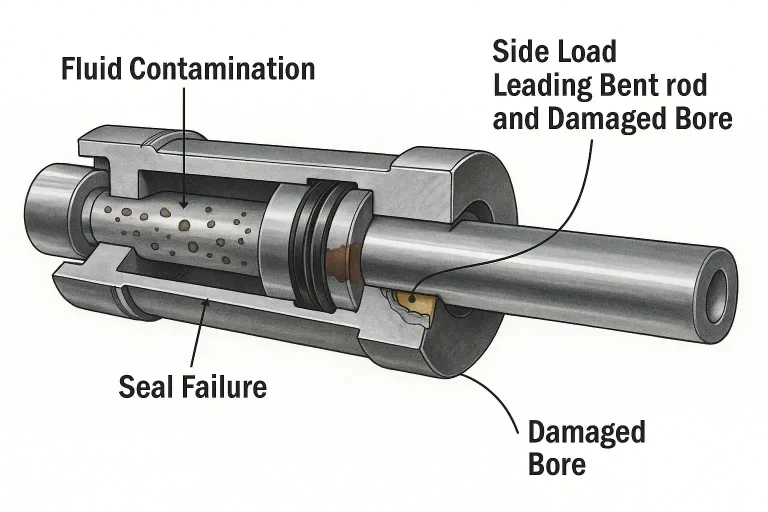
1.2 Common Press Brake Hydraulic Cylinder Leak Locations
| Leak Location | Possible Cause | What to Inspect |
|---|---|---|
| Piston rod / gland | Worn rod seal | Rod seal and rod surface |
| Cylinder gland joint | Damaged O-ring | Gland sealing groove |
| Hydraulic port | Damaged fitting seal | Port and connection |
| Hose connection | Damaged hose or crimp | Hose and connector |
| Valve block / manifold | Failed sealing interface | O-ring and mating surface |
| Internal piston seal | Internal bypass | Ram holding performance |
The key discipline here is to match each symptom to a testable cause, not to assume the cylinder is the problem because it is the most visible component.
1.3 How to Identify Internal Hydraulic Cylinder Leakage
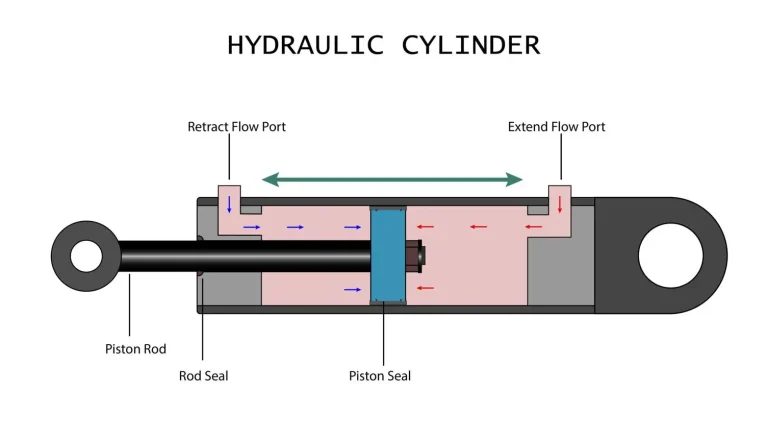
Internal leakage across the piston seal leaves no visible oil trail. Because the fluid moves within a sealed cylinder from the high-pressure side to the low-pressure side, there is nothing to wipe down or trace on the exterior. This makes it one of the more difficult faults to confirm without a systematic approach.
Ram drift is the most common indicator, but drift alone is not sufficient to diagnose a piston seal failure. The same behavior occurs when a counterbalance valve fails to hold, when a directional valve leaks across its spool, or when system pressure drops due to pump wear. Before any cylinder disassembly is considered, test and isolate the hydraulic circuit components that control ram holding behavior. Consult the machine's hydraulic schematic to identify the correct test procedure.
The piston seal becomes a credible suspect when holding-related faults persist after the valve circuit has been inspected and confirmed serviceable. Even then, confirming the fault requires the cylinder to be removed and inspected—internal leakage cannot be verified by external observation alone.
Ram drift and unstable pressure can also result from faults elsewhere in the hydraulic circuit. For a broader diagnosis of pressure loss, valve problems, and slow ram movement, see our hydraulic press brake troubleshooting guide.
2.What Causes Cylinder Leaks—and When Are New Seals Enough?
Not every cylinder leak requires a complete rebuild. The repair scope depends on the condition of the sealing surfaces and the underlying cause of failure.
Understanding the failure mechanism determines whether a seal kit resolves the problem or whether additional work is needed.
Seal degradation is the most common cause of external rod leakage. Seals age through thermal cycling, contamination, incompatible fluid, excessive pressure events, and simple service life. A well-maintained cylinder running clean, in-spec oil will outlast one operating with contaminated or oxidized fluid by a significant margin.
Rod or bore surface damage is a less obvious but equally important cause. A scored rod—even minor scoring from abrasive contamination or handling damage—will cut through a new seal within weeks. If the rod surface shows longitudinal scratches, pitting, or corrosion, fitting a new seal kit without addressing the rod condition will result in a repeat failure. The same logic applies to the cylinder bore and piston contact surfaces.
Contamination-driven failure occurs when particles or water in the hydraulic oil accelerate wear on seal lips and machined surfaces. This is frequently the root cause in cylinders that have been resealed more than once in a short period.
Internal bypass (piston seal failure) allows fluid to cross from one side of the piston to the other. The cylinder moves under load, but holding force is reduced and drift occurs. A simple test: if the ram drifts at rest and tightening or replacing counterbalance and check valves does not resolve it, piston seal condition becomes a reasonable suspect. Confirm with your OEM hydraulic schematic before proceeding.
A seal-only repair is appropriate when:
- The rod and bore surfaces are clean and free of scoring
- Seal grooves are undamaged and within dimensional tolerance
- There is no evidence of contamination-driven wear
- The cylinder body, end caps, and ports are structurally sound
If inspection reveals rod damage, bore wear, or structural issues, the scope expands to component repair, re-chroming, honing, or cylinder replacement. Fitting new seals over a damaged surface is not a repair.
3. Prepare for a Safe, Model-Specific Repair
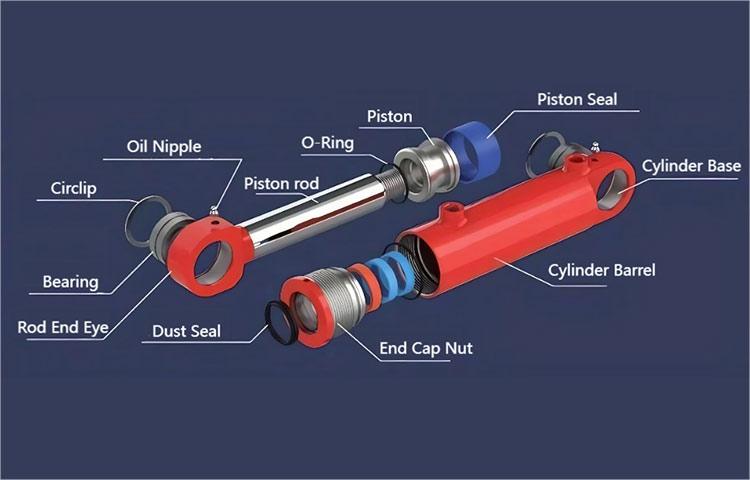
Press brake hydraulic cylinders vary significantly across manufacturers, tonnage ranges, and machine generations. There is no single disassembly procedure that covers all designs. The manufacturer's service documentation is the controlling reference—not a generic guide.
Before starting any work, gather:
| Item | Why It Matters |
|---|---|
| Machine make, model, serial number, and tonnage | Identifies the correct service manual and parts documentation |
| Cylinder identification (part number, dimensions if visible) | Required for seal kit ordering and cross-referencing |
| Hydraulic schematic for the machine | Needed to understand circuit function and safe isolation points |
| Oil specification and last service date | Affects seal material compatibility and fluid condition assessment |
| Photos of the leak location and any damage | Useful for parts identification and service scope discussion |
| Controller alarm codes (if present) | May indicate related valve, sensor, or synchronization faults |
Energy isolation is non-negotiable. Power off the machine and follow the OEM lockout/tagout procedure. Verify that stored hydraulic pressure has been relieved before disconnecting any hydraulic line or loosening any fitting. Many press brakes retain pressure in the circuit after power-off, particularly in the counterbalance and clamp circuits.
Cylinder removal requires a machine-specific lifting plan, appropriately rated lifting equipment, and qualified personnel. The lifting method and required personnel should be determined by the cylinder weight, mounting arrangement, and OEM service instructions.
Seal material compatibility deserves specific attention. Nitrile (NBR), polyurethane, PTFE, and other seal materials have different temperature ranges, chemical resistances, and pressure ratings. Using the OEM-specified seal material for the cylinder design and hydraulic fluid in the machine is not optional—a mismatch will shorten service life or cause immediate failure.
If the OEM service documentation is unavailable or the machine uses an obsolete control or hydraulic circuit, involve a qualified press brake service technician before proceeding. Some older machines have no available replacement parts; in that case, the decision between cylinder rebuild and machine upgrade needs to be made before work begins.
4. Press Brake Cylinder Resealing: The Repair Sequence
The sequence below is an overview of how a typical cylinder resealing is conducted. The exact procedure—fastener sizes, torque values, special tooling, and reassembly settings—comes from the machine-specific service manual. Do not substitute generic values.
4.1 Remove and Inspect the Cylinder Components
Mark the orientation of the cylinder, end cap, and gland before disassembly. Photographs at each stage are more reliable than notes alone. Protect the rod surface with a clean, non-abrasive covering as soon as it is exposed; a scratched rod is a failed repair.
Work through the disassembly sequence in the service manual. For most designs this involves removing the gland or end cap, withdrawing the piston and rod assembly, and accessing the piston seals once the assembly is clear of the bore.
Inspect every contact surface before ordering or fitting new seals:
- Rod: Look for longitudinal scratches, pitting, corrosion, or chrome delamination. Run a fingernail lightly along the surface—any catch that is felt will damage a new seal.
- Bore: Check for scoring, corrosion, and roundness. Surface finish matters: a honed bore with the correct surface texture retains lubrication and reduces seal wear.
- Piston: Inspect for damage to seal grooves, land surfaces, and thread engagement.
- Gland: Check the rod-contact surface and seal groove condition.
- Seals already removed: Their condition is evidence. Extrusion, cutting, hardening, or abrasion patterns point to the failure mechanism.
A seal-only repair proceeds only when all machined surfaces are within acceptable condition. If the rod is scored, it needs to be repaired or replaced before resealing. Continuing with a damaged rod surface is the single most common cause of repeat cylinder leaks.
4.2 Fit the Correct Seals and Reassemble
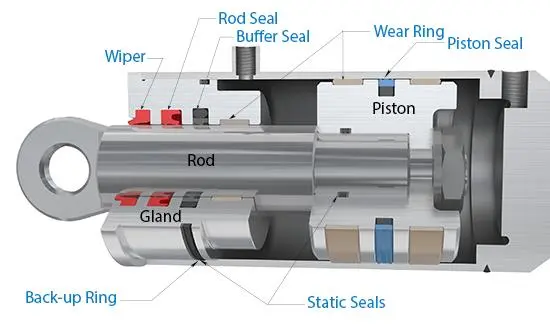
Cleanliness during reassembly is as important as the quality of the parts. Contamination introduced during the repair will accelerate wear on the new seals.
Work on a clean, covered surface. Lay out the complete seal kit and cross-reference each component against the parts diagram before starting. Press brake cylinders typically use a combination of piston seals, rod seals, wiper/dust seals, and O-rings at static joints. Missing or incorrectly positioned seals are a common source of post-repair leaks.
Common installation errors to avoid:
- Twisted or rolled seals: Lip seals and O-rings must seat flat in their grooves without distortion.
- Incorrect orientation: Many rod seals are directional. Fitting them backwards results in immediate leakage under pressure.
- Dry installation: Lightly lubricate seal lips with clean hydraulic fluid compatible with the seal material before installation. This prevents tearing during initial movement.
- Sharp-edge damage: Use smooth-tipped installation tools. Metal tools that contact seal lips will cut them.
- Skipping the wiper seal: The dust/wiper seal at the rod entry protects the rod seal from external contamination. It is not optional.
Reassemble in the reverse of disassembly, following OEM torque specifications for all fasteners. Under-torqued end caps and glands leak at static joints; over-torqued ones can distort bores or crack castings.
Reconnect hydraulic lines to the torque values specified for the fitting type and size. Do not use thread tape on hydraulic fittings that use O-ring face seal (ORFS) or port connections—these seal on the O-ring, not the thread.
5. Test the Repair Before Returning the Machine to Production
A leak-free cylinder is not the same as a functional press brake. Recommissioning needs to confirm that the hydraulic repair has not introduced any new fault and that the machine meets its performance specification before parts are run.
Follow the OEM recommissioning procedure for your specific machine. As a general framework, most procedures include:
- Check the hydraulic fluid level and top up if needed. Oil displaced during the repair or small losses from disconnected lines should be accounted for.
- Initial pressurization: With the machine powered on, cycle the hydraulic pump at low load before commanding full stroke movement. This allows air purging and gives an opportunity to inspect for leaks at the repaired connections before full pressure is applied.
- Static leak inspection: Hold the ram at a known position under load and inspect the repaired gland, all reconnected ports, and adjacent fittings. Any new seepage indicates a fastener, fitting, or seal installation issue.
- Dynamic cycling: Run the ram through its full stroke range at reduced speed. Observe movement smoothness, left/right position tracking, and any alarm codes on the controller.
- Synchronization check: Compare Y1 and Y2 position feedback during a controlled cycle. A synchronization error that exceeds the machine's acceptance tolerance after a hydraulic repair may indicate that a valve, scale, or control parameter requires attention—not necessarily further mechanical work.
- Sample bends: Run test pieces in a representative material and thickness. Measure the achieved angle against the target. Persistent angle error across the bend length is more likely a crowning, tooling, or material issue than a cylinder problem; angle error at one end points to synchronization.
If the machine does not meet its pre-fault performance after a confirmed successful cylinder repair, the remaining investigation belongs in the hydraulic valve circuit, control system, tooling condition, and crowning mechanism—not in the cylinder itself.
5.1 What Should Be Checked Before Returning to Production?
Before releasing the press brake for normal production, verify the following conditions against the machine manufacturer's acceptance criteria:
- No external leakage: No fresh hydraulic oil should appear around the repaired gland, ports, fittings, or connected lines.
- Stable ram positioning: The ram should maintain its commanded position within the specified holding tolerance.
- Consistent Y1/Y2 synchronization: Both sides should follow the required synchronization limits throughout the stroke.
- Normal operating temperature: Hydraulic oil temperature should remain within the manufacturer's specified operating range during sustained cycling.
- Consistent bending performance: Test bends should meet the required angle and dimensional tolerances for the material and tooling in use.
If any result falls outside the specified limits, investigate the hydraulic circuit, control system, or mechanical components before releasing the machine for production use.
6. Repair, Rebuild, Replace, or Call a Specialist?
After diagnosis, there are four realistic paths. The right choice depends on what the inspection found, what parts are available, and what the machine is worth to the operation.
| Cylinder Condition | Repair or Replacement Option | Main Consideration |
|---|---|---|
| Worn seals, undamaged surfaces | Seal replacement | Identify the original cause of seal wear |
| Scored or corroded piston rod | Rod repair or replacement | Restore the required rod surface finish |
| Worn cylinder bore or piston | Cylinder rebuild | Check dimensional tolerances |
| Cracked cylinder body or damaged ports | Cylinder replacement | Confirm mounting and hydraulic compatibility |
| Ram drift without confirmed cylinder damage | Hydraulic circuit diagnosis | Inspect valves and holding components |
| Obsolete cylinder with unavailable parts | Custom rebuild or replacement | Compare cost, lead time, and machine condition |
Downtime and economics matter. A cylinder rebuild for a large-tonnage machine may take several weeks if components require machining. A direct replacement cylinder from the OEM or an approved third-party rebuilder may be faster and have a known warranty. For older machines where control systems are also approaching end of life, a hydraulic cylinder repair that restores a 20-year-old machine to six more months of service is a different investment than the same repair on a well-maintained newer press brake.
When to involve a specialist: If the fault diagnosis is inconclusive, if the machine's hydraulic schematic is unavailable, if the cylinder involves unusual design features (integrated position sensing, servo-controlled proportional valves), or if the post-repair performance does not meet tolerance despite a confirmed clean repair—a qualified press brake service engineer is the right next step.
Before contacting a service provider, have ready:
- Machine make, model, serial number, tonnage, and bend length
- Photos of the leak and any visible damage
- Controller brand, model, and any active alarm codes
- Description of the fault: when it appeared, how it progressed, what has already been attempted
- Last hydraulic service date and oil specification
This information allows a service provider to quote a confirmed scope rather than a broad estimate.
7.How to Reduce Repeat Cylinder Leaks
A cylinder that has been correctly resealed will leak again prematurely if the conditions that caused the original failure are not addressed.
Match the hydraulic oil to the system specification. Using the wrong viscosity grade, mixing fluid types, or allowing fluid to oxidize and degrade are leading contributors to accelerated seal wear and varnish buildup on valve and cylinder components. Follow the OEM-specified oil type and change interval; in high-duty-cycle applications, oil condition monitoring (particle count, water content, viscosity) is more reliable than time-based changes alone.
Maintain system cleanliness. Most hydraulic seal failures in press brakes involve contamination as a contributing factor. Keep breather caps serviceable, replace return-line filters on schedule, and use clean, sealed containers when adding oil. After any repair that opens the circuit, flush or bleed the affected section before resuming production.
Monitor the rod surface condition. A light wipe-down of exposed rod surfaces after operation removes metal particles and contamination before they migrate past the wiper seal. Corrosion on rods in humid environments can be reduced by keeping the machine properly covered when idle and by not leaving the rod extended for extended periods if the installation allows the rod to retract.
Record faults and repairs. Repeated cylinder seal failures within a short period usually indicate an unresolved root cause, such as contamination, overheating, pressure spikes, misalignment, or incompatible hydraulic fluid. Tracking repair history allows that pattern to surface and be investigated before the next failure occurs.
8. Conclusion
A press brake hydraulic cylinder leak is a specific fault with a diagnosable cause—not a signal to immediately order a seal kit. Locating the oil source precisely, confirming that the cylinder is the actual fault point, and inspecting all contact surfaces before fitting new components are the steps that separate a lasting repair from a repeat job. The resealing procedure itself is straightforward for a qualified technician working from the correct service documentation; the work around it—isolation, inspection, recommissioning, and root-cause management—is what determines whether the machine runs reliably afterward.
If the fault is confirmed as a cylinder seal failure with clean, serviceable surfaces, a correctly executed reseal will restore the machine. If the investigation reveals something more—a scored rod, a contaminated system, a hydraulic circuit fault—address it at the same time. The cost of doing so is far lower than the cost of a second unplanned downtime event.
For manufacturers evaluating their next bending machine, explore our CNC press brake solutions to learn more about available machine configurations and production capabilities.
9.FAQ
Answer: On some designs, the rod gland and rod seal are accessible with the cylinder in place, allowing an external seal replacement without full cylinder removal. Whether this is possible depends on the specific machine design and the location of the seal failure. Check the OEM service documentation before attempting any work. If the piston seal is involved, full cylinder removal is typically required.
Answer: An internal bypass leak (across the piston seal) typically produces ram drift under load or at rest, reduced holding force, and slow or sluggish downward stroke—without visible oil loss on the exterior. Because ram drift is also caused by valve faults, the hydraulic circuit should be checked systematically before attributing the problem to the piston seal. A qualified technician can test valve function separately using the machine's hydraulic schematic.
Answer: Most press brake cylinders use polyurethane (PU) rod seals for their wear resistance and pressure capability, combined with PTFE or filled-PTFE piston rings and nitrile (NBR) O-rings at static joints. The correct material for each position depends on the operating pressure, temperature range, and hydraulic fluid specification. Using the OEM-specified seal kit ensures compatibility; substituting materials without verification can shorten seal life significantly.
Answer: Repeat leaks after a recent reseal typically point to one of three causes: a rod surface that was not properly inspected and has micro-scoring that is cutting through new seals; contaminated oil that is chemically degrading the seal material; or a pressure spike or overheating event that exceeded the seal's rated conditions. Review the rod surface condition under adequate lighting, test oil for contamination and condition, and check the system for over-pressure events or cooling faults before resealing a third time.
Answer: The cost depends on the type of failure, cylinder size, replacement parts required, any machining involved, and labor. A seal-only replacement is generally less extensive than a complete cylinder rebuild or a full cylinder replacement. Additional costs arise if the piston rod requires re-chroming, the bore needs honing, or other hydraulic components are found to be damaged during inspection. To get an accurate estimate, provide the machine make and model, cylinder specifications, photos of the damage, and a description of the observed symptoms to a qualified service provider before authorizing any work.