О нас
Durmapress specializes in designing, manufacturing, and selling various metal processing equipment, including bending machines, shears, punches, and laser cutting machines. The company was founded in 2014, with years of experience and technology accumulation. DurmaPress has become one of the well-known brands in China's metal processing machinery industry.

Свяжитесь с нами
Последние сообщения
Категории
Следуйте за нами
Еженедельное новое видео
1. What Is a Robotic Bending Cell?
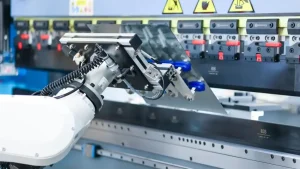
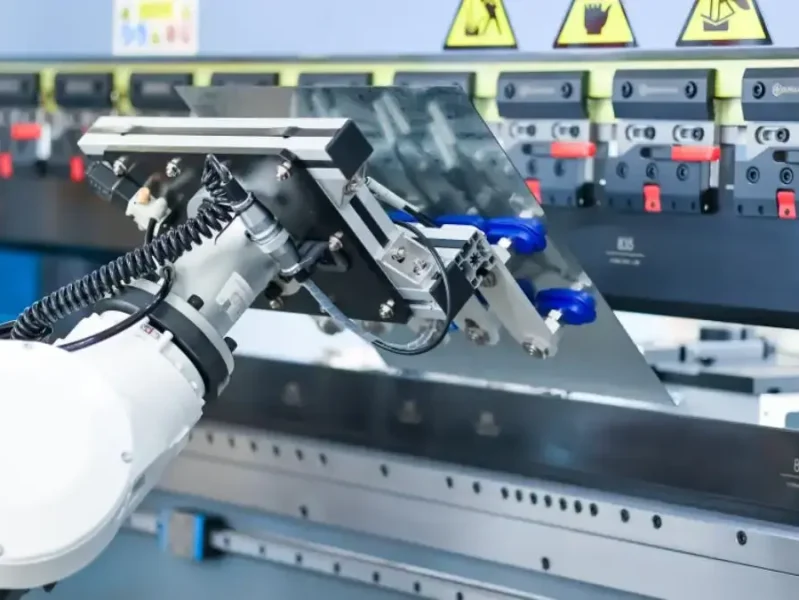
A robotic bending cell is an integrated automation system that combines a листогибочный пресс with an industrial robot to handle the entire bending cycle — from part picking to final palletizing — without continuous operator involvement.
Unlike manual bending, where output quality depends heavily on the operator's skill and attention, a robotic cell delivers consistent, repeatable results across every shift, including nights and weekends.
2. How Does a Robotic Bending Cell Work?
The automated bending cycle follows a fixed sequence:
- Part picking — The robot picks sheet metal blanks using suction cups or magnetic grippers
- Positioning & thickness check — Sensors verify material thickness and align the part precisely
- Изгиб — The press brake executes the bend program; the robot handles re-grips or flips as needed
- Palletizing — Finished parts are stacked automatically
3. Key Benefits of Automating Press Brake Operations
3.1Addresses skilled labor shortages
Finding experienced press brake operators is increasingly difficult. Robotic cells reduce dependency on specialized labor by automating repetitive bending tasks.
3.2 24/7 continuous production
Robotic cells can run overnight on simple, repetitive jobs while human operators focus on complex setups during day shifts — maximizing machine utilization without adding headcount.
3.3 Consistent quality & first-part accuracy
Every bend is executed to the same specification. Angle monitoring sensors and adaptive crowning systems correct for material variation in real time, ensuring the first part off the machine is a good part.
3.4 Lower cost per part
Higher throughput combined with reduced scrap and rework brings down the per-unit production cost, improving ROI over time.
4. Types of Robotic Bending Cells
Choosing the right configuration depends on your floor space, production volume, and workflow requirements.
4.1 Floor-Mounted Robot (Fixed or Rail)
The robot is mounted on the floor, either on a fixed platform or on a linear rail (7th axis). A rail-mounted robot can serve multiple workstations and reduce inter-station travel time, making it well-suited for higher-volume production lines.
4.2 Gantry Robot
The robot is suspended overhead on a gantry frame. This keeps the floor area completely clear, making it the preferred option for workshops with limited floor space. It also allows the press brake to operate in standalone mode without modification.
4.3 Rail Robot (7-Axis)
Adding a linear rail gives the robot a seventh axis of movement, enabling it to serve multiple machines along a production line. This configuration offers the highest flexibility for shops running varied part families.
| Конфигурация | Best For | Space | Гибкость |
|---|---|---|---|
| Fixed floor robot | Single-machine dedicated cells | Medium | Medium |
| Rail robot | Multi-machine lines | Large | High |
| Gantry robot | Space-constrained shops | Small | Medium |
5. Robotic Bending with Automatic Tool Changer (ATC)
For shops running multiple part families, pairing the robotic cell with an automatic tool changer (ATC) eliminates manual die setup entirely. The ATC swaps punch and die sets automatically between jobs, reducing changeover time by up to 4–5x compared to manual tool changes.
This combination — robot + ATC — is the most efficient setup for high-mix, low-to-medium volume production, where frequent changeovers would otherwise make automation impractical.
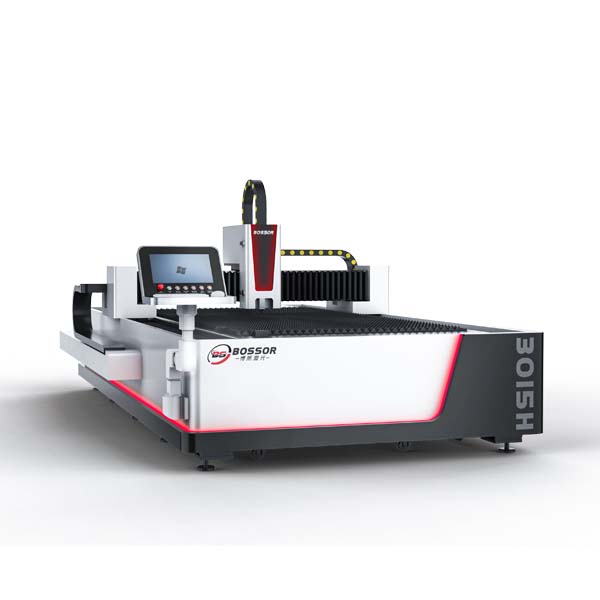
6. Full Automation: From Laser Cutting to Bending

For manufacturers looking to automate beyond the bending cell, it is possible to connect laser cutting and bending operations into a single automated line. In this setup:
- Laser-cut blanks are sorted and transported to the press brake via AGV (Automated Guided Vehicles)
- Gantry robots handle part transfer, sorting, and bending
- The line can run fully automatically during off-hours, with operators managing oversight during day shifts
7. How to Choose the Right Robotic Bending Cell
Before investing, evaluate these key factors:
- Annual production volume — High volume justifies a more complex, higher-cost cell configuration
- Part size range — Ensure the robot's reach and gripper options cover your largest and smallest parts
- Available floor space — Gantry configurations work better in tight spaces; rail robots need more room
- Changeover frequency — High-mix production benefits significantly from ATC integration
- Budget & payback period — Most robotic cells achieve ROI within 2–4 years depending on shift utilization
8.FAQ
Q1:What industries use robotic bending cells?
A:Sheet metal fabrication, HVAC ductwork manufacturing, automotive components, electrical enclosures, and general metal fabrication are the most common applications.
Q2:Can a robotic cell handle small batch production?
Yes, when paired with an ATC. Without a tool changer, robotic cells are most cost-effective for medium-to-high volume, low-mix production runs.
Q3:How long does programming take for a new part?
Modern bending cell software allows offline programming with CAD import, meaning most new parts can be programmed in under an hour without stopping production.
Q4:What is the typical ROI timeline?
Most operations recover their investment within 2–4 years, depending on shift patterns, labor costs, and part complexity.
9.Conclusion
Robotic bending cells solve two of the most pressing challenges in листовой металл fabrication: labor shortages и production consistency. Whether you need a compact gantry cell for a tight workshop or a full laser-to-bending automated line, the right configuration depends on your volume, part mix, and available space.