О нас
Durmapress specializes in designing, manufacturing, and selling various metal processing equipment, including bending machines, shears, punches, and laser cutting machines. The company was founded in 2014, with years of experience and technology accumulation. DurmaPress has become one of the well-known brands in China's metal processing machinery industry.
Свяжитесь с нами
Последние сообщения


Категории
Следуйте за нами
Еженедельное новое видео
Оглавление
Choosing the wrong press brake can cost you time, money, and material. Whether you're running high-volume production or handling complex custom jobs, understanding the difference between mechanical and hydraulic press brakes is essential before making any investment decision. Most modern fabricators are switching to hydraulic — here's why.
1.How Mechanical Press Brakes Work?
A mechanical press brake uses a flywheel, clutch, and crankshaft system to generate bending force. An electric motor spins the flywheel continuously, storing rotational energy. When the operator initiates a bend, the clutch engages and transfers that energy to the crankshaft, driving the ram downward to press the metal sheet between the punch and die.
The key limitation: once the stroke starts, it follows a fixed path and cannot be adjusted mid-operation. This makes mechanical press brakes fast and consistent, but rigid in terms of flexibility.
2.How Hydraulic Press Brakes Work
A hydraulic press brake uses a pump to push pressurized fluid into cylinders, which drive the ram downward with controlled, adjustable force. Unlike mechanical models, the operator can adjust pressure, stroke length, and speed at any point during operation.
This on-demand control makes hydraulic press brakes capable of handling a wide range of materials and thicknesses — from thin sheet metal to heavy steel plate — with consistent, precise results across every bend.
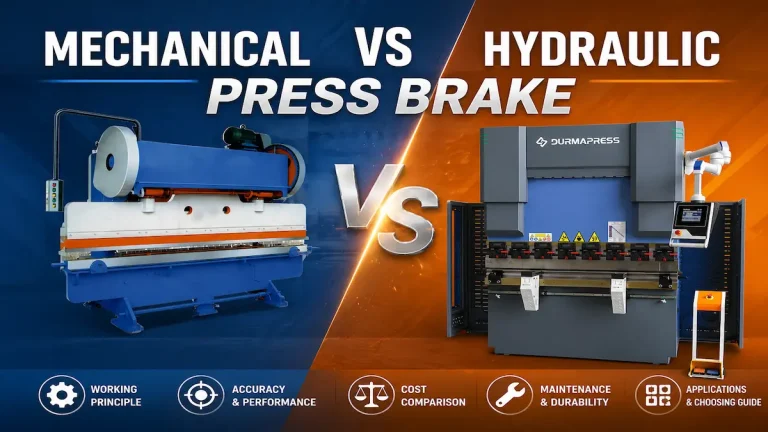
3.Mechanical vs Hydraulic Press Brake: Full Comparison
| Feature | Mechanical | Гидравлика |
|---|---|---|
| Скорость | ✅ Faster cycle | Slower |
| Точность | Good | ✅ Higher |
| Power / Capacity | Limited | ✅ Heavy-duty |
| Энергоэффективность | Higher consumption | ✅ On-demand |
| Initial Cost | ✅ Lower | Higher |
| Гибкость | Fixed stroke | ✅ Fully adjustable |
For most modern production environments, hydraulic press brakes deliver a stronger overall package — especially when precision and material variety matter.
4.Which Industries Use Which?
4.1Where Mechanical Press Brakes Excel
Mechanical press brakes work best in high-volume, repetitive production environments where material type and thickness remain consistent. They are a practical choice for smaller workshops with tight budgets that primarily work with thin to medium gauge sheet metal.
4.2Where Hydraulic Press Brakes Excel
Hydraulic press brakes are the preferred choice in aerospace, automotive, heavy machinery, and custom metal fabrication. They handle thick materials, complex bend sequences, and frequent job changeovers with ease — making them indispensable for shops that need both power and precision.
5.5 Reasons to Choose a Hydraulic Press Brake
5.1 Handles thick and varied materials
Hydraulic systems generate high, consistent force — ideal for heavy steel, stainless, and aluminum of varying thicknesses.
5.2 Adjustable stroke means less setup time
Operators can fine-tune stroke depth and pressure between jobs without mechanical reconfiguration.
5.3 Better long-term energy cost
Hydraulic systems only consume power when the pump is active, reducing overall electricity usage compared to mechanical models.
5.4 Compatible with CNC controls
Modern CNC hydraulic press brakes allow programmable bending sequences, improving repeatability and reducing operator error across complex jobs.
5.5 Built-in overload protection
Hydraulic systems automatically limit force to prevent damage to the machine and workpiece — a safety advantage mechanical systems lack.

6. Cost Breakdown: Upfront vs Long-Term
Mechanical press brakes have a lower purchase price and simpler maintenance, which appeals to operations with limited budgets. However, their high continuous energy consumption and limited flexibility can increase costs over time — especially when production requirements change.
Hydraulic press brakes require a higher initial investment, but lower energy consumption, fewer production interruptions, and better long-term adaptability deliver a stronger ROI for most operations.
If you're planning for long-term production efficiency, hydraulic wins on total cost.
7. FAQ
Q1: Which press brake is better for thick metal?
Hydraulic press brakes are the clear choice. Their adjustable high-force output handles thick steel and hard alloys that mechanical press brakes simply cannot manage reliably.
Q2: Is a hydraulic press brake more expensive to maintain?
Hydraulic systems do require regular fluid checks and seal inspections. However, their longer service life, fewer mechanical failures, and lower energy bills mean the total cost of ownership is competitive over time.
Q3: Can a hydraulic press brake replace a mechanical one?
In most production scenarios, yes. Hydraulic press brakes match or exceed mechanical models in precision, offer far greater flexibility, and are safer to operate.
8. Conclusion
When it comes to choosing between mechanical and hydraulic press brakes, the decision ultimately comes down to your production goals, material requirements, and long-term budget. Mechanical press brakes remain a solid option for simple, high-speed repetitive tasks involving thin materials. However, for shops that demand precision, power, and flexibility across diverse jobs, hydraulic press brakes are the stronger, more future-proof investment.
As manufacturing demands continue to evolve, hydraulic press brakes provide the adaptability and reliability needed to stay ahead. Ready to find the right machine for your operation? Explore our hydraulic press brake models or связаться с нами directly — our team is happy to help you make the right call.
Stay Updated on Industrial Innovations
Subscribe to our newsletter for the latest insights on manufacturing technology, sustainability, and industry trends.