About Us
Durmapress specializes in designing, manufacturing, and selling various metal processing equipment, including bending machines, shears, punches, and laser cutting machines. The company was founded in 2014, with years of experience and technology accumulation. DurmaPress has become one of the well-known brands in China's metal processing machinery industry.

Contact Us
Recent Posts

Categories
Follow Us
Weekly New Video
Table of Contents
1. Introduction
Sheet metal forming is one of the most fundamental manufacturing processes in modern industry. From automotive body panels to HVAC ductwork and aerospace components, formed sheet metal parts are everywhere—precisely shaped, structurally sound, and produced at scale.
Unlike cutting or machining, forming reshapes metal through controlled plastic deformation—no material is removed. The result is a near-net-shape part with excellent strength-to-weight ratio and minimal waste.
This guide covers everything manufacturers and buyers need to know: what sheet metal forming is, how it works step by step, the major process types, key engineering parameters, equipment requirements, and where it fits versus alternatives like cutting and forging.
2. What Is Sheet Metal Forming?
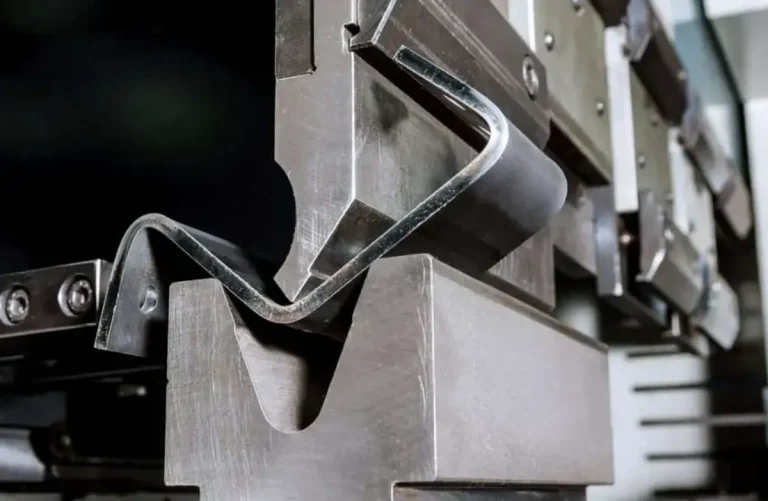
Sheet metal forming is a manufacturing process in which force is applied to a thin metal sheet to plastically deform it into a desired shape—without removing any material. The sheet's volume and mass remain constant throughout.
The process exploits the plastic deformation behavior of metals. When stress exceeds a material's yield point, permanent shape change occurs. Metals like mild steel, aluminum, stainless steel, copper, and brass are all suitable—each with different formability characteristics.
Sheet metal generally refers to metal between 0.6 mm and 6.35 mm thick. Below this range it is classified as foil; above it becomes plate steel, suited to different structural applications.
3. How Sheet Metal Forming Works
The general workflow follows four stages:
1. CAD Design
The part geometry is defined in CAD software. Flat blank dimensions are calculated using bend allowance, K-factor, and springback compensation. DXF or DWG files are prepared for machine input.
2. Blank Preparation
A flat sheet is cut from stock using laser cutting, shearing, or punching to produce the blank—the raw starting form before any forming operation.
3. Forming Operations
The blank is placed between upper and lower tooling (punch and die). Applied force—mechanical, hydraulic, or pneumatic—deforms the sheet into its final geometry. Multiple forming steps may be required for complex parts.
4. Post-Processing
Finished parts undergo deburring, surface treatment (powder coating, anodizing, plating), welding, or assembly as required.
4. Types of Sheet Metal Forming Processes
4.1 Bending
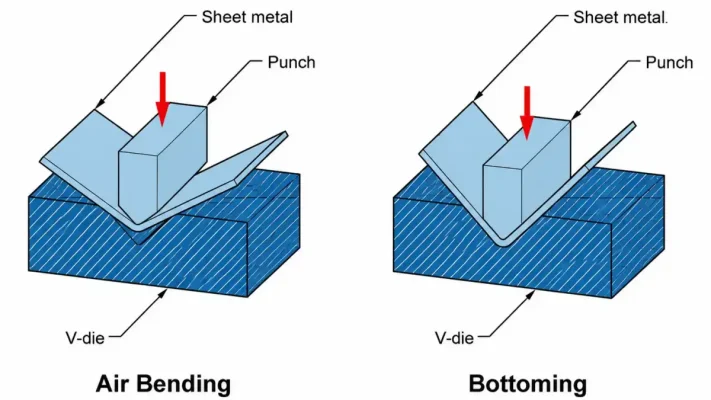
Bending deforms sheet metal along a straight axis by pressing it between a punch and die. It is the most commonly used sheet metal forming process and is performed on a press brake—available in manual, hydraulic, and CNC configurations.
Key bending methods include air bending (partial die contact, flexible angle range), bottoming (full die contact, high repeatability), and coining (maximum force, near-zero springback).
Bending is used for brackets, enclosures, electrical panels, HVAC components, and structural frames.
4.2 Stamping

Stamping uses a die set mounted in a stamping press to punch, blank, draw, or emboss sheet metal at high speed. It is the dominant process for large-volume production of identical parts—automotive stampings, enclosure panels, and appliance components.
Stamping presses can range from 20 tons to over 400 tons, producing parts as thin as 0.13 mm with tight tolerances. Progressive die stamping combines multiple operations in a single press stroke.
4.3 Deep Drawing

Deep drawing pulls flat sheet metal into a die cavity using a punch, creating hollow, cup-shaped, or cylindrical parts with a depth greater than half their diameter. The process uses a blank holder to prevent wrinkling.
Typical applications include kitchen sinks, beverage cans, automotive fuel tanks, and structural shells. Aluminum, copper, brass, and low-carbon steel are most suitable due to their high ductility.
4.4 Rolling
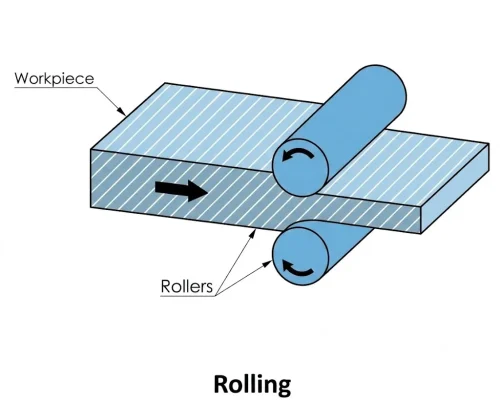
Rolling passes sheet metal through a series of paired roll stations, each progressively bending the sheet into a more complex cross-section. The process is continuous and highly efficient for long profiles.
Roll forming is used to manufacture roofing panels, purlins, C-channels, I-beams, storage racks, and HVAC duct profiles. Hot rolling and cold rolling differ in process temperature and resulting surface finish.
4.5 Hydroforming
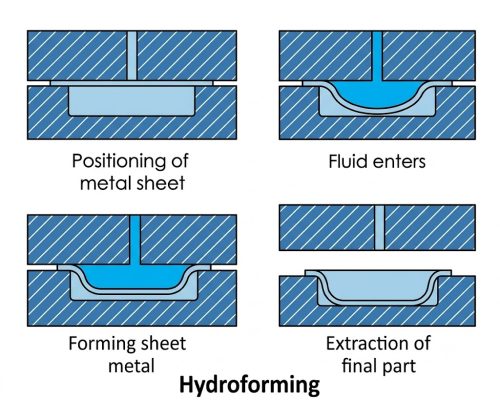
Hydroforming uses high-pressure hydraulic fluid to press sheet metal against a die, forming complex curved or hollow shapes that are difficult to achieve by conventional stamping. The process delivers uniform wall thickness and minimal spring-back.
Applications include automotive structural components, aircraft fuselage sections, and medical device housings. Aluminum and stainless steel are common materials. Tooling cost is higher, but the process reduces secondary operations.
4.6 Spinning
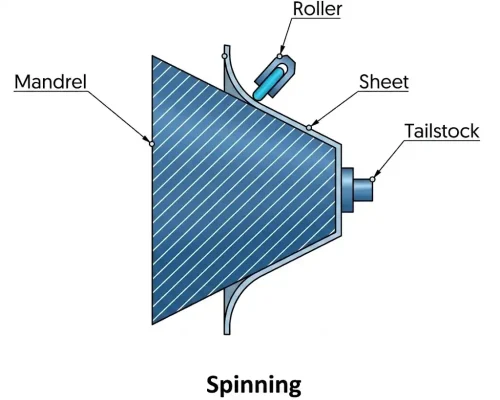
Spinning forms rotationally symmetric parts by pressing a rotating sheet metal blank against a mandrel using rollers. The blank conforms to the mandrel shape through incremental deformation.
Conventional spinning maintains wall thickness; shear spinning reduces it. Typical parts include cookware, satellite dishes, light reflectors, and pressure vessel heads.
4.7 Curling
Curling rolls sheet metal edges into a smooth, hollow circular profile. The process eliminates sharp edges, improves handling safety, and increases edge stiffness.
It is widely used in HVAC panel edges, appliance housings, door frames, tin can rims, and decorative architectural trim.
4.8 Shearing and Punching
Shearing cuts sheet metal along a straight line using two opposing blades, producing clean blanks or trimmed edges with minimal waste. Punching removes material to create holes, slots, or cutouts using a punch-and-die set.
Both are preparatory operations that typically precede bending or drawing. They are fast, repeatable, and suited to high-volume production.
5. Applications of Sheet Metal Forming
Sheet metal forming is the backbone of manufacturing across multiple industries:
Automotive: Body panels, door skins, chassis rails, fuel tanks, exhaust components.
HVAC: Ductwork, flanges, diffusers, fan housings, and plenums.
Aerospace: Fuselage skins, wing ribs, brackets, and structural frames.
Electronics: Server enclosures, control cabinets, electrical panels, and battery housings.
Appliances: Washer drums, refrigerator liners, oven bodies, and range hoods.
Construction: Roofing sheets, structural brackets, stair treads, and wall panels.
6. Sheet Metal Forming vs. Cutting
| Sheet Metal Forming | Sheet Metal Cutting | |
|---|---|---|
| Material removal | None | Yes—material is separated or removed |
| Process goal | Shape change through deformation | Size/profile change through separation |
| Examples | Bending, deep drawing, hydroforming | Laser cutting, shearing, punching |
| Waste | Minimal | Produces scrap/offcuts |
| Tooling | Dies, punches, rolls | Laser, blades, punches |
The two are not mutually exclusive. In practice, cutting prepares the blank; forming creates the final geometry. Most sheet metal parts require both.
7. Sheet Metal Forming vs. Forging
| Sheet Metal Forming | Forging | |
|---|---|---|
| Starting material | Thin flat sheet (0.6–6.35 mm) | Solid billet or bar stock |
| Deformation type | Surface/profile deformation | Bulk volumetric deformation |
| Part geometry | Thin-walled, lightweight structures | Solid, high-density structural parts |
| Tooling cost | Moderate | High |
| Best for | Enclosures, panels, ducts, brackets | Crankshafts, gears, flanges, heavy connectors |
| Material utilization | High | Moderate (flash trimming) |
Forming is preferred when weight reduction and production speed matter. Forging is chosen for parts requiring maximum density and fatigue resistance under cyclic loading.
8. Key Process Parameters
8.1 K-Factor
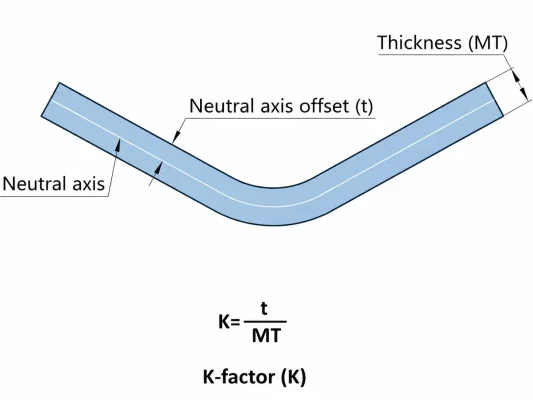
The K-Factor defines the position of the neutral axis—the layer within the sheet that neither stretches nor compresses during bending. It is used to calculate flat blank (unfold) dimensions accurately.
Formula: K = t / T
Where t = distance from inner bend surface to neutral axis; T = material thickness.
Typical values: soft aluminum / mild steel → 0.33; stainless steel / titanium → 0.40–0.50.
8.2 Bend Radius
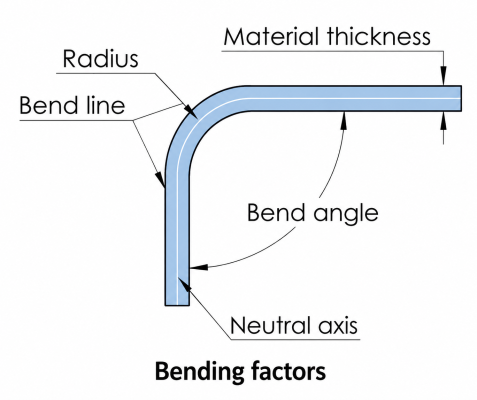
The bend radius is the inside radius of a bend. Too small a radius causes cracking on the outer surface; too large increases springback and part size.
Recommended minimum bend radius (as multiple of thickness T): mild steel → 1–2T; stainless steel → 2–4T; aluminum alloys → 1.5–3T.
8.3 Springback
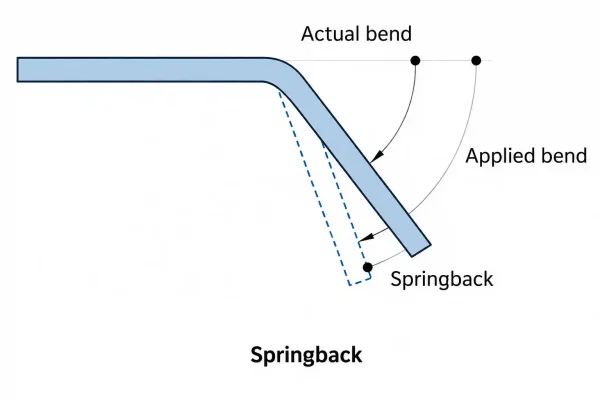
When bending force is released, elastic recovery causes the part to partially return toward its original shape. The magnitude depends on material yield strength, bend angle, and bend radius.
Springback is compensated by over-bending—programming a slightly larger angle than required so the part springs back to the target dimension. CNC press brakes with angle-measurement systems handle this automatically.
8.4 Die Clearance
Die clearance is the gap between punch and die. Insufficient clearance causes excessive stress and die wear; too much clearance produces burrs and poor edge quality.
Recommended clearance: soft metals (aluminum, copper) → 5–10% of thickness; mild steel → 10–15%; stainless steel / high-strength alloys → 15–20%.
9. Equipment for Sheet Metal Forming
Different forming operations require dedicated machinery. The following are the core equipment types:
1. Press Brake
The primary machine for bending operations. Press brakes are available in manual, hydraulic, electro-hydraulic, and full-electric CNC configurations. Tonnage ranges from 20 to 1,000+ tons; bending length from 1,000 to 6,000+ mm. CNC press brakes offer programmable backgauge, automatic crowning, and angle feedback for repeatable precision bending.
2. Stamping Press
Used for high-speed, high-volume production of stamped components. Mechanical presses operate at higher speeds; hydraulic presses offer more controlled force application.
3. Hydraulic Press
Versatile equipment used for deep drawing, hydroforming, coining, and general pressing operations. Force is applied gradually and can be precisely controlled throughout the stroke.
4. Roll Forming Machine
A continuous production line with multiple roller stations, each progressively forming the sheet into the final profile. High throughput, low per-part cost.
5. Shearing Machine
Cuts flat sheet along straight lines using upper and lower blades. Available in mechanical, hydraulic, and guillotine configurations.
10. Advantages and Disadvantages
1. Advantages
Sheet metal forming delivers high production rates with consistent part quality once tooling is set up. Material utilization is high—no chips or machining waste. The process is scalable from prototype quantities to millions of parts. Formed parts achieve excellent strength-to-weight ratios, making them ideal for lightweight structural applications. A wide range of metals can be processed.
2. Disadvantages
Tooling design and fabrication represent a significant upfront cost, making low-volume orders expensive per part. Highly complex 3D geometries may require multiple forming stages or alternative processes. Very thick plate (>6 mm) requires heavy-tonnage equipment. Springback and material variation can affect dimensional consistency if not properly compensated.
11.FAQ
Sheet metal forming is the process of applying force to a flat metal sheet to plastically deform it into a desired shape without removing material. Bending, stamping, deep drawing, and hydroforming are all sheet metal forming processes.
A common example is bending a flat steel sheet on a press brake to create an L-shaped bracket. Deep drawing a circular blank into a beverage can is another well-known example. Both reshape the metal without cutting or removing any material.
Forming deforms the sheet into a new shape without material loss. Cutting separates or removes material to change the sheet's size or profile. In practice, cutting (laser, shearing, punching) prepares the blank; forming (bending, drawing) creates the final part geometry. Most sheet metal components require both operations.
Sheet metal forming works with thin flat sheets (typically under 6.35 mm) and shapes them through bending, drawing, or pressing. Forging works with solid billets and uses compressive force to reshape the bulk of the material. Forged parts are denser and better suited to high-stress applications; formed sheet metal parts are lighter and faster to produce at scale.
Stay Updated on Industrial Innovations
Subscribe to our newsletter for the latest insights on manufacturing technology, sustainability, and industry trends.