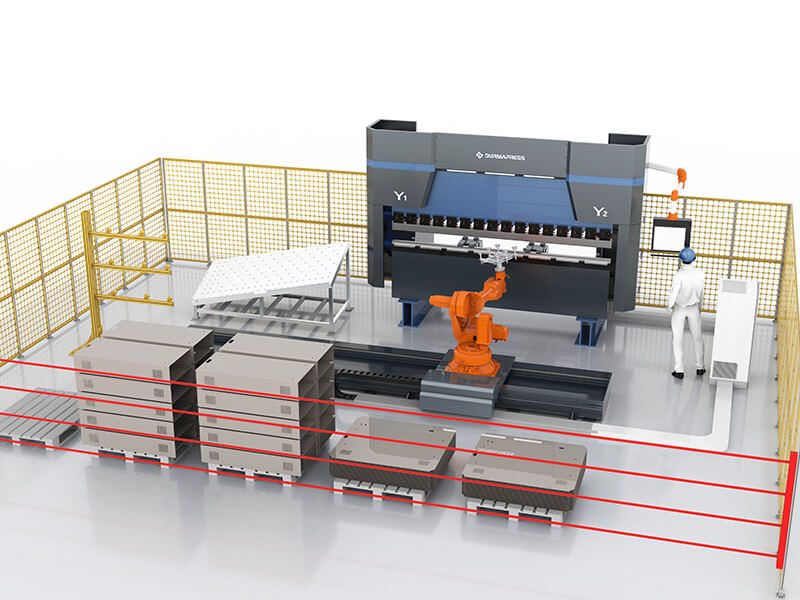
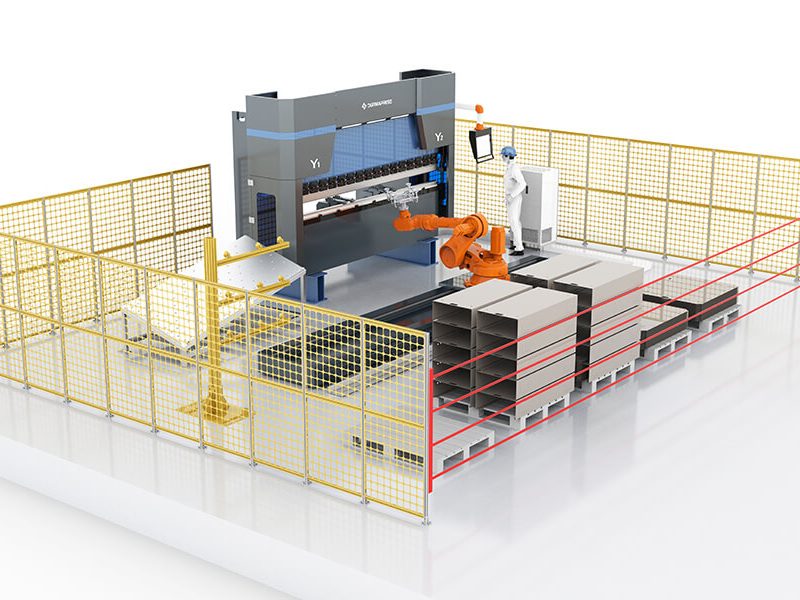
Choosing between a manual press brake and a robotic bending system is a key decision for any metal fabrication business. The right choice directly affects your production efficiency, labor cost, and long-term profitability.
Quick Answer
Robotic press brakes are ideal for high-volume, repetitive production with lower labor costs and consistent quality, while manual press brakes are better for small batches, flexible jobs, and lower initial investment.
Manual vs Robotic Press Brake (Quick Comparison)
Factor
Manual Press Brake
Robotic Press Brake
Labor
High
Low
Efficiency
Medium
High
Accuracy
Operator-dependent
Highly consistent
Initial Cost
Low
High
Flexibility
High
Medium
Best For
Small batch
Mass production
Why More Factories Are Choosing Robotic Bending
Higher efficiency
Robotic systems run continuously with stable cycle times, making them ideal for large production runs.
Lower labor cost
A simple estimation:
Payback Period = Robot Investment / Annual Labor Savings
In many cases, one robotic system can replace 1–2 operators, leading to a payback period of around 1–3 years.
Consistent quality
Robotic bending ensures repeatable accuracy and reduces errors caused by operator fatigue. This is especially important when controlling variables like springback in sheet metal bending.
Why More Factories Are Choosing Robotic Bending
Manual bending remains the right option when:
Orders are small or highly customized
Product types change frequently
Budget is limited
For job shops, flexibility often matters more than automation.
ROI: Is a Robotic Press Brake Worth It?
The real value of automation comes from long-term savings.
Typical benefits include:
Reduced labor cost
Increased production output
Improved consistency
For companies with stable, high-volume orders, robotic systems are often a profitable investment within a few years.
Real Example
A manufacturer producing standard metal brackets switched to robotic bending:
Output increased by over 40%
Labor reduced from 2 operators to 1 supervisor
Product consistency significantly improved
This type of result is common in repetitive production environments.
What Still Matters (No Matter Which You Choose)
Even with automation, bending fundamentals are critical:
Automation improves consistency—but it does not replace engineering basics.
Conclusion
Choose manual press brake for flexibility and low-volume production
Choose robotic press brake for efficiency, consistency, and cost savings at scale
If your business is moving toward standardized, high-volume production, robotic bending is a strong long-term investment.
FAQ
Is robotic bending better than manual bending? It depends on production volume. Robotic systems are better for large, repetitive jobs, while manual bending is better for flexible, small-batch work.
How long does it take to recover the cost of a robot? Typically 1–3 years, depending on labor savings and production volume.
Can robots fully replace operators? Not completely. Operators are still needed for programming and supervision.
Stay Updated on Industrial Innovations
Subscribe to our newsletter for the latest insights on manufacturing technology, sustainability, and industry trends.