About Us
Durmapress specializes in designing, manufacturing, and selling various metal processing equipment, including bending machines, shears, punches, and laser cutting machines. The company was founded in 2014, with years of experience and technology accumulation. DurmaPress has become one of the well-known brands in China's metal processing machinery industry.
Contact Us
Recent Posts
Categories
Follow Us
Weekly New Video
Table of Contents
1. Introduction
A CNC control system is the brain of any CNC machine. It reads programmed instructions, controls axis movement, manages speed and position, and helps equipment produce accurate, repeatable parts. In sheet metal fabrication, CNC control systems are especially important for press brakes, where they control ram movement, back gauge positioning, and bending accuracy.
2. What Is a CNC Control System?
CNC stands for Computer Numerical Control. A CNC control system uses embedded software and a microcomputer to convert digital instructions, usually written in G-code, into precise machine movement. It automates manufacturing by controlling motion, speed, and position, reducing human error and improving consistency.
3. Main Components of a CNC Control System
A typical CNC control system includes five core parts:
- Input device — loads the part program (control panel, USB, or network).
- Machine control unit (MCU) — the heart of the system; reads and decodes code, generates axis motion commands, and manages auxiliary functions.
- Drive system — servo motors, amplifiers, and ball screws that turn signals into movement.
- Feedback system — encoders or linear scales that monitor actual position and speed.
- Display unit — shows programs, parameters, alarms, and machine status.
4. Types of CNC Control Systems
CNC control systems are commonly divided based on three factors: motion type, control loop, and number of axes.
4.1 Motion Type CNC Control Systems
Point-to-point control systems move the tool or workpiece from one fixed position to another, with machining done after the position is reached. Typical uses include drilling, tapping, and boring.
Contouring control systems control continuous movement along a programmed path, following curves and complex shapes. Typical uses include milling, turning, routing, and laser cutting.
4.2 Loop Control CNC Systems
Open-loop systems send commands to the motors without feedback. They are simpler and cheaper but cannot automatically correct position errors, so accuracy is lower.
Closed-loop systems use feedback devices such as encoders or linear scales to monitor movement. If the actual position differs from the programmed position, the controller corrects it automatically, delivering higher accuracy.
4.3 Number of Axis Type CNC Control Systems
- 2-axis — controls X and Y only (e.g., lathes).
- 2.5-axis — has three axes but does not move all simultaneously; X/Y position first, then Z.
- 3-axis — controls X, Y, and Z simultaneously; the most common type (milling, routing).
- 4-axis — adds one rotational axis (B-axis) for more complex shapes.
- 5-axis — adds two rotational axes for undercuts, deep pockets, molds, and aerospace parts.
5. How CNC Control Systems Work in Press Brakes
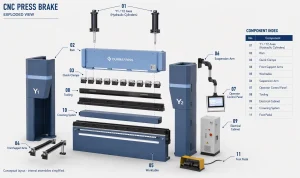
Unlike milling or cutting machines, a press brake CNC control system does not control a cutting-tool path. Instead, it controls bending-specific functions such as ram movement, back gauge positioning, and bending angle.
5.1 What Does a Press Brake CNC Controller Control?
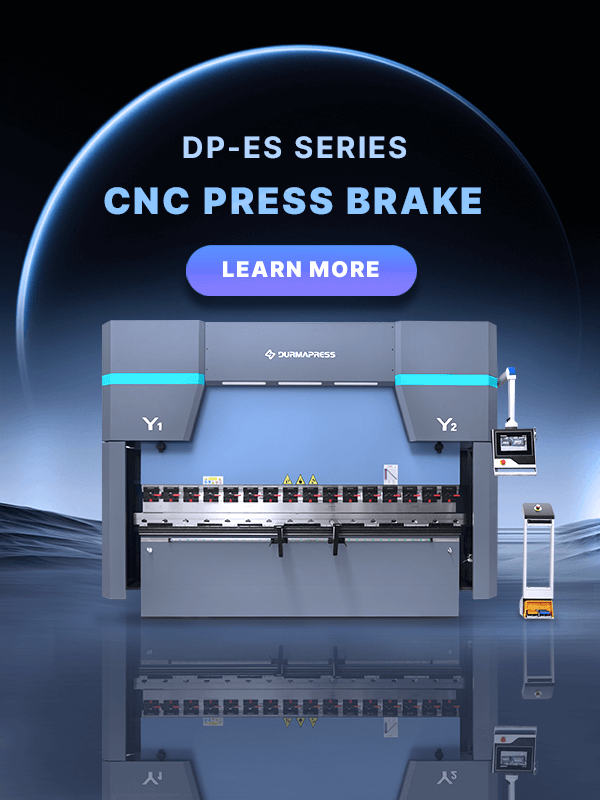
A press brake CNC controller manages ram position, Y1/Y2 synchronization, back gauge movement, bend angle, tooling data, bending sequence, crowning compensation, and springback correction. It can also store multiple bending programs for quick changeover.
5.2 Common CNC Axes in Press Brakes
| Axis | Function |
|---|---|
| Y1 / Y2 | Left and right ram movement |
| X | Back gauge depth |
| R | Back gauge height |
| Z1 / Z2 | Back gauge finger position |
| Crowning | Deflection compensation |
5.3 Why Closed-Loop Control Matters for Press Brake Accuracy
Bending accuracy depends on precise ram positioning and synchronized left-right cylinder movement. A closed-loop system uses feedback from linear scales to correct position errors in real time, keeping bending angles consistent across long parts and multi-step bends.
6. How to Choose the Right CNC Control System
When selecting a CNC control system, consider:
- Accuracy requirement — high-precision work needs closed-loop control.
- Machine type — press brakes, laser cutters, and mills have different control priorities.
- Number of axes — match axes to actual needs; more is not always better.
- Feedback and compensation — check for angle, crowning, and springback compensation.
- Operator interface — graphical bending simulation and tool libraries reduce setup time.
7. CNC Control System Comparison Table
| Type | Feedback | Accuracy | Cost | Common Use |
|---|---|---|---|---|
| Open-loop | No | Lower | Low | Simple CNC machines |
| Closed-loop | Yes | High | Higher | Press brakes, precision machines |
| Point-to-point | — | Medium | Medium | Drilling, tapping |
| Contouring | — | High | Higher | Milling, laser cutting |
| 2–5 axis | — | Basic → Very high | Low → High | Lathes → Aerospace parts |
8. FAQ About CNC Control System Types
They are classified by motion type (point-to-point, contouring), control loop (open-loop, closed-loop), and number of axes (2 to 5 axes).
Open-loop has no feedback and lower accuracy; closed-loop uses feedback to correct errors automatically for higher precision.
Closed-loop systems, because they detect and correct movement errors in real time.
CNC press brakes typically use closed-loop control for ram synchronization, back gauge positioning, and angle correction.
Base it on machine type, accuracy needs, number of axes, feedback functions, and operator interface.
9. Conclusion
CNC control systems can be classified by motion type, control loop, and number of axes. Open-loop systems are simple and low-cost, while closed-loop systems offer higher precision through feedback. For sheet metal bending, the CNC control system directly determines press brake accuracy, repeatability, and efficiency. To learn how CNC control works specifically in bending, visit our Press Brake CNC Control System solution page.
Stay Updated on Industrial Innovations
Subscribe to our newsletter for the latest insights on manufacturing technology, sustainability, and industry trends.