About Us
Durmapress specializes in designing, manufacturing, and selling various metal processing equipment, including bending machines, shears, punches, and laser cutting machines. The company was founded in 2014, with years of experience and technology accumulation. DurmaPress has become one of the well-known brands in China's metal processing machinery industry.
Contact Us
Recent Posts
Categories
Follow Us
Weekly New Video
Table of Contents
1. Introduction
Hybrid press brakes have become one of the most talked-about machine types in sheet metal fabrication — and for good reason. They sit between traditional hydraulic press brakes and fully electric models, combining the tonnage capacity of hydraulic systems with the energy efficiency and precision of servo motor control.
But what exactly makes a press brake "hybrid"? How does it differ from a standard hydraulic or servo-electric machine? And more importantly, is it the right choice for your operation?
This guide answers all of that — covering how hybrid press brakes work, their key advantages, and what to consider when comparing models.
2. What Is a Hybrid Press Brake?
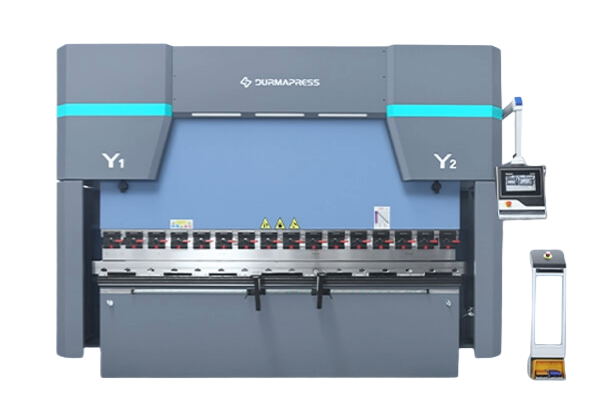
A hybrid press brake is a sheet metal bending machine that combines a hydraulic power system with servo motor control. Unlike conventional hydraulic press brakes — where the main motor runs at constant speed regardless of demand — a hybrid system uses a servo motor to drive the hydraulic pump. The motor speed adjusts in real time based on what each phase of the bending cycle actually requires.
The result is a machine that delivers the high tonnage and structural rigidity of hydraulic systems, while consuming energy only when the bending process needs it.
In practice, "hybrid" refers specifically to this servo-controlled hydraulic architecture. It should not be confused with dual-motor designs or machines that mix hydraulic and electric actuation on different axes.
3.How Does a Hybrid Press Brake Work?
The core mechanism involves three coordinated components: a servo motor, a hydraulic pump, and the ram cylinder.
When a bending cycle starts, the CNC controller sends a signal to the servo motor drive. The servo motor responds within milliseconds, spinning the hydraulic pump at precisely the speed required for that phase — fast approach, controlled bending stroke, or rapid return. Hydraulic pressure is generated only as needed, not maintained continuously.
This on-demand operation is what separates hybrid press brakes from conventional machines. Traditional hydraulic systems run their pumps at full speed continuously, bleeding off excess pressure through relief valves — a process that wastes energy and generates heat. Hybrid systems eliminate this by matching pump output to real demand at every moment.
Left and right cylinder synchronization is handled by the servo control system, maintaining positional accuracy and compensating for eccentric loads automatically.
4. Hybrid Press Brake vs Other Press Brake Types
Understanding where hybrid press brakes fit requires comparing them against the main alternatives.
4.1 Hybrid vs Conventional Hydraulic Press Brake
Conventional hydraulic press brakes use a standard induction motor running at constant speed. This means the hydraulic pump operates continuously, even during idle periods between bends. Energy consumption remains high regardless of actual production demand.
Hybrid press brakes address this directly. The servo motor adjusts speed in real time, reducing energy consumption by 25–35% compared to conventional hydraulic machines. Noise levels drop significantly, hydraulic oil temperatures stay lower, and the reduced thermal load extends component lifespan.
In terms of tonnage range, both types cover similar territory — from smaller 40-ton machines up to 1,000+ tons for heavy fabrication.
4.2 Hybrid vs Servo-Electric Press Brake
Servo-electric press brakes eliminate hydraulic systems entirely, using servo motors and ball screws to drive the ram directly. They offer the highest precision and cleanest operation — no hydraulic oil, no leaks, no fluid maintenance.
However, servo-electric machines are generally limited to lower tonnage ranges (typically 35–70 tons) and are best suited for high-precision work on thinner materials. Their ball screw mechanisms are not designed for sustained high-tonnage applications.
Hybrid press brakes remain the practical choice when you need both high tonnage capability and improved energy efficiency — the servo-electric's precision advantages are offset by its tonnage limitations in heavy fabrication environments.

5. Key Advantages of Hybrid Press Brakes
1.Energy Savings
The most quantifiable advantage. By running the hydraulic pump only when the bending cycle demands it, hybrid press brakes typically reduce energy consumption by 25–35% versus conventional hydraulic machines. For facilities running multiple shifts, this translates to significant annual cost reductions.
2.Precision and Repeatability
Servo motor control enables millisecond-level response times. The system continuously adjusts hydraulic pressure based on real-time feedback, maintaining bend angle consistency across long production runs. Electro-hydraulic synchronization keeps left and right cylinders aligned, reducing angular deviation on asymmetric bends.
3.Reduced Noise and Heat
Variable-speed operation means the hydraulic pump runs quieter than fixed-speed systems. Lower operating temperatures reduce stress on hydraulic seals and fluid, extending service intervals and reducing maintenance costs.
4.Broad Tonnage Range
Unlike servo-electric press brakes, hybrid machines are available in the full range of tonnages needed for industrial fabrication — from light-duty sheet work to structural components requiring several hundred tons of bending force.
5.Lower Long-Term Operating Costs
Reduced energy consumption, lower fluid replacement frequency, and longer component service life combine to lower total cost of ownership compared to conventional hydraulic machines over a typical 10–15 year machine lifespan.
6. What to Consider When Buying a Hybrid Press Brake
1.Tonnage and Bend Length Requirements
Calculate the maximum bending force your most demanding jobs require, then add a 20–30% safety margin. Overloading a press brake consistently degrades precision and accelerates wear. Bed length should accommodate your longest workpieces with enough back-gauge travel for repositioning.
2.CNC Controller Compatibility
The controller determines your programming capabilities and integration options. Common choices include Delem, ESA, and Cybelec systems. Evaluate whether you need 2D or 3D programming, multi-axis back-gauge control, and offline programming support for complex part sequences.
3.Operating Environment
Servo drives in hybrid systems have temperature sensitivity. Ensure your facility maintains appropriate ambient temperature ranges — extreme heat can trigger drive alarms, while sub-zero cold can prevent startup. Stable power supply quality is also important for servo motor performance.
4.After-Sales Support and Parts Availability
For a machine that forms the core of your production workflow, local technical support and accessible spare parts matter more than upfront price. Confirm service response times and parts availability before committing.
7. Is a Hybrid Press Brake Right for Your Operation?
A hybrid press brake makes the most sense when:
- Your current hydraulic press brake energy bills are a significant operational cost
- You need consistent bend quality across high-volume production runs
- Your material range includes both standard mild steel and higher-strength alloys
- You want to reduce maintenance frequency without moving to a fully electric machine
- Your tonnage requirements exceed what servo-electric machines can reliably handle
It is less likely to be the optimal choice if your work is exclusively low-tonnage, high-precision forming on thin materials — in that case, a servo-electric machine may offer better precision at a lower cost point.
8. Conclusion
Hybrid press brakes represent a practical step forward for fabrication shops that need high tonnage capability but want to reduce energy costs and improve bending consistency. By combining servo motor intelligence with proven hydraulic power, they close the gap between the raw capability of conventional hydraulic machines and the efficiency of fully electric alternatives.
For most mid-to-heavy fabrication operations, the combination of energy savings, precision, and broad material compatibility makes hybrid servo press brakes a well-rounded investment over the machine's service life.
If you're evaluating whether a hybrid press brake fits your specific production requirements, contact our team for a detailed consultation and product specifications.
Stay Updated on Industrial Innovations
Subscribe to our newsletter for the latest insights on manufacturing technology, sustainability, and industry trends.